
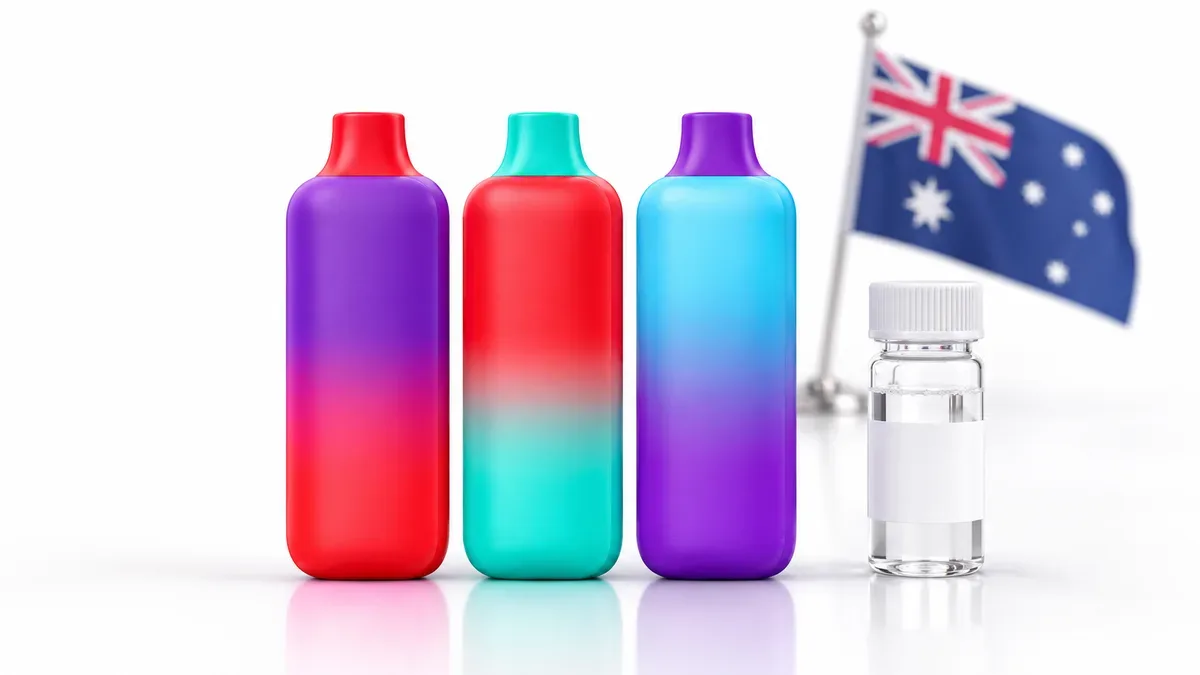
What does “up to 7,000 puffs” reveal about the nicotine inside one device? Surprisingly, it does not confirm the concentration or your likely dose. WOTOFO NEXBAR 7000 Puffs: Nicotine Content and Australian Labelling Requirements must therefore be assessed using several separate facts.
A manufacturer specification, an overseas package and an Australian therapeutic-vape label may describe nicotine differently. Moreover, variants can change across markets, strengths and production batches. You need the exact units, fill volume and legal supply status to interpret any claim correctly.
1. WOTOFO NEXBAR 7000 Puffs and Nicotine Content
Identify the exact product first
Start with the model name printed on the device and original packaging. Then record the SKU, country of sale, batch number and flavour. Additionally, photograph every package panel before separating the device from its box.
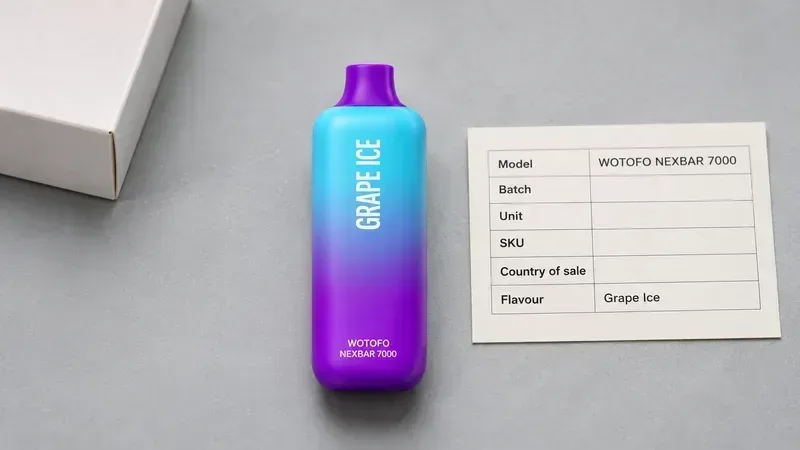
These details matter because one product name may cover several market-specific variants. Declared strength, liquid volume, nicotine formulation and warning text can differ between countries. Therefore, a photograph from an overseas retailer may not describe the unit being examined.
Compare the device markings with the package and any accompanying leaflet. Specifically, look for spelling differences, altered logos, over-labels or missing batch information. Those inconsistencies may indicate another variant, repackaging or an unreliable declaration.
What the manufacturer publishes
The WOTOFO nexBar 7K specifications list a 14 mL liquid capacity. The page also claims up to 7,000 puffs. Moreover, it presents selectable nicotine entries of “50mg” and “20mg.”
However, those entries omit a per-millilitre denominator on the displayed product page. You should not silently convert “50mg” into 50 mg/mL without supporting evidence. Instead, confirm the units using the original package, variant documentation or a credible laboratory report.
The manufacturer identifies the formulation as nicotine salt. Nevertheless, that description does not identify the particular salt, such as nicotine benzoate or lactate. It also does not prove the actual concentration inside an individual device.
What the evidence establishes
The published information establishes three limited manufacturer claims: 14 mL capacity, up to 7,000 puffs and a nicotine-salt formulation. It also shows “50mg” and “20mg” options without complete displayed units. Therefore, each figure should remain attributed to the manufacturer rather than treated as an independent measurement.
For a specific unit, confirm the salt form, nicotine concentration and measured fill volume separately. Ideally, use an unopened sample from the matching batch for laboratory work. Most importantly, never combine a concentration from one variant with a volume from another market.
- Package evidence: product name, batch, expiry, declared strength, flavour and fill volume.
- Manufacturer evidence: variant-specific technical specifications and intended market.
- Laboratory evidence: measured concentration, nicotine identity, formulation and liquid volume.
2. How to Convert Nicotine Percentage to mg/mL and Calculate Total Nicotine
Convert only compatible measurements
Milligrams per millilitre, written as mg/mL, measures nicotine concentration in the liquid. For a weight-per-volume percentage, 1% means one gram per 100 mL. Therefore, 1% equals 10 mg/mL.

Using that relationship, 2% weight per volume equals 20 mg/mL. Likewise, 5% equals 50 mg/mL. However, the shortcut works only when the percentage represents weight per volume.
A weight-per-weight percentage describes nicotine mass relative to total liquid mass. Consequently, converting it into mg/mL requires the liquid’s density. Packaging that simply states “5%” may remain ambiguous unless it defines the measurement basis.
- 1% w/v: 10 mg/mL.
- 2% w/v: 20 mg/mL.
- 5% w/v: 50 mg/mL.
- Percentage w/w: density information is required.
Before calculating anything, check whether the declaration refers to nicotine base, a nicotine salt or nicotine-base equivalent. Specifically, Australian therapeutic labels express salt products using equivalent nicotine-base concentration. The salt’s total mass can be higher because it also includes the associated acid.
Calculate total labelled nicotine
Multiply the verified concentration by the labelled fill volume to estimate total labelled nicotine. The calculation is straightforward: concentration in mg/mL multiplied by volume in mL equals milligrams. Nevertheless, the answer remains only as reliable as both input values.
Consider a hypothetical device containing 14 mL at 20 mg/mL. The calculation is 20 multiplied by 14, producing 280 mg. Therefore, the original liquid would contain 280 mg of labelled nicotine-base equivalent when the concentration uses that declaration basis.
Now consider a hypothetical 14 mL fill at 50 mg/mL. In that case, 50 multiplied by 14 produces 700 mg. Again, this conditional example does not establish the content of every NEXBAR 7K device.
- 20 mg/mL × 14 mL = 280 mg of labelled nicotine.
- 50 mg/mL × 14 mL = 700 mg of labelled nicotine.
The figures describe nicotine present in the original liquid, not a dose delivered during one session. Furthermore, some liquid can remain in the device after it stops operating. Manufacturing tolerances may also make the measured volume differ from the nominal fill.
Why puff count does not equal nicotine dose
Nicotine in liquid differs from nicotine emitted into aerosol, inhaled through the mouth and absorbed into the body. Each stage can reduce or change the amount involved. As a result, dividing total nicotine by 7,000 does not produce a reliable personal dose.
Puff duration, airflow and heating power affect liquid consumption. Moreover, longer or stronger draws can generate more aerosol than short machine puffs. Coil condition, battery charge and environmental temperature can also change device performance.
An “up to 7,000 puffs” statement usually reflects particular test conditions. However, the manufacturer page does not provide a complete protocol beside the claim. Without disclosed methods and independent verification, treat the figure as a maximum marketing specification rather than a personalised usage estimate.
3. Is the WOTOFO NEXBAR 7000 Legal in Australia?
The disposable format determines the answer
The NEXBAR 7000 cannot lawfully enter Australia’s ordinary pharmacy supply pathway in its disposable form. Australian law prohibits the commercial supply of disposable vapes, including nicotine-free products. The TGA guidance for individuals and patients explains the current pharmacy-based framework.
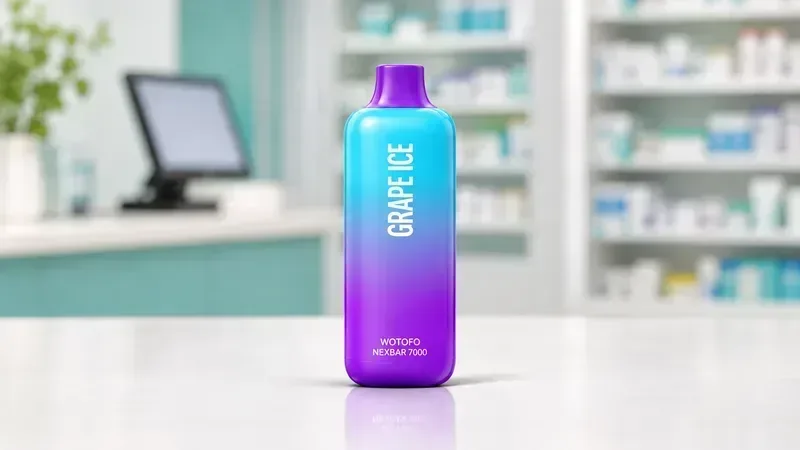
A charging port does not automatically make a device reusable under the rules. Some disposable devices allow battery recharging but lack replaceable or refillable therapeutic components. Therefore, rechargeability alone does not overcome the prohibition on disposable vapes.
Pharmacies cannot lawfully supply the NEXBAR 7000 merely because it contains an otherwise familiar concentration. Likewise, a mint version does not become eligible because mint is a permitted therapeutic flavour. The prohibited disposable format remains decisive.
Notified-list status
A search of the TGA notified vape list on 26 November 2026 found no match for “NEXBAR” or “Wotofo.” That result reflects the list available on the search date. Readers should repeat the search whenever assessing another product or later supply claim.
Search the exact product name and sponsor rather than relying only on a brand. Additionally, compare the variant, nicotine strength, dosage form and notification status. Small naming differences can identify genuinely different goods.
Notification supports the ordinary lawful supply pathway, but it does not mean TGA approval. These products generally remain unapproved therapeutic goods. In fact, the sponsor notifies the TGA that the product complies with applicable standards.
The therapeutic pharmacy pathway
Australia permits eligible therapeutic vapes for smoking cessation or managing nicotine dependence through pharmacies. Where state or territory law allows, adults may access products containing no more than 20 mg/mL after a pharmacist consultation. However, the pharmacist must still decide whether supply is clinically appropriate.
A prescription is required for concentrations above 20 mg/mL. It is also required for patients under 18 and wherever local law demands one. Furthermore, the TGA product standards cap therapeutic vaping substances at 50 mg/mL.
The national framework interacts with state and territory medicines laws. Therefore, access conditions may differ by location. A pharmacist or healthcare professional can explain the rules applying to an individual patient.
Why an overseas label is insufficient
An overseas strength declaration does not establish lawful Australian supply. Nor does packaging that resembles an Australian medicine label. Specifically, the exact product, sponsor and variant must satisfy the relevant notification, formulation, packaging and supply conditions.
Permitted therapeutic flavours are limited to mint, menthol and tobacco. Branding and packaging must also meet Australian restrictions. Consequently, fruit, confectionery, beverage or “ice” flavour descriptions can signal non-compliance.
For an otherwise eligible reusable product, assess concentration, ingredients, flavour, branding and package design. However, none of those changes can convert a disposable vape into an eligible product. Repackaging the NEXBAR 7000 would not remove its disposable classification.
4. Australian Vape Labelling Requirements Under TGO 110
Reading the primary pack
The English-language primary pack should identify the product clearly. On the main label, the product name must appear prominently and continuously. Immediately below it, a single nicotine-strength line must state the concentration in mg/mL.
No words or images should interrupt that name-and-strength presentation. Additionally, the label should state the fill volume and permitted flavour description. Applicable medicine signal headings and child-safety wording must also appear where required.
A typical main-label sequence might look like this:
- Brand or product name
- Nicotine (as benzoate) 20 mg/mL
- Mint flavour
- 10 mL
The exact requirements vary by packaging layer and available label space. Containers, intermediate packaging and outer primary packs can carry different information. Moreover, small and very small containers receive size-related adjustments under the TGA TGO 110 guidance.
Freebase nicotine and nicotine salts
Freebase nicotine refers to nicotine in its base form. A nicotine salt combines nicotine with an acid, such as benzoic or lactic acid. Therefore, the mass of the complete salt differs from the mass of nicotine base it supplies.
Australian labels identify the salt form while declaring the equivalent nicotine-base concentration. They cannot satisfy the rule by stating only the salt’s concentration. This approach lets readers compare nicotine strength across different salt formulations.
For example, suppose a liquid contains 15 mg/mL of nicotine lactate. That amount may correspond to 10 mg/mL of nicotine base. The compliant strength line would read “Nicotine (as lactate) 10 mg/mL”.
Notably, you should not use a universal conversion factor for every nicotine salt. Molecular composition and formulation affect the equivalent base amount. Consequently, manufacturers need formulation-specific calculations supported by appropriate records or testing.
The nicotine warning panel
The required nicotine warning reads: “THIS PRODUCT CONTAINS NICOTINE, WHICH IS A HIGHLY ADDICTIVE SUBSTANCE.” The text uses bold, sans-serif capital letters. It must appear in black on a white background and follow the product name’s orientation.
Where required, the warning panel covers at least 30% of the main label. The text should fill the available panel as much as practical. Therefore, a tiny warning hidden among graphics would not match the prescribed presentation.
Size-related exceptions apply to certain small containers and restricted label spaces. However, smaller formats still carry specified nicotine, flavour, volume and safety information. The rules do not create a general exemption for compact products.
Other information consumers should find
Labels and accompanying materials collectively provide medicine and traceability information. Depending on pack type, required details can appear on the container, primary pack or another label panel. Specifically, users should be able to identify the product’s ingredients and responsible sponsor.
- Names of active and other permitted ingredients.
- Batch number and expiry date with appropriate prefixes.
- Sponsor name and required contact details.
- Storage conditions, such as temperature and light protection.
- Warnings against swallowing and skin or eye contact.
- Poisons Information Centre contact information where required.
- Applicable medicine signal heading and child-safety statement.
Required leaflets provide directions and medicine information that cannot fit comfortably on a label. Moreover, packaging must include suitable dispensing-label space where the standard requires it. Compliance teams should examine the complete supplied pack, not one photographed panel.
Child-resistant packaging helps prevent access to nicotine liquid. Containers and closures must meet the applicable requirements for their product and format. Nevertheless, child-resistant never means childproof, so secure storage remains essential.
Plain packaging, flavours and branding
Australian therapeutic-vape packaging must follow plain-presentation controls. Promotional designs, elaborate finishes and decorative features face strict limits. Furthermore, product names and imagery cannot appeal to children or suggest confectionery, desserts, cartoons or youth culture.
Only mint, menthol and tobacco flavours are permitted within this pathway. The term “classic” may describe a tobacco flavour on the label. However, names suggesting fruit, soft drinks, energy drinks or sweets do not fit the permitted flavour framework.
An overseas package must satisfy every applicable Australian requirement before lawful supply. Importers cannot rely on compliance in the country of manufacture. Additionally, a sticker may not cure broader problems involving formulation, prohibited branding or missing required information.
Most importantly, packaging changes cannot make a disposable vape eligible for pharmacy supply. A redesigned NEXBAR box would leave the device’s physical format unchanged. Therefore, labelling analysis supplements the disposable-product decision rather than replacing it.
5. How Laboratory Testing Checks Labelled Nicotine Content
The 90% to 110% acceptance range
TGO 110 requires actual nicotine concentration or content to fall within 90% to 110% of the stated value. The comparison uses the applicable declaration basis. Consequently, laboratories must know whether the label states nicotine base, a salt or equivalent nicotine base.
For a declaration of 20 mg/mL, 90% equals 18 mg/mL. Likewise, 110% equals 22 mg/mL. The assay range is therefore 18–22 mg/mL.
This tolerance does not alter separate legal controls. Scheduling thresholds still apply to the declared and actual product as relevant. Moreover, the 50 mg/mL therapeutic-product maximum remains a separate check rather than expanding by 10%.
What a useful laboratory report includes
A useful report identifies nicotine and quantifies its concentration. Where relevant, it also determines the salt form or confirms the declaration basis. Additionally, measured fill volume helps test claims about total liquid and total nicotine.
The laboratory should examine prohibited ingredients when the testing purpose requires it. It should then compare results directly with the correct label. The TGA’s vape testing reports illustrate why analytical evidence matters.
- Exact product, variant, flavour and batch identification.
- Sample condition, collection details and chain of custody.
- Nicotine identity, concentration and relevant chemical form.
- Measured liquid volume and applicable ingredient screening.
- Validated analytical method and calibration information.
- Clear units, detection limits and measurement uncertainty.
- Direct comparison between results and label declarations.
Traceable samples are especially important because visually similar devices may contain different liquids. Therefore, the report should link every tested unit to packaging photographs and batch details. An untraceable marketplace sample cannot reliably validate all products carrying the same brand.
Interpreting a discrepancy
A mismatch can arise from genuine formulation differences between markets. It can also reflect an inaccurate declaration, manufacturing variability or product degradation. Meanwhile, storage temperature and time may influence sample condition.
Sampling procedures and analytical uncertainty can affect results as well. For instance, incomplete liquid recovery may distort a fill-volume finding. An unsuitable method may also struggle to distinguish nicotine forms or interfering ingredients.
Before diagnosing non-compliance, compare like with like. Use the correct batch, formulation, market and declaration basis. Most importantly, document uncertainty rather than presenting one unexplained result as proof about every NEXBAR device.
6. How to Spot Non-Compliant Vapes and Reduce Nicotine Exposure Risks
A practical compliance checklist
Consumers and compliance teams should begin with the current notified list and the complete package. They should also confirm lawful pharmacy supply. Specifically, check that the exact sponsor, product, variant and strength match the listed information.
- Exact notified product and responsible Australian sponsor.
- Supply through a pharmacy under applicable local rules.
- Nicotine strength stated clearly in mg/mL.
- Mint, menthol or tobacco flavour only.
- Plain packaging without youth-oriented names or graphics.
- Required nicotine warning panel and safety statements.
- Ingredient declaration, batch number and expiry date.
Missing information deserves caution. Likewise, cartoon graphics, confectionery themes and non-permitted flavours can indicate non-compliance. The TGA’s prohibited sales guidance explains restrictions on retail supply outside pharmacies.
Nicotine exposure and poisoning
Nicotine can cause dependence and may poison people through swallowing. Liquid contact with skin or eyes can also cause harmful exposure. Therefore, keep every device and liquid locked away from children and pets.
Do not leave a vape in a handbag, bedside drawer or vehicle cup holder. Additionally, wash exposed skin promptly and avoid inducing vomiting after ingestion. For suspected human exposure in Australia, call the Poisons Information Centre on 13 11 26.
Battery and fire safety
Lithium batteries can overheat after damage, crushing, puncture or unsuitable charging. Stop using any device that becomes unusually hot, swollen, cracked or wet. Moreover, keep it away from combustible materials and do not continue charging it.
Do not place vaping devices in ordinary household recycling. Instead, follow local battery or electronic-waste disposal instructions. The Better Health Channel safety guidance provides further practical information about nicotine and battery hazards.
Conclusion
WOTOFO declares a 14 mL capacity, up to 7,000 puffs, nicotine salt and “20mg” or “50mg” entries. However, verified mg/mL units and fill volume are needed to estimate total labelled nicotine. The NEXBAR 7000’s disposable format rules out lawful Australian pharmacy supply.
Check the exact product and sponsor against the current TGA notified vape list. Additionally, consult a pharmacist or healthcare professional about local rules or nicotine dependence. Use batch-specific packaging and laboratory evidence when verifying product claims.
