
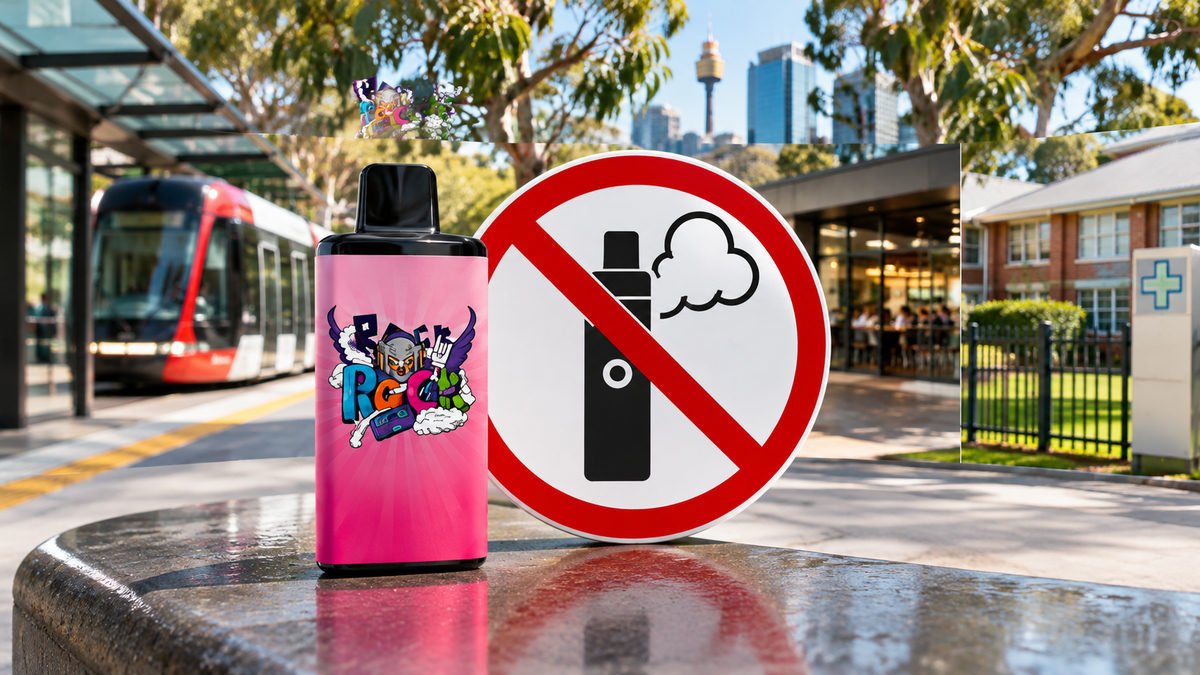
A place can seem vape-friendly, then become prohibited after one step across a boundary. So, where is vaping prohibited in Australia? The answer depends on legislation, council rules, transport regulations, workplace policies, and property conditions. Moreover, crossing a state border can change the boundaries, exemptions, and penalties that apply.
Australia does not have one simple list of lawful vaping locations. Instead, Commonwealth product controls operate alongside state and territory rules about use. Additionally, councils, airports, employers, landlords, and venue operators may impose stricter conditions. This guide explains the common restrictions and shows how to check a particular location.
1. Where Is Vaping Prohibited in Australia?
The general rule
Australian jurisdictions generally treat vaping like smoking in regulated smoke-free places. Therefore, vaping is commonly prohibited inside enclosed public venues, many workplaces, and public transport. Restrictions also cover numerous dining, educational, healthcare, sporting, and child-focused areas. However, the precise wording and boundaries differ between jurisdictions.
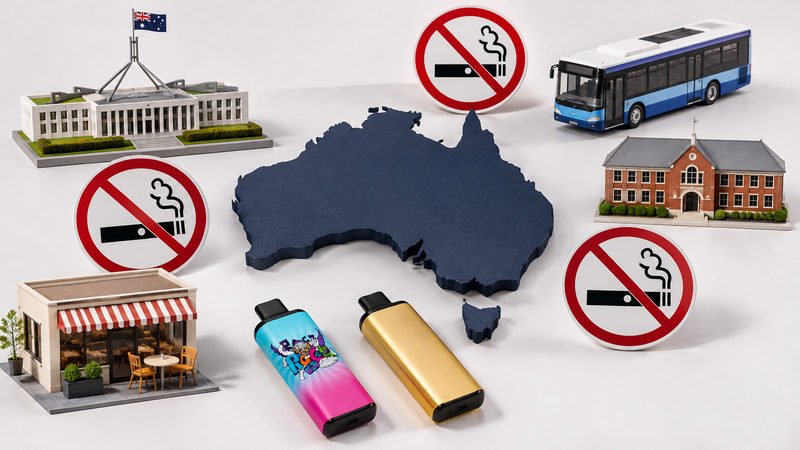
These rules commonly regulate using an e-cigarette, not merely consuming nicotine. As a result, a device may remain prohibited even when its liquid contains no nicotine. The same principle may cover disposable devices, refillable devices, personal vaporisers, and similar products. Specifically, users should not assume a “nicotine-free” label creates an exemption.
The absence of a sign does not prove that vaping is permitted. Legislation can apply automatically without requiring a nearby notice. Moreover, council declarations, leases, employment policies, and venue conditions may create additional restrictions. A staff member can also direct visitors to stop using a vape on private property.
Federal controls versus location-based restrictions
Commonwealth rules primarily control the importation, manufacture, supply, advertising, and lawful access pathways for vaping goods. Meanwhile, state and territory laws usually determine where someone may use a vape. Local rules and property policies can narrow those options further. Therefore, product access and permission to vape remain separate questions.
A legally obtained therapeutic vape cannot override a smoke-free or vape-free restriction. For instance, a pharmacy-supplied product cannot normally be used inside a restaurant, train, or prohibited workplace. The same restriction applies to residents and visitors. Tourists, international students, temporary workers, and interstate travellers receive no general exemption.
Why these restrictions exist
Smoke-free frameworks aim to reduce other people’s exposure to vape aerosol and related emissions. Additionally, restrictions limit vaping around children and reduce conflicts in crowded public spaces. Applying similar rules to smoking and vaping also makes enforcement easier. Staff can use one clear standard instead of examining every device or liquid.
Public amenity provides another practical reason. Visible vapour, scents, and airborne particles can affect nearby people, even outdoors. Moreover, consistent restrictions reduce uncertainty around entrances, queues, tables, and shared facilities. These concerns explain why many rules extend beyond completely enclosed rooms.
2. Vaping Laws by State and Territory in Australia
The following comparison offers a practical overview, not a substitute for current legislation. Definitions, buffer distances, age thresholds, exemptions, and fine amounts can change. Furthermore, one jurisdiction may regulate an entire property while another targets defined areas. Always confirm the exact boundary before using a vape.

New South Wales and Victoria
New South Wales prohibits vaping wherever its smoke-free laws prohibit smoking. Common examples include enclosed public places, commercial outdoor dining areas, public transport locations, and specified building entrances. Additionally, restrictions cover many children’s recreation areas, sporting locations, and vehicles carrying children. Health services and individual facilities may maintain broader vape-free grounds.
Victoria also applies its smoke-free framework to e-cigarettes. Prohibited locations include enclosed workplaces, outdoor dining areas, public transport platforms, stations, and shelters. Moreover, rules cover many playgrounds, patrolled beaches, underage sporting events, and entrances to specified public buildings. Schools, childcare services, hospitals, and community health centres also face extensive restrictions.
Queensland and Western Australia
Queensland applies smoking restrictions to vaping products, including products without nicotine. The state regulates enclosed places and many outdoor public areas. Notably, bans cover public transport waiting points, schools, healthcare facilities, children’s playgrounds, sporting events, and outdoor eating areas. Licensed venues may only provide compliant smoking areas under strict conditions.
Western Australia treats smoke-free public places as vape-free under its current framework. Restrictions affect enclosed public areas and regulated outdoor locations, including many food-service and hospitality settings. Furthermore, workplaces, schools, hospitals, transport property, and sporting venues may have statutory or property-wide bans. Operators can choose entirely smoke-free and vape-free premises.
South Australia and Tasmania
South Australia prohibits vaping in legislated smoke-free areas. These include enclosed public places, workplaces, outdoor dining areas, educational premises, hospital grounds, and numerous building entrances. Additionally, rules cover playgrounds, swimming facilities, underage sporting events, designated beaches, and declared public events. Vehicles carrying a child under the applicable age are also regulated.
Tasmania’s smoke-free rules cover electronic cigarettes and personal vaporisers. Commonly restricted places include workplaces, licensed and dining premises, public transport facilities, playgrounds, swimming pools, and sporting venues. Moreover, streets, malls, events, and other public spaces may receive smoke-free declarations. Facility policies can extend beyond the minimum legislative requirements.
Australian Capital Territory and Northern Territory
The Australian Capital Territory prohibits vaping in enclosed public places and outdoor eating or drinking areas. Its rules also cover public transport interchanges, nearby waiting areas, government buildings, schools, health facilities, and specified stadiums. Additionally, vaping is prohibited near government-managed play equipment. Cars carrying children under the applicable age are vape-free.
The Northern Territory applies many smoking restrictions to e-cigarette use. Enclosed workplaces, enclosed public venues, and various eating or drinking areas commonly prohibit vaping. Moreover, transport operators, licensed premises, schools, health services, and event managers may impose specific conditions. Declared areas and facility-wide policies can create broader restrictions than general legislation.
| Jurisdiction | Enclosed public places | Outdoor dining | Transport areas | School and hospital grounds | Vehicles with children | Official source |
|---|---|---|---|---|---|---|
| New South Wales | Generally prohibited | Commercial areas prohibited | Vehicles and many facilities restricted | Extensive site rules apply | Prohibited under child-related rules | NSW Health and current NSW legislation |
| Victoria | Generally prohibited | Prohibited, with related buffers | Stations, platforms, and shelters restricted | Broad restrictions apply | Prohibited under child-related rules | Victorian Department of Health and current legislation |
| Queensland | Generally prohibited | Prohibited, subject to licensed-area provisions | Vehicles, stops, queues, and waiting points restricted | Broad restrictions apply | Prohibited under child-related rules | Queensland Health and current Queensland legislation |
| Western Australia | Generally prohibited | Many food-service areas restricted | Regulated facilities and operator property restricted | Legislation and site policies apply | Check the current local age rule | WA Health and current Western Australian legislation |
| South Australia | Generally prohibited | Prohibited | Vehicles and regulated facilities restricted | Broad grounds and boundary rules apply | Prohibited under child-related rules | SA Health and current South Australian legislation |
| Tasmania | Generally prohibited | Dining and licensed-premises rules apply | Vehicles and declared facilities restricted | Legislation and site policies apply | Check the current local age rule | Tasmanian Department of Health and current legislation |
| Australian Capital Territory | Generally prohibited | Eating and drinking areas prohibited | Interchanges, stops, and nearby areas restricted | Government sites face broad bans | Prohibited when a child under 16 is present | ACT Government and current ACT legislation |
| Northern Territory | Generally prohibited | Rules vary by venue type | Operator and location rules apply | Government and facility policies apply | Check the current local age rule | NT Health and current Northern Territory legislation |
Local governments and land managers may establish additional smoke-free areas. For example, declarations can cover beaches, parks, pedestrian precincts, festivals, and community facilities. Therefore, statewide guidance provides only the first layer of a location check. Consult the relevant health department and current legislation for exact rules, exemptions, and penalties.
3. Restaurants, Workplaces, Shops, and Enclosed Venues
Hospitality and entertainment venues
Vaping is usually prohibited inside restaurants, cafés, pubs, bars, clubs, cinemas, and theatres. The restriction often extends to enclosed foyers, corridors, bathrooms, gaming rooms, and function spaces. Moreover, opening a window rarely changes the legal status of an enclosed area. A partially covered space may also qualify as enclosed under local definitions.
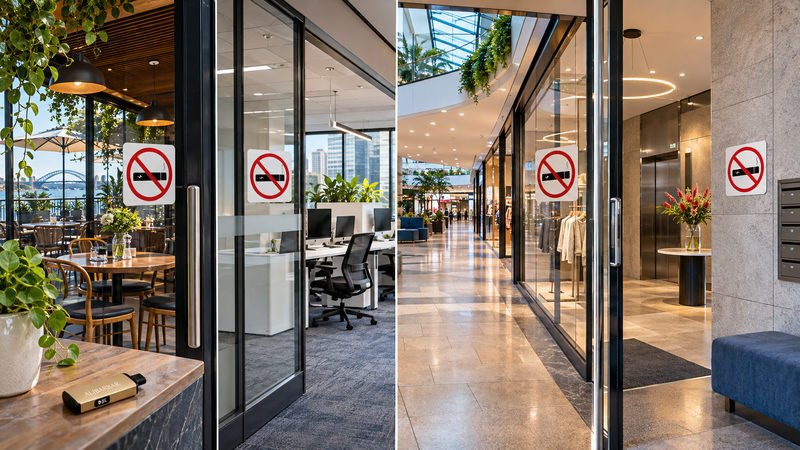
Outdoor dining areas commonly carry strong restrictions, although the details differ. Food-service zones, beer gardens, licensed premises, entrances, and nearby buffers may follow separate rules. For instance, one part of a beer garden may allow smoking while tables nearby remain vape-free. Therefore, patrons should check signs and ask staff before using any device.
A designated smoking or vaping area is lawful only when legislation allows it. The area must also satisfy local design, separation, signage, and service requirements. Furthermore, the operator must permit vaping there. A faded ashtray or smoking bin does not establish lawful permission.
Offices and other workplaces
Enclosed workplaces generally prohibit vaping, including shared offices, factories, warehouses, and staff rooms. Restrictions may also cover work vehicles, loading areas, balconies, and staff facilities. Additionally, employers must manage health and safety risks affecting workers and visitors. A manager may consequently prohibit vaping across the entire worksite.
Employers can commonly adopt rules stricter than the statutory minimum. For example, a business may make its car park, garden, loading dock, and entrance completely vape-free. Workers must follow those lawful workplace directions. Furthermore, breaching the policy may trigger employment consequences separate from any government fine.
Shopping and residential properties
Shopping centres, retail stores, and connected cinemas usually prohibit vaping indoors. Common corridors, lifts, stairwells, toilets, and food courts also fall within typical restrictions. Moreover, centre management can prohibit vaping across outdoor forecourts and parking areas. Individual retailers may enforce additional conditions inside their leased spaces.
Apartment buildings create a more complicated mix of public health, tenancy, and property rules. Owners corporations or body corporates may regulate vaping in lobbies, hallways, lifts, gardens, and shared balconies. Additionally, smoke or aerosol drift can create nuisance disputes between neighbours. Residents should check building rules before vaping in any common area.
Landlords and accommodation operators may prohibit vaping inside rental homes, hotel rooms, and short-stay properties. These conditions can apply even when legislation does not independently ban vaping inside that private space. Similarly, cleaning charges or tenancy consequences may follow a breach. Businesses may also need to display notices or stop prohibited conduct under local law.
4. Transport, Airports, Schools, and Healthcare Grounds
Public transport
Vaping is commonly prohibited on buses, trains, trams, ferries, taxis, and other passenger transport. Rideshare providers may also prohibit vaping through operator rules and driver conditions. Additionally, a driver or passenger cannot assume an empty vehicle creates permission. Work health, passenger safety, and vehicle policies may still apply.
Restrictions often extend beyond the vehicle itself. Stations, platforms, stops, shelters, terminals, interchanges, queues, and waiting areas may all be vape-free. Moreover, operator-controlled property can have wider boundaries than statutory transport bans. Look for signs at every entrance and platform change.
Airports
Airport terminal buildings generally prohibit vaping. Airline lounges, boarding gates, toilets, baggage areas, and enclosed walkways normally follow the same rule. Furthermore, airlines forbid vaping aboard aircraft. Using or charging certain devices may also conflict with airline safety requirements.
Outdoor airport property is not automatically available for vaping. Airports usually confine smoking and vaping to clearly designated areas, where they provide them. Therefore, travellers should inspect terminal maps, signs, airline instructions, and security rules. Leaving security to vape can also create delays before departure.
Education and childcare
Schools and childcare facilities commonly have extensive smoke-free and vape-free boundaries. Restrictions may cover buildings, playgrounds, sporting fields, entrances, car parks, and surrounding grounds. In some jurisdictions, a buffer extends beyond the property boundary. Therefore, standing just outside a gate may remain unlawful.
Universities and vocational campuses often maintain campus-wide vape-free policies. Those rules may include student accommodation, research sites, vehicles, courtyards, and sports facilities. Moreover, campus policy can exceed the minimum statutory restriction. Students, employees, contractors, and visitors must follow the same site directions.
Health and care facilities
Hospitals, clinics, community health facilities, and aged-care settings often prohibit vaping across their grounds. Entrances, pathways, gardens, car parks, and adjoining areas may fall inside the restricted boundary. Additionally, mental health services may operate under specialised facility policies. Visitors should ask staff before leaving a ward to vape.
Any exemption will usually be narrow, controlled, and location-specific. It may also apply only to particular patients or designated areas. Most importantly, never assume a medical need creates permission. Confirm the arrangement with authorised facility staff before using a device.
5. Cars, Parks, Beaches, Playgrounds, and Sporting Venues
Vehicles carrying children
Australian jurisdictions prohibit vaping in vehicles carrying children under locally defined rules. However, the relevant age threshold and penalty can differ. Drivers and passengers should verify the current rule for their jurisdiction. Crossing a border may change the applicable age definition.
The restriction can apply while a vehicle is moving or stationary. Opening a window or sunroof generally does not provide a reliable exemption. Furthermore, separate workplace and passenger transport rules may cover work vehicles, taxis, and rideshare cars. Private ownership does not cancel a child-protection restriction.
Child-focused and recreational areas
Playgrounds, swimming pools, skate parks, and sports grounds often have specific vape-free zones. Stadiums, spectator areas, and organised sporting events may also prohibit vaping. Notably, youth events can attract larger buffers than general adult recreation. The protected boundary may include seating, competition areas, and nearby access routes.
Several layers can operate at the same location. State legislation may create the initial ban, while a council declaration adds surrounding land. Additionally, a facility policy or ticket condition may prohibit vaping across the whole venue. Event staff can enforce those conditions even beyond a marked statutory buffer.
Beaches, parks, and other outdoor spaces
Vaping is not automatically prohibited in every Australian open-air location. However, particular beaches, parks, pedestrian malls, festivals, markets, and community events may be declared smoke-free. Patrolled beach sections can also have defined vape-free boundaries. Therefore, never apply the rule from one beach to another.
Outdoor restrictions frequently focus on busy or sensitive areas. These can include public-building entrances, food stalls, crowds, queues, and children’s facilities. Moreover, temporary event maps may create designated areas for one day only. A normal public park can consequently become entirely vape-free during a festival.
Check boundary signs, council notices, venue maps, and ticket conditions. Additionally, follow instructions from rangers, security officers, transport staff, and event personnel. If a boundary remains unclear, move away and ask an authorised person. That simple step can prevent exposure, conflict, and a possible infringement.
6. Fines, Signs, and How to Find a Legal Vaping Area
Signs and enforcement
Common notices include “No Smoking,” “No Vaping,” “Smoke-Free,” and “Tobacco and E-Cigarette-Free.” In many jurisdictions, a no-smoking sign also covers vaping. However, the law may operate without any sign. Damage, removal, or poor placement of a notice does not necessarily create permission.
An individual may receive a warning, infringement notice, or court-imposed penalty. Fine amounts vary by offence and jurisdiction, so one nationwide figure would mislead readers. Moreover, enforcement practices can change over time. Police, health officers, council officers, transport staff, or authorised inspectors may have enforcement roles.
Venue operators and employers can face separate consequences for failing to meet their duties. Depending on local law, they may need to display signs or address prohibited conduct. Additionally, operators may have to structure designated areas correctly. Individual and operator liabilities should always be checked separately.
A practical location-checking process
Start with the health department for the relevant state or territory. Next, examine council rules and any information from the transport operator, airport, or land manager. Furthermore, check workplace, tenancy, accommodation, campus, and venue conditions. Each source may control a different part of the same location.
- Identify the state or territory and check its current health guidance.
- Confirm whether the council has declared additional smoke-free public areas.
- Review rules from the transport network, airport, facility, or land manager.
- Check any employer, landlord, owners corporation, hotel, or event policy.
- Ask authorised staff when a boundary or designated area remains unclear.
Private owners and businesses can generally impose stricter vape-free conditions on their property. Therefore, a location can remain prohibited even when legislation does not directly ban vaping there. Follow the property rule or leave the site. Permission from one employee may not override an official venue policy.
Where vaping may be lawful
Possible locations include private property where the owner clearly permits vaping. Properly designated outdoor smoking or vaping areas may also allow use. However, no legislation, council declaration, facility rule, or event condition can prohibit the activity there. A compliant area can also close or relocate temporarily.
Do not treat an unmarked footpath, doorway, car park, park, or open space as automatically permissible. The location may sit inside an entrance buffer or controlled property boundary. Moreover, a nearby playground, food-service area, or transport stop may create another restriction. When uncertain, wait until you can verify the rules.
Useful official references include Commonwealth product guidance and each jurisdiction’s health laws. Council registers, transport networks, airports, schools, universities, healthcare facilities, and venue policies provide further detail. Specifically, check current legislation when exact boundaries or exemptions matter. Official guidance can summarise rules, but legislation remains essential for legal interpretation.
Important disclaimer: Vaping laws, policies, designated areas, and penalties can change without notice. This guide provides general information and does not offer legal advice. Therefore, check the applicable law and site conditions immediately before vaping. Seek professional advice when a legal dispute or enforcement matter arises.
Conclusion
Vaping is generally treated like smoking in Australian smoke-free areas. However, exact locations, boundaries, exemptions, and penalties depend on jurisdiction, council rules, and property policies. Enclosed venues, many workplaces, transport networks, educational sites, healthcare grounds, and child-focused areas are commonly vape-free. Outdoor spaces can also become prohibited through buffers or declarations.
Before vaping, check the current health department guidance for that jurisdiction. Additionally, confirm council, transport, airport, workplace, tenancy, and venue-specific rules with the responsible operator. Never rely only on missing signs or another person’s behaviour. A quick location check offers the safest and most reliable answer.
