
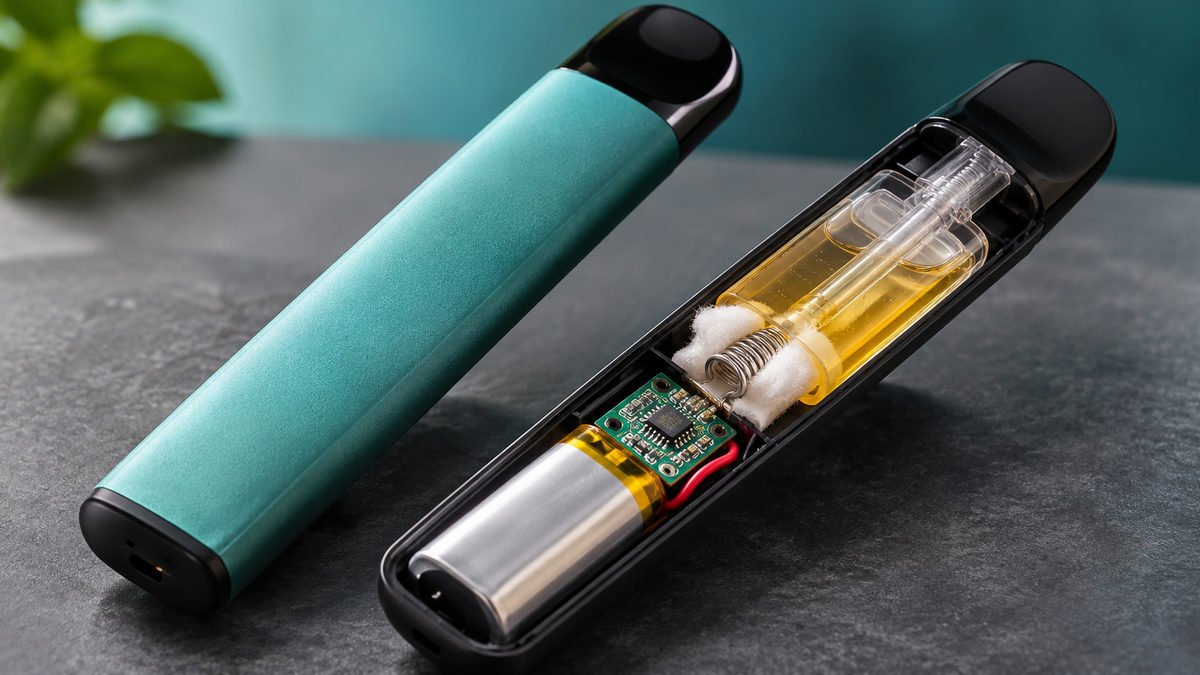
What happens inside a disposable vape during one brief inhale? What Is a Disposable Vape? Device Components Explained reveals a surprisingly coordinated process inside a compact casing. A sensor, battery, liquid supply, and heating element respond within moments.
However, the simple exterior can hide important health, battery, and disposal concerns. Beginners may not know what the aerosol contains or why a device suddenly stops working. Therefore, understanding its construction helps adults recognize normal depletion, damage, and unsafe behavior.
This guide explains disposable vape anatomy, operation, lifespan, storage, travel, and recycling in plain language. Moreover, it compares common formats without presenting vaping as harmless. Vaping products are only for adults where legally permitted, and every form carries risks.
1. What Is a Disposable Vape? Device Components Explained
A disposable vape is a compact device containing a prefilled liquid supply and an integrated heating system. Manufacturers design it for single use or limited use before disposal or recycling. Unlike refillable devices, most models do not allow users to replace the liquid safely.

Some basic versions have non-rechargeable batteries and stop working when their power or liquid runs out. However, larger models may include a charging port while remaining non-refillable. Rechargeability extends battery use, but it does not make the device endlessly reusable.
Aerosol Is Not Tobacco Smoke
A disposable vape heats e-liquid to form an inhalable aerosol. In contrast, a cigarette burns tobacco and creates smoke through combustion. Because no tobacco leaf burns, the resulting emissions differ from traditional cigarette smoke.
However, vape aerosol is not harmless water vapor. It may contain nicotine, flavoring chemicals, tiny particles, and other substances created during heating. Moreover, people nearby may breathe some material after the user exhales.
The exact contents depend on the liquid formula, device temperature, coil condition, and user behavior. For instance, an overheated or nearly dry coil may produce unpleasant compounds and a burnt taste. Therefore, the absence of smoke does not mean the absence of exposure.
An Integrated, Low-Setup Design
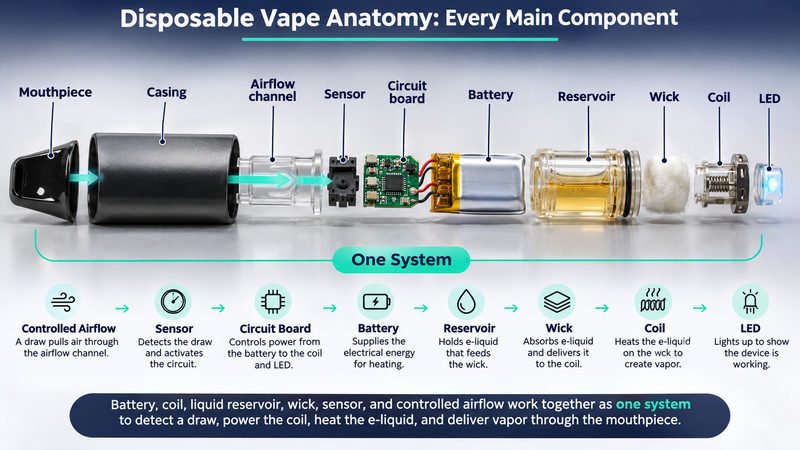
A typical disposable combines the mouthpiece, airflow channel, reservoir, wick, coil, electronics, and battery in one casing. As a result, the user usually performs little or no setup. Many products activate automatically when someone inhales through the mouthpiece.
Other models include a button, adjustable airflow, display, or selectable power mode. Nevertheless, their basic purpose remains similar. They store liquid, deliver it to a heated coil, and guide the resulting aerosol toward the user.
Convenience creates limitations as well. Most internal parts cannot be inspected, cleaned, or replaced when problems develop. Therefore, adults should treat leaks, cracks, overheating, or unusual noises as reasons to stop using the device.
2. Disposable Vape Anatomy: Every Main Component
The parts of a disposable vape operate as one connected system. A battery alone cannot create aerosol, while a coil cannot work without liquid and controlled airflow. Moreover, small changes in one component may affect flavor, temperature, and device lifespan.
Mouthpiece, Air Inlet, and Airflow Path
The mouthpiece sits at the end placed near the user’s lips. Its internal channel carries aerosol from the heating area toward the opening. Additionally, its shape helps control comfort, airflow resistance, and condensation.
One or more air inlets usually appear near the base or side. When the user inhales, air enters these openings and travels through a designed pathway. However, pocket lint, tape, or fingers can block the inlet and disrupt activation.
Reservoir, E-Liquid, and Wick
The reservoir stores the factory-filled e-liquid. Depending on the design, it may use a sealed chamber or absorbent material holding the liquid. Specifically, this supply feeds the heating area without requiring manual refilling.
E-liquid commonly contains propylene glycol, vegetable glycerin, flavorings, and sometimes nicotine. However, formulas and nicotine strengths vary widely between products and markets. Labels may also use percentages or milligrams per milliliter, which can confuse inexperienced users.
The wick draws liquid from the reservoir toward the coil. Many devices use cotton or another porous material for this job. In fact, steady wicking helps prevent the coil from heating without enough liquid.
Coil and Heating Chamber
The coil is a small resistive heating element positioned beside or around the wick. Electrical current raises its temperature when the device activates. As a result, nearby e-liquid changes into tiny airborne droplets and gases.
The surrounding chamber directs this aerosol into the airflow path. Moreover, chamber size and coil design can influence warmth, vapor volume, and flavor intensity. A worn, contaminated, or dry coil may create harshness or a burnt taste.
Battery and Control Circuitry
A lithium-based battery supplies the electrical energy needed for heating. Capacity varies with the device’s size and intended liquid volume. However, even a small battery can release significant heat when crushed, punctured, or short-circuited.
Control circuitry manages power delivery between the battery and coil. It may also limit activation time or respond to some electrical faults. Nevertheless, these protections cannot make damaged batteries completely safe.
Rechargeable disposables add a charging port and related charging electronics. Notably, the port replenishes the battery but does not replace the liquid supply. Users should only follow the charging directions supplied with that specific product.
Draw Sensor and Indicator Light
The draw sensor detects pressure or airflow changes created by inhalation. It then signals the control circuit to energize the coil. Therefore, many disposables work without a physical fire button.
An indicator light may glow during activation, charging, or fault conditions. For instance, repeated blinking can indicate low power, a connection problem, or a protection response. However, light patterns differ, so the product instructions remain the best reference.
All these parts sit inside a protective outer casing. Construction varies considerably between manufacturers, even when two products look similar. Most importantly, users should never cut, open, refill, rewire, or modify a disposable vape.
3. How Disposable Vapes Work From Inhalation to Aerosol
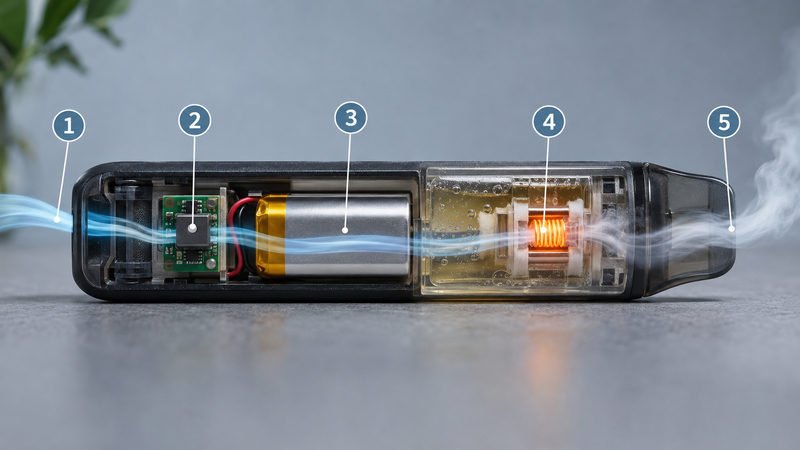
A disposable vape completes several actions during a short draw. The process begins with airflow and ends when aerosol leaves the mouthpiece. Meanwhile, electronics coordinate power quickly enough that activation may feel nearly immediate.
Step One: Inhalation Changes the Air Pressure
When the user inhales, outside air enters through the device’s inlet. That movement changes pressure around the draw sensor. As a result, the sensor sends an activation signal to the control circuitry.
The airflow path must remain reasonably clear for reliable detection. For instance, condensation or debris may make activation inconsistent. However, forceful inhalation does not necessarily solve the problem and may pull excess liquid into the airway.
Step Two: The Battery Powers the Coil
After receiving the sensor signal, the circuit connects controlled battery power to the heating coil. Electrical resistance converts part of that energy into heat. Specifically, the coil heats the liquid held within the nearby wick.
The circuit may stop power after a set period, even if inhalation continues. This cutoff helps limit prolonged heating during one draw. Nevertheless, safety features cannot correct every manufacturing fault, leak, or battery injury.
Step Three: Liquid Reaches the Heating Surface
Before activation, the wick holds e-liquid against or near the coil. Capillary action moves more liquid from the reservoir as the wick loses moisture. Therefore, the reservoir, wick, and coil must remain in balance.
Very frequent draws can outpace that liquid movement. As a result, the wick may become temporarily too dry and produce harsh aerosol. Allowing time between draws may restore normal wicking, unless the reservoir is already depleted.
Step Four: Heat Creates Aerosol
The heated liquid forms a mixture of droplets, gases, and suspended particles. Incoming air carries this mixture through the chamber and central airway. Finally, it exits through the mouthpiece as an inhalable aerosol.
This process does not involve the sustained burning of tobacco. Therefore, vaping differs from combustion at a basic mechanical level. However, heating can still release irritating or harmful substances from the liquid and device materials.
The visible cloud mainly comes from condensed aerosol droplets rather than ordinary steam. Moreover, nicotine and other chemicals can travel within those droplets. Calling the cloud “water vapor” gives an incomplete and potentially misleading description.
Step Five: The Device Stops Heating
When inhalation ends, pressure returns toward its resting state. The sensor then tells the circuit to stop powering the coil. Meanwhile, the wick begins moving fresh liquid toward the heating surface for another draw.
Condensation may collect inside the mouthpiece after repeated use. A small amount can cause gurgling, while a larger leak may reach the lips or hands. Therefore, users should stop if liquid escapes, rather than continuing through the problem.
A properly functioning device repeats this cycle until its battery weakens, liquid runs out, or another component fails. In fact, uneven depletion can make one part fail before another. That imbalance explains why some devices stop while liquid appears to remain.
4. Lifespan, Puff Counts, and Signs a Vape Is Empty
A disposable vape has no universal lifespan. Its usable period depends on liquid volume, battery capacity, coil efficiency, draw length, and frequency. Additionally, temperature, storage, and manufacturing consistency can affect performance.
Why Puff Counts Are Estimates
Advertised puff counts usually come from standardized short draws under controlled conditions. Real users may inhale longer, harder, or more often. Therefore, a label showing 5,000 puffs does not guarantee 5,000 personal draws.
For example, a three-second draw consumes more liquid and energy than a one-second draw. Moreover, higher-power modes can increase aerosol production during each activation. Greater output often shortens the number of available draws.
Usage frequency also changes the calendar lifespan. One adult might take 100 draws daily, while another takes 300. As a result, identical devices could last very different numbers of days.
Common Signs of Normal Depletion
- Lower aerosol output: The cloud becomes noticeably smaller despite normal airflow.
- Weaker flavor: Flavor intensity declines as the available liquid approaches depletion.
- Burnt or dry taste: The wick no longer receives enough liquid for proper heating.
- Blinking light: Some devices signal low battery power or a protection condition.
- No activation: The sensor responds poorly, or the coil receives no usable power.
A burnt taste usually means the user should stop immediately. Continuing can overheat a dry wick and create a harsher aerosol. Furthermore, users should not shake, pierce, or dismantle the casing to recover remaining liquid.
Empty Battery, Charging Problem, or Malfunction?
A non-rechargeable device may stop when its battery reaches its designed limit. A rechargeable model may resume after approved charging, provided liquid remains. However, charging cannot fix an empty reservoir, burnt wick, or failed coil.
A device that will not charge may have a damaged port, unsuitable cable, contaminated connector, or internal failure. Specifically, unusual heat, swelling, odor, or hissing suggests more than ordinary depletion. Users should disconnect it safely and move it away from flammable materials.
Intermittent firing, activation without inhalation, and persistent leaking also indicate possible malfunctions. Therefore, the safest response is to stop using the product. Never attempt a home repair on a sealed lithium-battery device.
5. Disposable Vape Safety, Storage, and Air Travel
Disposable vapes present health and physical safety concerns. Precautions may reduce certain handling risks, but they cannot remove nicotine or aerosol exposure. Most importantly, people who do not currently vape should not start.
Health and Nicotine Risks
Many disposable vapes contain nicotine, which can cause dependence. Frequent use may reinforce cravings and withdrawal symptoms. Moreover, nicotine exposure presents special concerns for young people, pregnant people, and developing fetuses.
Aerosol can expose users to fine particles, flavoring chemicals, and other compounds. The amount varies by product and use conditions. However, an appealing flavor or mild sensation does not prove that an aerosol is safe.
Nicotine liquid can also cause harm through swallowing or skin contact. Therefore, users should keep devices away from children and animals. If exposure occurs, they should contact an appropriate medical or poison-control service promptly.
Leaks, Heat, and Battery Damage
Leaking liquid may appear around the mouthpiece, seams, or air inlet. Users should avoid direct contact and wash exposed skin with soap and water. Additionally, they should isolate the leaking device from personal items until proper disposal.
Never use a device with cracks, swelling, punctures, or severe dents. Likewise, stop using one that becomes unusually hot, hisses, smokes, or smells strange. These warning signs may indicate an internal battery or electrical problem.
Users should not leave disposables in direct sunlight or a hot vehicle. Moreover, they should keep them away from stoves, heaters, water, and loose metal objects. Coins or keys can create dangerous electrical contact if a device lacks adequate protection.
Safer Storage and Charging Practices
- Store the device upright in a cool, dry place.
- Keep it inside its protective packaging when practical.
- Follow the manufacturer’s charging instructions exactly.
- Use a suitable cable and undamaged power source.
- Monitor charging and disconnect the device after completion.
- Keep every vape beyond the reach of children and pets.
Charging on a bed, sofa, or other soft surface can trap heat. Therefore, users should choose a stable, nonflammable surface with clear airflow. Furthermore, they should never charge a wet, leaking, swollen, or damaged product.
Air Travel Rules
Lithium-powered vaping devices generally belong in carry-on baggage, not checked luggage. Travelers must also prevent accidental activation and protect devices from damage. However, airline, airport, and national requirements can differ or change.
Using or charging a vape aboard an aircraft is generally prohibited. Additionally, some destinations restrict possession, importation, or sale of vaping products. Travelers should check current airline and government rules before packing any device.
Security screening does not guarantee that a product complies with destination laws. Therefore, travelers should verify transit-country rules as well. When uncertain, leaving the device at home may avoid confiscation, penalties, or battery-related complications.
6. Disposable Vape vs Pod Systems, Costs, and Recycling
Disposable vapes compete with closed pod systems, refillable pod devices, and traditional vape pens. Each format balances convenience, maintenance, flexibility, and waste differently. However, none removes the health risks associated with inhaling vape aerosol.
How the Main Formats Compare
A disposable arrives prefilled and usually activates without setup. When its liquid or usable battery ends, the entire unit reaches the end of service. Therefore, it offers convenience but creates repeated hardware waste.
A closed pod system uses a rechargeable battery with replaceable, prefilled pods. The user keeps the main device and changes only the pod. As a result, it may generate less battery waste than repeatedly discarding complete devices.
A refillable pod device lets the user add compatible e-liquid and replace pods or coils. Moreover, it offers greater control over flavor and nicotine strength. That flexibility requires cleaning, refilling, charging, and correct component selection.
Vape pens often use larger refillable tanks and replaceable coils. They may provide adjustable power and longer hardware life. However, they usually demand more maintenance and technical familiarity than disposable products.
Convenience and Ongoing Cost
- Disposable vape: Minimal setup, limited customization, and frequent whole-device replacement.
- Closed pod system: Simple pod changes, reusable battery, and dependence on compatible cartridges.
- Refillable pod: More maintenance, broader liquid choice, and potentially lower recurring hardware costs.
- Vape pen: Greater adjustment, replaceable parts, and a steeper learning curve.
A disposable may have a lower initial price than a complete reusable kit. Nevertheless, repeated purchases can create a higher long-term cost for frequent users. For instance, buying several complete devices monthly can exceed the cost of replacing liquid and coils.
Actual spending depends on local prices, consumption, device failures, and product choice. Additionally, reusable systems need occasional replacement parts and proper maintenance. No format offers guaranteed savings, and lower cost does not reduce health risk.
Why Disposables Need Special Recycling
A used disposable vape combines a lithium battery, electronics, plastics, metal, and possible nicotine residue. Consequently, it does not belong in ordinary household recycling. Standard sorting equipment may crush its battery and start a fire.
Throwing the device into general waste can also send recoverable materials to a landfill. Moreover, leaked liquid may create additional exposure concerns. Users should never burn, puncture, crush, or separate the internal components themselves.
Collection options vary between communities. Some battery programs reject devices containing liquid, while certain electronic-waste facilities accept complete units. Therefore, adults should contact local programs before delivering used products.
Until drop-off, users should keep depleted devices in a cool place away from children, pets, and combustible materials. Additionally, they should prevent accidental activation and protect damaged units from further impact. Local authorities may provide special instructions for leaking or swollen batteries.
Responsible disposal reduces fire risks within waste trucks and sorting facilities. It also allows trained handlers to manage the battery and electronic parts. However, recycling does not erase the resources used to manufacture a single-use product.
Conclusion
A disposable vape integrates a mouthpiece, airflow path, draw sensor, circuitry, battery, coil, wick, and prefilled reservoir. Together, these parts create aerosol when the user inhales. However, that aerosol is not harmless water vapor and may contain nicotine and other substances.
Some designs are non-rechargeable, while others recharge but remain non-refillable. Moreover, actual lifespan can differ sharply from an advertised puff count. Draw length, frequency, power, battery capacity, and liquid volume all influence depletion.
These adult-only products carry nicotine, aerosol, leakage, malfunction, battery, and environmental risks. Therefore, users should never treat them as harmless or attempt internal repairs. Any device showing swelling, overheating, hissing, severe damage, or uncontrolled activation requires immediate caution.
Check the device instructions and current local aviation and electronic-waste rules before use, travel, or disposal. Most importantly, stop using any damaged or overheating product. Take depleted devices to an approved battery or electronic-waste collection program whenever local rules allow.
