
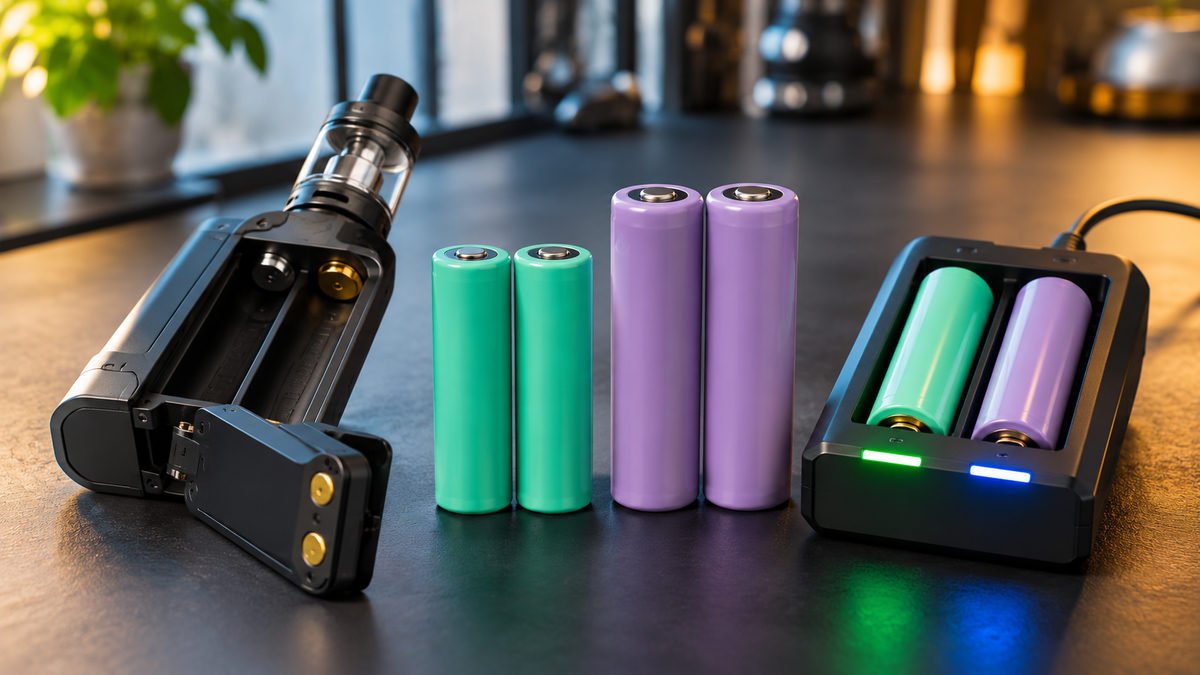
Why can two batteries with the same capacity deliver noticeably different results? Understanding Vape Battery Capacity and mAh Ratings helps explain this common puzzle. Capacity matters, but power demand, cell quality, temperature, and device design also shape real-world performance.
Moreover, an impressive number on a wrapper does not guarantee safety or compatibility. Beginners often treat mAh as a complete performance score. However, choosing a battery requires several specifications, plus careful charging, handling, and inspection.
This guide explains those specifications with practical examples. Additionally, it provides a simple runtime estimate and compares common battery formats. You will also learn how to select, charge, store, and replace vape batteries responsibly.
1. Understanding Vape Battery Capacity and mAh Ratings
What the mAh number means
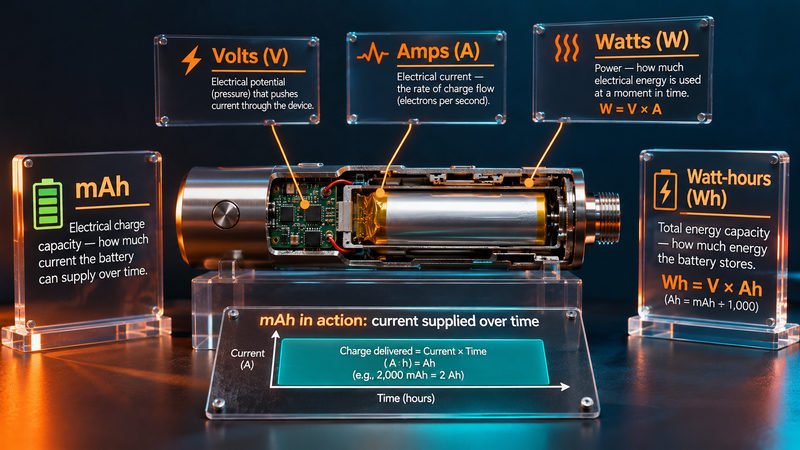
A milliamp-hour, written as mAh, measures electrical charge capacity. The rating describes how much current a battery can theoretically supply over time. For instance, a 3,000 mAh cell could supply 3,000 milliamps for one hour under specified laboratory conditions.
However, that example does not promise one hour of vaping. Test conditions may involve a controlled discharge rate, temperature, and voltage endpoint. In fact, a vape device places changing demands on the cell during each puff.
A larger mAh rating generally suggests longer potential runtime when other conditions remain comparable. Those conditions include voltage, device efficiency, wattage, cell health, and usage habits. Therefore, comparing mAh makes the most sense between suitable batteries used in similar devices.
Capacity, voltage, current, power, and energy
Several battery terms describe different electrical properties. Capacity measures stored charge in mAh, while voltage describes electrical potential. Meanwhile, current measures electrical flow in amps, and power measures the delivery rate in watts.
Energy combines capacity and voltage, usually expressed in watt-hours. Convert mAh into amp-hours by dividing it by 1,000. Then calculate energy using Wh = nominal voltage × Ah.
For example, a 3,000 mAh battery equals 3.0 Ah. At a nominal 3.6 volts, it stores about 10.8 Wh. Notably, watt-hours provide a better comparison when batteries or devices operate at different nominal voltages.
Consider two battery packs that both claim 3,000 mAh. One operates at 3.6 volts, while another operates at 7.2 volts. Although their charge capacities match, the second pack represents roughly twice the nominal energy.
What mAh does not tell you
Capacity alone cannot reveal maximum safe current or discharge performance. It also cannot confirm cell quality, charging speed, internal resistance, or exact runtime. Furthermore, mAh says nothing about whether a cell physically fits a particular device.
The highest advertised capacity is not automatically the safest or most powerful choice. High-capacity cells often sacrifice some current capability. As a result, a genuine lower-capacity high-drain cell may better suit demanding power settings.
Additionally, suspiciously large ratings can signal misleading labeling or an unknown rewrapped cell. Always evaluate capacity beside the cell’s continuous discharge rating and manufacturer specifications. Most importantly, treat compatibility and safety as requirements, not optional features.
2. How to Estimate Vape Battery Runtime
Variables that change runtime
Runtime depends heavily on selected wattage, puff duration, and puff frequency. Coil resistance also matters, although its effect changes between regulated and unregulated devices. Moreover, device efficiency determines how much stored energy reaches the coil.

Temperature, voltage cutoff, battery age, and standby power also influence results. Cold conditions can temporarily reduce available performance. Meanwhile, an older cell may show more voltage sag and deliver less usable energy under load.
Two people can therefore get different runtime from identical equipment. One might take short, occasional puffs at 20 watts. The other might take frequent, four-second puffs at 50 watts, draining the same battery much faster.
A simple energy-based estimate
Start by converting capacity from mAh to Ah. Next, multiply amp-hours by nominal voltage to estimate watt-hours. Then apply a reasonable efficiency allowance before dividing usable watt-hours by operating wattage.
- Divide the mAh rating by 1,000 to calculate Ah.
- Multiply nominal voltage by Ah to estimate stored Wh.
- Multiply stored Wh by the assumed usable efficiency.
- Divide usable Wh by selected wattage to estimate cumulative firing hours.
- Multiply hours by 60 for minutes or by 3,600 for seconds.
Consider a 3,000 mAh cell with a nominal voltage of 3.6 volts. Its estimated energy equals 3.0 Ah multiplied by 3.6 volts, giving 10.8 Wh. Assuming 85% usable efficiency leaves about 9.18 Wh for the calculation.
At 30 watts, divide 9.18 Wh by 30 W. The result is approximately 0.306 hours, or about 18 minutes of cumulative firing time. Specifically, that represents roughly 1,102 firing seconds rather than 18 minutes of ordinary clock time.
If each puff lasts three seconds, divide 1,102 by three. The calculation suggests around 367 puffs under the stated assumptions. However, actual puff counts can vary greatly because wattage, puff length, cutoff behavior, and battery condition change.
Why the estimate has limits
Nominal capacity comes from testing under controlled conditions. High loads, voltage sag, cold temperatures, and conservative device cutoffs reduce accessible energy. Additionally, battery wear increases internal resistance and may cause the device to reach its cutoff sooner.
Regulated mods adjust voltage and current to maintain selected power. Therefore, battery-side current usually rises as cell voltage falls. Coil resistance affects the output requirements, but selected wattage often provides the more useful runtime reference.
In an unregulated device, coil resistance has a more direct relationship with current. Small resistance changes can produce meaningful current changes. However, generic calculations never replace verified cell limits, equipment instructions, or the knowledge required for such devices.
Multiple cells can increase available energy and may support higher power. Nevertheless, results depend on series or parallel configuration and the device’s electronics. Doubling the batteries does not guarantee double the runtime if the user also raises wattage substantially.
Treat every runtime calculation as a planning estimate. Most importantly, follow limits supplied by the device, battery, and charger manufacturers. A screen estimate or puff counter should never override physical warning signs or verified specifications.
3. Capacity, Discharge Rate, and Device Compatibility
Why continuous discharge rating matters
The continuous discharge rating, or CDR, describes current a manufacturer permits continuously under stated conditions. Manufacturers normally express this value in amps. It matters because excessive current can create dangerous heat and accelerate battery damage.

Capacity and current capability often involve a practical trade-off. A high-capacity cell may provide longer runtime at moderate power but offer a lower CDR. Conversely, a cell designed for high current may sacrifice some capacity.
Therefore, application fit matters more than either headline number alone. A 3,500 mAh cell is not automatically better than a 2,500 mAh model. The lower-capacity option may provide the verified current capability required by a demanding device.
Current demand and basic electrical relationships
Voltage, current, resistance, and power connect through basic electrical relationships. Ohm’s law states that current equals voltage divided by resistance. Additionally, electrical power can be calculated using voltage multiplied by current.
However, regulated mods complicate simple coil-side calculations. Their electronics convert battery power to maintain the chosen output. As battery voltage falls, the device can draw more battery-side current to maintain the same wattage.
Consequently, a moderate coil resistance does not automatically mean low battery current at high wattage. Account for device efficiency, cutoff voltage, cell count, and maximum selected power. Never use a generic formula to justify exceeding manufacturer limits.
A complete compatibility check
Before buying a removable cell, confirm the required format and terminal style. Check its exact physical dimensions, CDR, and device power requirements. Furthermore, verify cell count, polarity markings, and every recommendation in the device manual.
- Confirm the required format, such as 18650 or 21700.
- Verify a genuine CDR that meets the device’s requirements.
- Check terminal style, dimensions, polarity, and physical fit.
- Review the supported power range and required cell count.
- Use only models recommended or permitted by the manufacturer.
Trust specifications from established cell manufacturers, device makers, or reputable specialist vendors. Unknown marketplace listings may repeat inaccurate wrapper claims. In fact, exaggerated capacity ratings often accompany unidentified or unsuitable cells.
Avoid counterfeit, damaged, rewrapped, or unknown-origin batteries. Here, “rewrapped” means a cell sold under an unverified wrapper with uncertain original specifications. A professionally replaced protective wrap on a known cell is a different maintenance procedure.
Pairing cells in multi-battery devices
Cells used together should match in brand, model, capacity, age, and condition. They should also share their charge level and usage history. This practice, often called battery marrying, helps the cells age and discharge together.
Buy paired cells together and reserve them for the same device. Additionally, charge, inspect, and rotate their positions according to manufacturer instructions. Replace the complete set if one member develops damage or abnormal performance.
Never combine cells with different capacities, ages, models, conditions, or charge levels inside one multi-cell device. Mismatched cells can experience unequal stress. As a result, one cell may reach an unsafe condition before the others.
4. 18650, 21700, Built-In, and Multi-Battery Options
Common removable formats
The 18650 format remains common in removable-battery vape devices. Its name refers approximately to an 18-millimeter diameter and 65-millimeter length. However, capacity and discharge specifications vary substantially between models.
The larger 21700 format measures approximately 21 millimeters across and 70 millimeters long. Its larger volume can support more capacity, higher current capability, or a useful balance. Nevertheless, performance still depends on the specific cell design.
A 21700 cell cannot be assumed to fit an 18650 device. Never force a battery into a compartment or modify its contacts. Furthermore, use an adapter only when the device manufacturer explicitly supports that adapter and configuration.
Built-in and removable batteries
Built-in batteries support compact designs and convenient USB charging. They also remove many cell-selection and pairing decisions. However, significant battery wear may eventually require professional servicing or replacement of the entire device.
Removable cells allow rapid swapping and provide external charging options. They can also extend a device’s useful service life. On the other hand, owners must select, inspect, pair, store, and transport those cells correctly.
Single-cell devices often prioritize portability and moderate output. Multi-cell devices may extend runtime, support higher power, or provide both advantages. Still, doubling cell count cannot guarantee twice the practical runtime at every power setting.
General battery comparison
| Battery type or approximate capacity | Likely use pattern | Typical wattage context | Charging considerations | Compatible device types |
|---|---|---|---|---|
| Built-in, about 800–1,500 mAh | Light or occasional use | Usually lower-power operation | Use the supported onboard input and cable | Compact pods and small integrated devices |
| Built-in, about 1,500–3,000 mAh | Light to moderate use | Low or moderate power | Charging time varies by input and thermal management | Larger pods and integrated regulated devices |
| Single 18650, about 2,000–3,500 mAh | Moderate use, depending on power | Moderate or supported higher power | Suitable onboard or reputable external charger | Compatible single-cell regulated devices |
| Single 21700, about 3,000–5,000 mAh | Moderate or frequent use | Moderate to higher supported power | Charger must support the format and chemistry | Compatible 21700 regulated devices |
| Matched multi-cell set | Frequent use or higher energy demand | Higher supported output or extended runtime | Balanced onboard charging or a suitable multi-bay charger | Designed multi-cell regulated devices |
These capacity ranges provide general examples, not performance promises. Authentic specifications, power demand, device efficiency, and user behavior determine actual results. Specifically, a high-wattage setup can exhaust a large battery faster than a modest device drains a smaller one.
5. Choosing the Right mAh Rating for Your Vaping Habits
Match the battery to daily use
Occasional short puffs at low wattage may make a modest-capacity device practical. Such a setup can remain compact and easy to charge. However, its output and safety specifications must still match the intended use.
Moderate users should balance capacity, portability, charging access, and adequate discharge capability. A slightly smaller authentic cell may outperform a questionable high-capacity option. Moreover, convenient charging can matter more than carrying extra weight throughout the day.
Frequent or higher-wattage users may benefit from greater total battery energy. Correctly stored spare cells or an appropriate multi-cell regulated device may also help. Nevertheless, raising power can shorten runtime substantially despite a larger battery pack.
A practical selection framework
Start with your usual wattage and daily puff frequency. Then estimate average puff duration and consider your preferred device size. Additionally, decide how often you can charge and whether removable-cell responsibilities suit your routine.
- Record your normal wattage rather than the device’s maximum wattage.
- Estimate daily puff frequency and average puff duration.
- Decide how much size and weight you will comfortably carry.
- Consider access to safe charging during a typical day.
- Choose whether you can manage removable cells responsibly.
- Confirm local availability of authentic replacement batteries.
Extra capacity can require a larger, heavier device and longer charging. In some cell designs, it can also mean lower current capability. Therefore, the highest mAh rating may conflict with portability or higher-power requirements.
Choose an authentic battery that meets the device manufacturer’s format and discharge requirements first. Next, compare capacity only among options that pass those checks. Most importantly, never trade verified safety information for an impressive wrapper number.
Consider realistic future power needs and replacement availability. However, avoid buying cells with unnecessary, exaggerated, or unverifiable specifications. A suitable battery delivers the needed performance without depending on limits you cannot confirm.
6. Charging, Battery Degradation, and Essential Safety
Understanding charging time
Charging time depends on capacity, starting level, charging current, and temperature. Battery balancing and charger design can also affect total time. Furthermore, lithium-ion charging slows near full capacity during the final constant-voltage stage.
A rough estimate divides battery capacity in Ah by charger current in amps. For example, 3.0 Ah divided by 1.0 A gives a three-hour baseline. However, real charging normally takes longer because current tapers and conversion losses occur.
Use the manufacturer-recommended cable, power source, onboard system, or reputable external charger. An external charger must support the cell’s chemistry, size, and permitted charging current. Never assume that physical fit alone confirms electrical compatibility.
Safer charging habits
Charge equipment on a stable, nonflammable surface away from heat and moisture. Monitor the device or cells during charging. Additionally, stop immediately if a battery becomes unusually hot, swells, leaks, deforms, or produces an unusual odor.
- Inspect the battery, charging port, cable, and charger before use.
- Keep charging equipment uncovered and adequately ventilated.
- Prevent water, excessive heat, and combustible clutter from reaching the charging area.
- Disconnect equipment after charging according to manufacturer guidance.
- Stop charging when heat or physical changes appear abnormal.
Vape while charging only when the manufacturer explicitly supports pass-through operation. Some devices pause charging whenever the user fires the coil. Others lack a design intended for safe simultaneous charging and vaping.
Degradation and replacement signs
Lithium-ion batteries gradually lose capacity through use and time. Heat exposure, demanding loads, and repeated deep discharge can accelerate this decline. However, no universal cycle count predicts replacement for every cell and usage pattern.
Sharply reduced runtime often signals meaningful wear. Excessive heat, charging irregularities, repeated device errors, or sudden voltage drops also require attention. Furthermore, replace or professionally assess cells showing deformation, corrosion, leakage, or damaged terminals.
Inspect removable-cell wraps and top insulator rings regularly. A torn wrap can expose conductive metal, while a damaged insulator can compromise terminal protection. As a result, contact with the device or another metal object could create a short circuit.
Do not use a damaged cell until a qualified person properly assesses it. A known cell may sometimes receive a correct replacement wrap and insulator. Nevertheless, replacement remains the safer choice when identity, internal condition, or repair quality remains uncertain.
Storage and transport
Carry loose cells only in protective battery cases designed for their format. Never place them in pockets or bags beside keys, coins, tools, or other metal objects. Those items can bridge battery terminals and cause rapid heating.
Store batteries in dry conditions at moderate temperatures. Keep them correctly oriented and protected from crushing, impact, and direct sunlight. Additionally, follow manufacturer guidance for charge level during longer storage periods.
Never use damaged, counterfeit, mismatched, unidentified, or deceptively rewrapped batteries. Follow the specific instructions supplied by the device, cell, and charger manufacturers. Most importantly, stop using any setup that behaves abnormally until you identify the cause.
Conclusion
mAh indicates charge capacity, but it cannot predict vape battery life by itself. Runtime also depends on total energy, wattage, puff behavior, device efficiency, temperature, cell condition, and voltage cutoff. Moreover, adequate continuous discharge capability remains essential for safe operation.
The right option is an authentic, compatible battery with suitable capacity and verified discharge performance. It is not simply the cell carrying the largest advertised number. Therefore, compare only batteries that already satisfy every requirement from the device manufacturer.
Before buying or using a battery, confirm its format and CDR against the device manual. Inspect its wrap, terminals, and overall condition, then use compatible charging equipment. Finally, complete a personal selection-and-safety checklist before placing any cell into service.
