
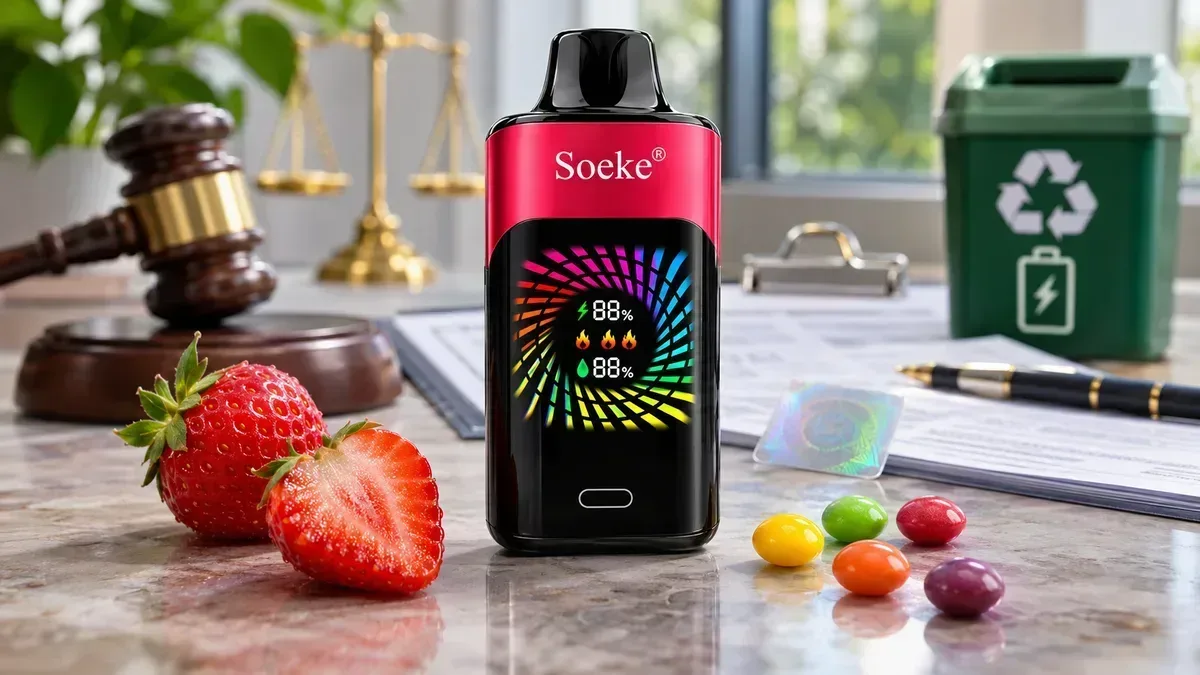
What can a familiar candy name and a 28,000-puff claim really tell you about a vape? SOEKE S9 28000 Puffs Skittles and Chupa Chups Strawberry: Confectionery-Inspired Naming and Regulatory Concerns raises several separate questions. A seller page alone cannot confirm an official flavor, licensed brand relationship, nicotine strength, or lawful market status.
However, buyers and retailers can investigate those questions using evidence tied to the exact product. Start with the device, package, batch, manufacturer records, and official regulatory databases. Then examine youth appeal, labeling, health risks, battery safety, and disposal requirements.
1. SOEKE S9 28000 Puffs Skittles and Chupa Chups Strawberry Flavor Claims
The SOEKE S9 appears in seller listings as a high-puff-count, rechargeable disposable vape. Some listings advertise up to 28,000 puffs in Regular Mode and fewer puffs in Turbo Mode. They also describe features such as dual mesh coils, a color display, and battery or liquid indicators.
However, seller specifications conflict on important details, including battery capacity and liquid volume. That inconsistency weakens any conclusion drawn from one store page. Treat the 28,000 figure as an advertised maximum, not an independently verified performance result.
Are the candy names official flavors?
“Skittles” and “Chupa Chups Strawberry” may appear in product titles, photographs, or seller flavor menus. Yet those appearances do not prove that SOEKE officially adopted either name. They also cannot establish approval from the confectionery brands’ owners.
Specifically, compare each name with a current manufacturer catalog and clear photographs of batch-specific packaging. Check whether the box, device, barcode label, and accompanying leaflet use the same wording. Moreover, ask the manufacturer or responsible importer to confirm that exact variant in writing.
Without that evidence, both names should remain qualified. A name may be an official variant, a seller-created taste description, an outdated regional label, or an unverified listing. Even genuine packaging needs further checks because copied artwork and unauthorized production can look convincing.
Why puff totals vary
A puff estimate depends heavily on the testing method. A one-second machine draw consumes less liquid than a four-second draw under similar conditions. Furthermore, Turbo Mode can increase heating power, aerosol production, and liquid consumption.
- Draw duration: Longer inhalations generally consume more liquid per puff.
- Power setting: Higher output may produce larger aerosol volumes and reduce the total draw count.
- Battery behavior: Charging performance and voltage management can affect usable output.
- Liquid depletion: Wick design may leave some liquid inaccessible near the end.
- Test cutoff: A laboratory must define when a puff becomes too small to count.
Therefore, request the puff duration, interval, airflow, power setting, and cutoff threshold behind the advertised figure. Ask whether the test used production units and how many samples were tested. Most importantly, a puff count cannot reveal nicotine delivered per puff without chemical and aerosol testing.
2. Candy-Inspired Vape Names, Brand Licensing, and Youth Appeal
A recognizable candy reference does not automatically prove a partnership. Proper evidence would identify the relevant rights holder, licensed manufacturer, product, territory, and permitted period. Ideally, the rights holder would publish a statement or provide verifiable licensing documentation.
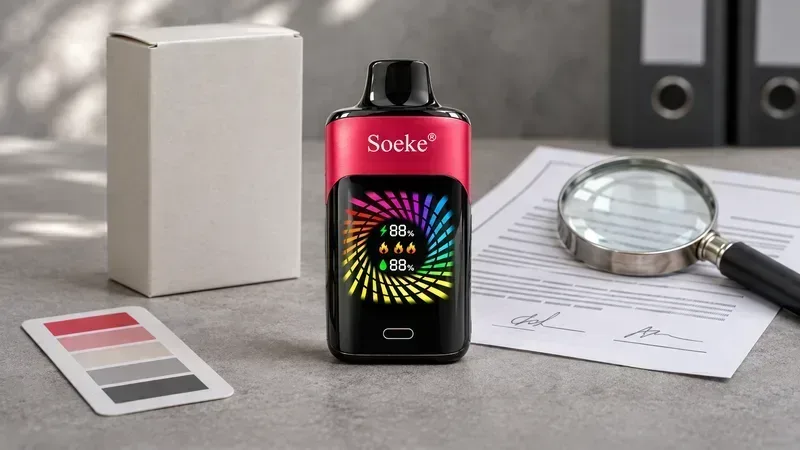
However, a retailer invoice or wholesaler assurance offers much weaker proof. Packaging may use familiar wording without permission. Therefore, retailers should seek documentation that covers the exact SOEKE S9 variant rather than relying on general brand claims.
Trademark and consumer-confusion questions
Confectionery names, logos, signature colors, and package layouts can create legal concerns. Depending on local law, those concerns may include trademark infringement, consumer confusion, unfair competition, or passing off. The result depends on the mark, presentation, territory, and surrounding facts.
For instance, a descriptive fruit phrase may receive different treatment from a distinctive registered candy name. A package that imitates a sweet wrapper can create stronger concerns than plain text. Additionally, a disclaimer may not cure an overall design that still suggests sponsorship.
Businesses should ask qualified local counsel about uncertain artwork or naming. They should not assume that online availability proves permission. In fact, marketplaces often display products before a rights holder or regulator reviews them.
Why regulators examine youth appeal
Bright colors, sweet descriptions, and familiar candy references may make nicotine products more attractive to minors. Small devices can also resemble ordinary consumer items. Moreover, candy-style presentation may reduce a young person’s perception of risk.
The FDA has described enforcement involving unauthorized tobacco products that resembled everyday items. Its concerns included accidental ingestion and appeal to children. Those examples show why presentation matters alongside ingredients and device design.
However, evidence of appeal does not automatically prove actual use. A survey showing greater interest measures attraction or intention, not completed purchases or sustained uptake. Likewise, youth-friendly artwork raises concern but does not alone prove deliberate targeting of children.
Therefore, assessments should separate four questions: recognition, appeal, intention to try, and actual use. Each requires different evidence. Still, retailers can reduce risk by avoiding confectionery mimicry and using restrained, adult-oriented presentation.
3. Are Candy-Flavored Disposable Vapes Legal Where You Live?
There is no universal answer because location changes the rules. National law may govern authorization, ingredients, and imports. Meanwhile, states, provinces, cities, and delivery jurisdictions may impose additional flavor, retail, or licensing restrictions.
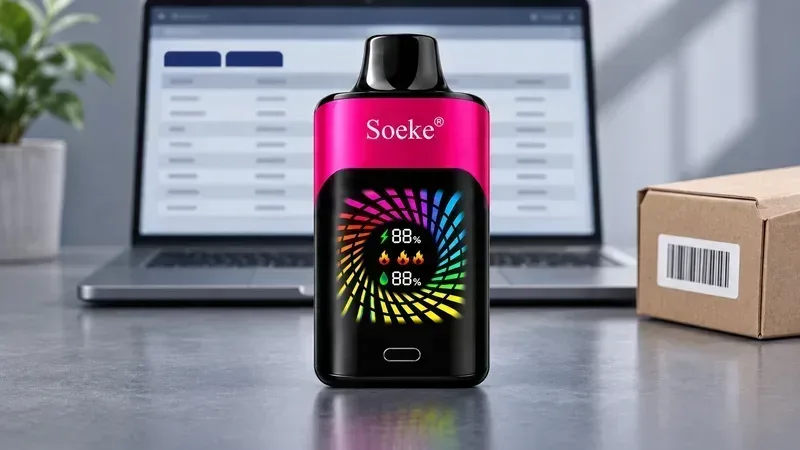
Check the exact formulation, flavor, nicotine concentration, device format, packaging, and sales method. A compliant reusable product does not make a single-use version compliant. Similarly, authorization for one strength or flavor may not cover another variant.
United States and United Kingdom checks
In the United States, a tobacco product generally needs the relevant FDA authority before lawful marketing. Retailers can use the FDA Searchable Tobacco Products Database. Search the precise company, model, flavor, and nicotine strength rather than the brand alone.
Notably, a pending application does not equal marketing authorization. An absent product should prompt further investigation, not a guess. State and local flavor restrictions, retailer licenses, tax rules, and delivery requirements can still apply to authorized products.
Across the United Kingdom, businesses cannot sell or supply single-use vapes under the UK single-use vape ban guidance. The prohibition covers online and physical sales, including products without nicotine. A rechargeable battery alone does not make a device reusable under that guidance.
For relevant nicotine products, the MHRA e-cigarette regulations explain notification and product requirements. Search published records using the exact manufacturer, brand, model, flavor, and strength. However, notification does not override the separate single-use prohibition.
Labels, capacity, and age controls
Inspect the consumer package for required warning text, placement, size, and local language. Verify nicotine strength, ingredients, responsible manufacturer or importer, and usable contact details. Additionally, check child-resistant and tamper-evident features where local rules require them.
Regulatory filings may contain more technical information than the retail label. Therefore, do not treat a short ingredient panel as proof that every filing exists. Match the physical product to any official record using identifying details, not appearance alone.
- Exact model and flavor designation
- Nicotine concentration with clear units
- Tank, pod, or liquid capacity
- Batch, lot, and product codes
- Manufacturer or importer identity
- Required warnings and instructions
A 28,000-puff claim deserves particular scrutiny where capacity limits apply. In the UK, relevant rules restrict nicotine-containing tanks to 2 milliliters and refill containers to 10 milliliters. They also set a 20 mg/mL maximum nicotine strength for products within scope.
However, apply each limit only to the product and jurisdiction it governs. Determine whether the device has a fixed reservoir, replaceable pods, or a separate refill arrangement. Then compare those facts with the advertised draw count and supporting test information.
Finally, confirm the minimum purchase age and every required identity check. Rules may cover the store counter, online checkout, collection point, and doorstep delivery. A simple age-confirmation box may not satisfy local verification duties.
4. How to Verify SOEKE S9 Nicotine Strength and Authenticity
Begin with the exact package and device, not a generic seller description. Record the flavor, strength, barcode, lot number, and manufacturer or importer. Then compare them with manufacturer documentation and a matching official regulatory entry where one exists.
Nicotine strength should include clear units, such as mg/mL or a properly defined percentage. A label stating only “5%” leaves important questions about its calculation basis. Moreover, converting a percentage to 50 mg/mL assumes a weight-per-volume convention that the documentation should confirm.
Physical and supply-chain checks
Inspect tamper-evident seals, warning labels, print quality, contact details, and package alignment. Look for mismatches between the box, device, leaflet, and invoice. Additionally, ask the seller to identify its supplier and provide traceable purchase records.
If the package includes a verification code, find the manufacturer’s verification page independently. Do not follow an unfamiliar address printed beside the code without checking it. However, remember that counterfeiters can clone valid codes or copy genuine labels.
A failed code may support a counterfeit concern, but it does not prove one by itself. Conversely, a successful code cannot guarantee lawful sale in your location. A genuine product may still lack local authorization, proper notification, or compliant labeling.
What to do when details do not match
Preserve photographs of every package side, the device, seals, lot details, and receipt. Keep screenshots of the listing and written communications with the seller. Specifically, avoid using a leaking, damaged, or suspicious device while the matter remains unresolved.
Request a refund or other remedy when the description appears misleading and local consumer law applies. Furthermore, report suspected counterfeiting or safety problems to the relevant consumer, product, tobacco, or customs authority. Give regulators precise evidence rather than assumptions about the entire brand.
5. What Retailers and Distributors Should Check Before Selling or Advertising
A retailer needs more than a product photo and favorable wholesale price. Before ordering, identify the legal supplier and verify its business details. Then obtain invoices that connect each shipment to specific batches and product variants.
A practical pre-stock workflow
- Confirm the supplier, manufacturer, importer, and responsible local entity.
- Obtain invoices, shipment records, batch numbers, and recall contacts.
- Match the exact flavor and strength to required authorization or notification.
- Review import, tax, licensing, retail, and flavor restrictions.
- Request evidence supporting nicotine, capacity, and puff-count claims.
- Document the decision and schedule periodic compliance reviews.
Inconsistent specifications should stop the process until the supplier explains them. For example, conflicting battery or liquid figures may indicate listing errors or different production versions. Therefore, require batch-specific documents instead of combining details from unrelated pages.
Artwork, age controls, and recalls
Review names, logos, colors, mascots, and package shapes for trademark and youth-appeal concerns. Seek evidence of permission for recognizable confectionery references. Moreover, remove unsupported statements suggesting sponsorship, approval, safety, or guaranteed puff performance.
Age verification should cover every legally relevant stage. That may include account creation, checkout, payment review, collection, and delivery. Additionally, train staff to reject questionable identification and document failed delivery procedures.
Create a written process for complaints, adverse incidents, returns, and recalls. It should connect a complaint to the affected batch quickly. Most importantly, preserve supplier contacts and customer transaction records for the period local law allows or requires.
Advertising channel checks
Permission to sell does not necessarily permit every form of promotion. Examine local law and platform rules for web listings, paid advertisements, social posts, email, sponsorships, and influencer content. Requirements can change by channel and audience location.
Specifically, review restrictions on flavor imagery, candy references, warning display, audience selection, and age-gating. Influencers may also need clear sponsorship disclosures. Furthermore, retailers should retain approval records and final copies of every published promotion.
Do not rely on a platform accepting an advertisement as proof of legality. Automated review can miss restricted products or misleading claims. Therefore, complete an independent legal and policy review before publication.
6. Health Risks and Safe Storage for High-Capacity Disposable Vapes
Nicotine exposure depends on more than the number printed on the package. Concentration, aerosol output, draw length, frequency, and individual behavior all affect intake. Moreover, dependence can develop as repeated use reinforces nicotine-seeking behavior.
The FDA overview of e-cigarettes and vaping products explains that e-liquids commonly contain nicotine, flavorings, propylene glycol, and vegetable glycerin. Heating creates an aerosol for inhalation. These products are not harmless, particularly for young people and non-users.
However, claiming that this SOEKE model produces greater exposure requires product-specific evidence. Researchers would need confirmed ingredients, nicotine concentration, device output, and standardized aerosol testing. An advertised puff maximum alone cannot establish a dose or health comparison.
Liquid exposure and secure storage
Leaked nicotine liquid can create risks through swallowing or skin contact. Children and pets face particular danger because a small amount may cause serious poisoning. Therefore, store the device upright in its original packaging and inside a secure location.
- Keep devices away from children, pets, food, and medicines.
- Avoid hot cars, direct sunlight, water, and freezing conditions.
- Wash exposed skin promptly and remove contaminated clothing.
- Do not induce vomiting after suspected ingestion unless professionals instruct you.
For suspected human exposure, contact local poison control or emergency services promptly. Describe the product, nicotine strength, estimated amount, and symptoms. Meanwhile, contact a veterinarian immediately if a pet may have chewed or swallowed any part.
Battery warning signs
Stop using or charging a device that overheats, swells, leaks, hisses, smells unusual, or shows physical damage. Move away from the device if doing so remains safe. Additionally, keep people and animals clear of any leaking material.
Do not puncture, crush, dismantle, or improvise repairs on an embedded lithium battery. Ask the local waste authority or fire service how to manage a damaged unit. Specifically, tell them that the device may contain nicotine liquid and a rechargeable battery.
A damaged vape should not sit loose in a pocket, drawer, or vehicle. Its terminals or internal components may short circuit. Therefore, follow professional instructions for temporary isolation and transport to an approved facility.
7. How to Dispose of a Disposable Vape and Its Battery
A disposable vape combines several waste problems in one small object. It may contain an embedded lithium battery, electronic circuitry, plastic, metal, and residual e-liquid. As a result, ordinary disposal routes can endanger workers and the environment.
Compactors may crush the battery during collection or processing. That damage can trigger heat, smoke, or fire inside trucks and facilities. Meanwhile, residual nicotine liquid can leak and expose workers, wildlife, soil, or water.
Use an approved whole-device collection route
Households should find a local program that explicitly accepts whole vaping devices. In the United States, the EPA recommends household hazardous waste collection for e-cigarettes. Contact the facility first because acceptance rules and operating dates can differ.
Leave an embedded battery inside the device unless the manufacturer designed it for safe consumer removal. Do not cut the casing or pull internal wires. Furthermore, never place the whole vape in household trash, curbside recycling, or a battery-only drop box without approval.
Do not pour leftover liquid into a sink, toilet, storm drain, or onto the ground. Keep the device away from children and pets while awaiting collection. If it leaks or becomes damaged, ask the receiving program for special handling instructions.
Responsibilities for returned or unsold stock
Retailers should determine whether local take-back, producer-responsibility, hazardous-waste, or electronic-waste duties apply. Consumer drop-off rules may not cover commercial quantities. Therefore, businesses should confirm the correct route with their waste authority or licensed contractor.
Returned, damaged, recalled, and unsold devices may require separate storage or records. Staff should prevent crushing, mixing, and unauthorized dismantling. Additionally, the contractor should confirm acceptance of both embedded batteries and nicotine-contaminated components.
Keep transfer documents and collection receipts where regulations require them. Those records can support inventory reconciliation and recall management. Most importantly, never use a disposal claim in advertising unless the actual collection system supports it.
Conclusion
The flavor names and advertised puff count create separate questions about manufacturer naming, licensing, nicotine content, authenticity, and permission to sell. One answer cannot resolve the others. Each conclusion needs evidence tied to the exact variant, batch, territory, and sales channel.
Therefore, match the model, flavor, nicotine strength, and batch details with manufacturer records and the relevant official regulator database. Check local sales, advertising, age-verification, and disposal rules with the responsible authority. When the evidence remains incomplete, do not treat a seller listing as confirmation.
