

You step onto your apartment balcony to vape, but a neighbour says the vapour enters their bedroom. Can strata legally make you stop? Do Australian Strata By-Laws Restrict Vaping on Balconies? Sometimes they do, although Australia has no single nationwide rule for every apartment building.
Instead, the answer depends on local legislation, registered building rules, tenancy terms, and the balcony’s legal classification. Moreover, the effect of drifting vapour on neighbouring homes can matter greatly. The following guidance explains how restrictions, complaints, resident rights, and enforcement commonly operate.
1. Do Australian Strata By-Laws Restrict Vaping on Balconies?
A strata scheme may restrict or completely prohibit vaping on apartment balconies. However, the same rule does not apply identically across every Australian jurisdiction. Each state or territory controls its own strata, community-title, tenancy, and public health systems.

Four factors usually determine whether a resident can vape on a particular balcony:
- The strata or community-title legislation operating in that state or territory.
- The exact wording of the scheme’s registered by-laws or rules.
- Whether the balcony forms part of the lot, common property, or an exclusive-use area.
- Whether vapour enters another lot or interferes with common property.
General public-place laws provide only part of the answer. For instance, a public health law might not prohibit vaping on a private balcony. Nevertheless, that permission does not override a valid building rule, lease condition, or statutory nuisance obligation.
Restrictions can also reach more people than the registered owner. Depending on the governing documents, they may bind occupiers, tenants, subtenants, visitors, guests, and other invitees. Therefore, a tenant cannot necessarily avoid responsibility by arguing that only the landlord belongs to the owners corporation.
Check the rules actually applying to the building
Model rules provide standard wording that schemes may adopt or modify. However, they do not automatically represent every building’s current registered rules. A scheme may retain an older rule, adopt a tailored provision, or omit the relevant model rule entirely.
Consequently, residents should obtain the complete registered version rather than relying on lobby signs or informal summaries. They should also examine amendments approved after the original scheme began. Most importantly, the definition of “smoking” may determine whether a rule reaches electronic cigarettes and vaporizers.
2. Is the Balcony Private, Common Property, or Exclusive Use?
A balcony may feel private because only one apartment can access it. Legally, however, everyday privacy does not prove that the balcony forms part of that apartment’s lot. Its floor, railings, walls, ceiling, doors, and surrounding airspace may have different classifications.
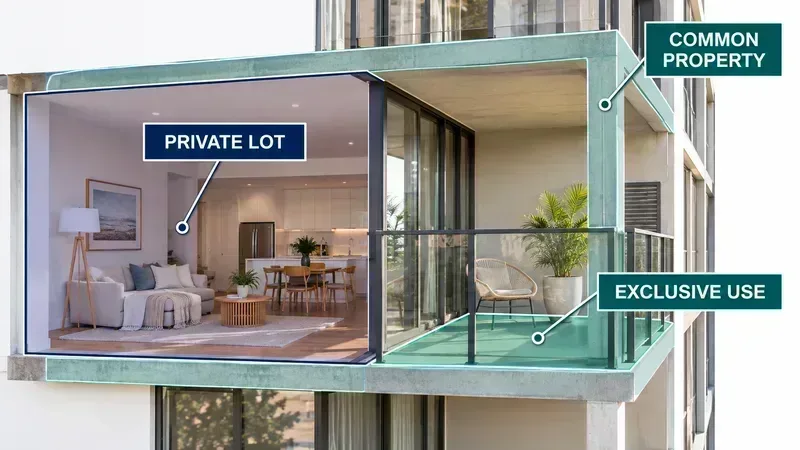
Lot property generally belongs to the lot owner within boundaries shown on the registered plan. Common property belongs collectively to the scheme or its owners. Meanwhile, exclusive-use common property remains common property but gives a particular resident special usage rights.
Terminology and boundary rules differ between jurisdictions. Therefore, residents should inspect the documents governing their particular development. Useful records can include:
- The registered strata, subdivision, or survey plan.
- The certificate of title and relevant title dealings.
- The scheme’s registered by-laws or owners corporation rules.
- The community management statement used in applicable jurisdictions.
- Any exclusive-use, special privilege, or licence arrangements.
One balcony can contain several legal components
Consider a balcony with tiled flooring, a concrete slab, glass railings, and a sliding door. The owner might own the tiles or internal surface. However, the structural slab, balustrade, external wall, or façade may remain common property.
The registered plan defines boundaries rather than ordinary assumptions. Specifically, lines, notations, elevations, and statutory boundary rules may identify ownership. Professional interpretation may become necessary when older plans contain unclear markings.
Exclusive use does not usually transfer ownership. Additionally, it does not remove building rules or grant unlimited freedom over the area. A resident may enjoy private access while still following restrictions concerning behaviour, appearance, maintenance, safety, and vapour drift.
Classification affects who maintains the area and who can regulate conduct there. It may also influence whether a common-property restriction applies directly. Nevertheless, conduct on lot property may still attract action when its effects interfere with neighbours or common areas.
3. How Australian Strata Vaping Laws Differ by Jurisdiction
Strata and community-title legislation operates at state and territory level. As a result, legal terminology, rule-making powers, notice requirements, and dispute pathways vary. Residents should never treat guidance from one jurisdiction as universally applicable.

New South Wales
NSW strata schemes operate through registered by-laws and statutory duties. Owners, tenants, and occupiers must not create a nuisance or hazard for another lot’s occupier. Furthermore, they must not unreasonably interfere with another person’s use of common property or a lot.
Smoke penetration may support such a claim, depending on the circumstances. However, vaping requires attention to the wording used by the legislation and the scheme. An older by-law mentioning tobacco smoke alone may create interpretive questions about electronic vapour.
NSW model by-laws concerning smoking do not automatically represent every scheme’s adopted rules. Therefore, residents should obtain their scheme’s registered version. If informal resolution fails, the process may involve a notice to comply, mediation, and NSW Civil and Administrative Tribunal proceedings.
Queensland
Queensland gives bodies corporate express power to restrict smoking products in specified locations. Covered locations can include common property and outdoor lot areas, including balconies. The framework can also reach outdoor exclusive-use areas, subject to its precise statutory terms.
Queensland definitions can include electronic cigarettes and vaporizers. Moreover, regularly exposing another occupier or common-property user to emissions may constitute nuisance, hazard, or unreasonable interference. The person’s conduct, location, exposure pattern, and applicable scheme provisions all remain important.
Residents should examine the community management statement because it contains the scheme’s by-laws. They should also verify the legislation currently applying to their development. Queensland Government guidance explains that vaping devices may fall within body corporate smoking restrictions.
Victoria and other jurisdictions
Victorian owners corporations can make registered rules concerning lots and common property within their legislative authority. Nuisance, hazard, and unreasonable interference provisions may also apply. Additionally, specific powers concerning tobacco-smoke drift do not automatically settle every dispute involving vaping emissions.
Victorian complaints may progress through internal breach procedures and dispute resolution. If the problem continues, the Victorian Civil and Administrative Tribunal may hear an enforcement application. However, the owners corporation must follow applicable procedural requirements before escalating the matter.
Residents elsewhere should consult their local strata, community-title, tenancy, health, and tribunal authorities. Comparable principles may exist under differently worded statutes. Public smoke-free or vape-free laws do not automatically create a universal ban covering every private apartment balcony.
4. When Vape Drift Becomes a Nuisance or Unreasonable Interference
A building does not always need a rule that expressly says “no vaping.” Nuisance, hazard, and unreasonable-interference provisions may address the same conduct. Likewise, protections for reasonable use and enjoyment can become relevant when vapour repeatedly enters another home.
An occasional faint trace may receive different treatment from substantial daily exposure. However, no universal number of incidents guarantees a successful complaint. The legal threshold depends on local legislation, the rule’s wording, and reliable evidence about the actual effect.
Decision-makers may consider several practical factors:
- How frequently vaping occurs and how long each incident lasts.
- The vapour’s apparent intensity and proximity to neighbouring openings.
- Prevailing wind, airflow, and the balcony’s physical configuration.
- Open windows, vents, shared ducts, and air-conditioning systems.
- How far emissions penetrate another lot or common property.
- Whether the impact continues after reasonable requests or warnings.
Proving impact without overstating the case
Relevant impacts may include odour, residue, headaches, or documented health effects. Additionally, a resident might lose ordinary use of their balcony, bedroom, or living room. Repeatedly closing windows during warm weather can also demonstrate interference with normal apartment living.
Second-hand aerosol concerns can support a complaint when backed by appropriate evidence. Nevertheless, residents should avoid unsupported medical conclusions or exaggerated claims. A stronger complaint connects observable conduct with specific dates, entry points, symptoms, and disruptions.
Strata may sometimes regulate conduct occurring inside private property. Specifically, the relevant question may concern where the effects travel, not merely where vaping begins. Vapour entering common corridors or another apartment can bring otherwise private behaviour within the scheme’s authority.
Finally, smoking and vaping are not always legally identical. Some modern rules expressly include electronic cigarettes, vaporizers, aerosols, and inhaled smoking products. On the other hand, older references to tobacco, smoke, or “smoking a substance” may need careful legal interpretation.
5. How to Make or Respond to a Neighbour Vaping Complaint
If vapour is entering your home
Begin with respectful communication when doing so feels safe. Describe the entry point, frequency, and effect without accusing your neighbour of deliberate harm. For instance, ask whether they could use another location or avoid vaping near your bedroom window.
If the problem continues, keep evidence that shows a consistent pattern. Useful material can include:
- An incident diary recording dates, times, and duration.
- Weather conditions and the apparent wind direction.
- Windows, doors, vents, or ducts through which vapour enters.
- Witness accounts and copies of relevant correspondence.
- Lawfully obtained photographs or video showing visible drift.
- Medical records connecting symptoms with reported exposure.
- Evidence showing vapour or residue inside the affected apartment.
However, evidence gathering must remain lawful and proportionate. Do not trespass, point cameras into private rooms, or make unlawful covert recordings. Moreover, record what you genuinely observed rather than estimating events you could not see.
Submit a factual written complaint to the appropriate recipient. This may include the strata manager, committee, owners corporation, body corporate, building manager, landlord, or property agent. Tenants should notify their landlord or agent while also following the scheme’s complaint procedure.
The complaint should identify the applicable rule, affected locations, incident dates, and requested solution. Additionally, attach supporting records and mention earlier resolution attempts. A specific request usually works better than a general demand to “do something.”
If you receive a complaint about vaping
First, obtain the exact rule and check whether it covers vaping, balconies, visitors, and vapour penetration. Do not assume the complaint fails simply because the balcony feels private. Tenants and visitors generally remain subject to valid rules affecting occupiers and invitees.
Meanwhile, take reasonable steps to prevent drift. You might change locations, move away from adjoining windows, or keep nearby doors closed. Ventilation changes, agreed schedules, or a designated area may also resolve the dispute.
Respond to warning letters and formal notices within the stated period. If you dispute the allegation, explain the facts calmly and provide relevant evidence. Most importantly, obtain advice before challenging the rule’s validity or refusing compliance during formal proceedings.
Neighbours may reach a practical private arrangement. However, their agreement cannot override legislation or a valid building-wide prohibition. It also cannot remove the rights of other residents affected by the same vapour.
6. By-Law Enforcement, Breach Notices, and Dispute Resolution
Most disputes begin with a conversation, complaint, or warning letter. If the behaviour continues, the scheme may issue a formal notice to comply or breach notice. However, the required form, approval, wording, and service method depend on the jurisdiction.
The owners corporation, body corporate, committee, or authorised manager may initiate enforcement. Nevertheless, each body must act within its statutory or delegated authority. A manager cannot automatically exercise every power belonging to an elected committee or general meeting.
A tenant may receive a formal notice even though the landlord owns the apartment. Moreover, enforcement can proceed against an occupier responsible for the conduct. Owners and landlords may also have duties to provide current rules and address continuing breaches.
Possible escalation and outcomes
Depending on location, the next stage may involve mediation, conciliation, adjudication, a tribunal, or a court. Not every jurisdiction uses every step. Therefore, parties should follow the pathway specified by their legislation and local dispute service.
Possible outcomes can include:
- An order requiring the resident to stop vaping in a covered area.
- Directions to modify behaviour and prevent vapour penetration.
- An order requiring compliance with a valid registered rule.
- Financial penalties for repeated breaches where legislation permits them.
- Costs orders in limited circumstances under applicable procedures.
A scheme should preserve evidence and follow procedural fairness. Specifically, it should use the correct notice, obtain necessary votes, meet service requirements, and respect statutory time limits. Procedural mistakes can weaken an otherwise credible case.
A resident may challenge the alleged facts or the rule’s interpretation. Furthermore, they may dispute defective service, insufficient authority, invalid adoption, or disproportionate coverage. Some challenges allege that the rule exceeds the scheme’s legislative power.
Formal disputes can become expensive and stressful. Consequently, residents should seek guidance from their state regulator, tenancy authority, tribunal service, strata specialist, or lawyer. Early advice can prevent missed deadlines and poorly framed applications.
7. Can Strata Introduce a Blanket No-Vaping By-Law?
A scheme can often propose a new no-vaping rule or amend an existing smoking rule. The usual process involves drafting, notice to members, voting, adoption, and registration. However, voting thresholds and registration requirements differ across Australia.
Clear drafting reduces future disputes. A proposed rule should define:
- Vaping, electronic cigarettes, vaporizers, aerosols, and smoking products.
- The lots, balconies, courtyards, and common areas it covers.
- Whether the restriction applies to guests, contractors, and other invitees.
- How vapour drift, penetration, and repeated exposure will be assessed.
- Any designated locations, limited exceptions, or transitional arrangements.
- The complaint, notice, and enforcement procedures.
A rule must remain within the scheme’s statutory authority. Additionally, it cannot conflict with higher legislation or regulate matters beyond the scheme’s permitted scope. It should not improperly discriminate against owners, occupiers, tenants, or visitors.
Blanket prohibition or targeted restriction?
A resident may challenge a blanket ban as harsh, excessive, oppressive, unconscionable, unreasonable, or disproportionate. The available grounds depend on the jurisdiction’s legislation. Procedural errors during adoption or registration can create separate grounds for challenge.
A complete ban may cover common property and every outdoor area within the scheme’s authority. Conversely, a narrower rule could target common areas, specified balconies, vapour penetration, or repeated nuisance. A designated vaping location may provide another option where space and local laws permit it.
Committees should obtain jurisdiction-specific advice before regulating balconies forming part of private lots. Queensland, for example, provides express powers concerning smoking products on certain outdoor lot areas. However, another jurisdiction may define the scheme’s authority differently.
Finally, communicate the proposal before the vote. Explain its purpose, coverage, commencement date, complaint pathway, and possible consequences. Clear notice helps owners make an informed decision and gives occupiers time to adjust their behaviour.
Conclusion
Whether vaping is allowed on an Australian apartment balcony depends on several connected issues. These include local legislation, registered building rules, tenancy terms, balcony classification, and the vapour’s impact. Therefore, neither apparent privacy nor general public-place laws provide a complete answer.
Residents should verify the governing documents, document genuine drift, and seek a proportionate solution first. If enforcement becomes necessary, every party should follow the correct jurisdictional procedure. Careful evidence and respectful communication often prevent a balcony disagreement from becoming a costly tribunal dispute.
Obtain your scheme’s current registered by-laws and strata plan before taking formal action. Compare them with your state or territory’s current rules. Additionally, seek advice from the relevant regulator, tenancy authority, tribunal service, strata specialist, or lawyer.
