
Introduction
Your new appliance stops working one month after its written warranty expires. Must you now pay for the repair or replacement? Under Product Defects, Warranties and Australian Consumer Law, the expiry date may not end your rights. In fact, automatic consumer guarantees can continue for as long as a reasonable buyer would expect the product to remain reliable.

Consumers and businesses often misunderstand how these guarantees interact with written warranties. Moreover, confusion arises about who must handle a claim and which remedy applies. This guide explains defective-product remedies, supplier duties, evidence requirements, complaint options, and protections against unsafe goods. However, each dispute depends on its facts, so complex or costly claims may require legal advice.
1. Product Defects, Warranties and Australian Consumer Law: The Basics
Rights that businesses generally cannot remove
The Australian Consumer Law, commonly called the ACL, creates automatic protections for qualifying purchases. These protections form part of the Competition and Consumer Act. Importantly, a contract, store notice, or warranty condition generally cannot exclude them. A business cannot avoid its obligations by displaying “no refunds” or imposing an arbitrary seven-day claim limit.
The protections generally apply when someone acquires goods as a consumer under the ACL. They can also cover purchases made by businesses, depending on the price and type of goods. However, goods acquired for resale or transformation in production usually fall outside these guarantees. Therefore, the buyer’s purpose can matter as much as the buyer’s identity.
Who handles a defective-product dispute?
The supplier is usually the business that sold the product directly to the buyer. For example, a department store remains the supplier when it sells a television made by another company. If the television breaches a consumer guarantee, the retailer must address the buyer’s claim. It cannot simply insist that the buyer deal only with the manufacturer.
A manufacturer makes the goods, while an importer may carry corresponding responsibilities for imported products. Specifically, manufacturers and importers can face claims involving quality, descriptions, repairs, spare parts, express promises, and related losses. Retailers may later recover certain remedy costs from the manufacturer. However, that commercial process should not become the consumer’s burden.
The consumer should explain the fault and provide reasonable proof of purchase. Meanwhile, the supplier should assess the claim fairly and offer the remedy required by law. A warranty administrator may assist when a separate warranty applies. Nevertheless, using that service does not remove the retailer’s ACL responsibilities.
2. Automatic ACL Consumer Guarantees for Products
What the guarantees require
Consumer guarantees arise automatically when a qualifying product is supplied. You do not need to register the product or buy an extended warranty. Moreover, losing a warranty card does not erase these legal protections. The guarantees exist independently of promises printed in a manufacturer’s booklet.
Goods must be of acceptable quality. This means they should remain safe, durable, free from defects, acceptable in appearance, and suitable for their normal purposes. However, the law does not demand perfection from every product. A reasonable consumer’s expectations depend on all relevant circumstances.
Products must also match their description, sample, or demonstration model. Additionally, they must satisfy any purpose disclosed to the supplier when the buyer reasonably relies on its advice. A salesperson’s specific promise can create an express warranty. For instance, a claim that a watch works underwater at 30 metres must be accurate.
- Consumers should receive clear title and ownership of the goods.
- They should enjoy undisturbed possession without unexpected repossession claims.
- The goods should have no undisclosed securities, debts, or charges.
- Manufacturers should provide repairs and spare parts for a reasonable period, subject to disclosed exceptions.
- Businesses must honour additional promises about performance, condition, quality, or characteristics.
How acceptable quality is assessed
No single expiry period applies to every product. Instead, the assessment considers its nature, price, age, condition, advertising, packaging, and representations. Expected use also matters. Therefore, a premium refrigerator and a low-cost portable cooler may have different reasonable durability periods.
Consider a refrigerator costing $1,800 that completely fails after four and a half years. Its written warranty may have ended after two years. However, the price and expected durability could support an ACL claim. In fact, buyers generally expect an expensive household appliance to last longer than a short written warranty.
Normal wear, misuse, accidents, and unauthorised alterations can weaken a claim. Likewise, a buyer cannot complain about a defect clearly disclosed before purchase. Seconds and discounted display goods still receive guarantees, but known faults affect reasonable expectations. Most importantly, the remaining parts of those goods must still satisfy applicable guarantees.
3. Consumer Guarantees Versus Product Warranties
Legal protections and voluntary promises
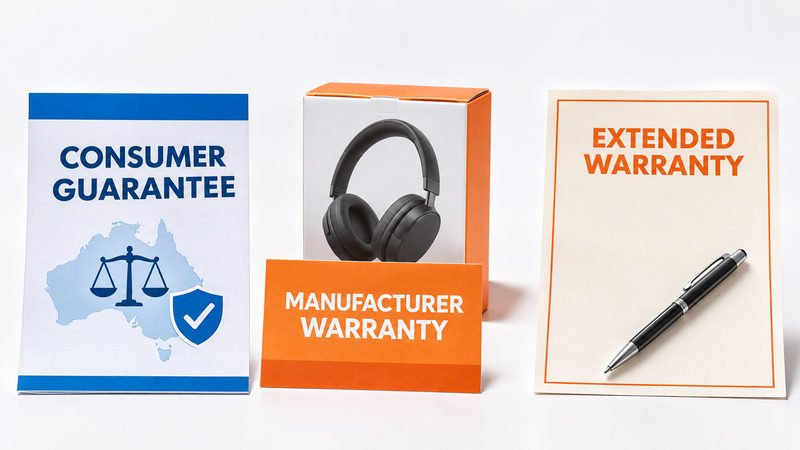
Consumer guarantees come from legislation and apply automatically. By contrast, a written warranty contains additional promises from a retailer, manufacturer, or warranty provider. It may promise free repairs for 24 months or replacement after particular faults. However, its terms operate alongside the ACL rather than replacing it.
A warranty against defects usually explains what the provider will do when a defect appears. It may require a claim number, inspection, or return to an authorised repairer. These procedures can make a straightforward claim easier. Nevertheless, they cannot lawfully reduce remedies available under consumer guarantees.
Express warranties can also arise through spoken or written representations. For example, a salesperson might promise that outdoor furniture will not fade for five years. If it fades badly after two years, that promise may support a claim. Therefore, buyers should preserve advertisements, product pages, emails, and sales messages.
What an extended warranty changes
An extended warranty usually offers specified protection beyond the standard written warranty. It may include convenient collection, accidental-damage benefits, or a defined replacement process. However, consumers may already hold substantial rights without buying it. Sellers must not suggest that ACL protection disappears unless the customer pays extra.
Before buying extended coverage, compare its benefits with existing legal rights. Specifically, check exclusions, claim fees, depreciation rules, repair limits, and cancellation conditions. A useful plan should provide genuine benefits beyond the ACL. Otherwise, the customer may pay for protection that the law already supplies.
Suppose a laptop carries a one-year manufacturer’s warranty and develops a serious internal fault after 18 months. The manufacturer’s written promise has ended. Even so, the retailer must consider whether a reasonable buyer would expect longer durability. Consequently, “the warranty expired” does not decide the ACL claim.
4. Major and Minor Failures: Repair, Replacement or Refund
When a failure is major
The classification of a failure determines who initially chooses the remedy. A product has a major failure when a reasonable buyer would not have purchased it after knowing the problem. A failure is also major when the product is unsafe or substantially different from its description. Additionally, the test covers goods that cannot fulfil their disclosed or normal purpose and cannot easily be fixed promptly.
Several smaller problems can collectively amount to a major failure. For instance, a new vehicle might suffer repeated electrical, steering, and braking faults. Each repair could appear manageable when viewed alone. However, the combined problems may have stopped a reasonable buyer from purchasing the vehicle.
For a major failure, the consumer may reject the goods and choose a refund or replacement. Alternatively, the consumer may keep the product and claim compensation for its reduced value. A refund should generally equal the amount paid without deductions for previous use. Moreover, it should usually return through the original payment method unless both parties agree otherwise.
- An electric heater creates a serious fire or shock risk.
- A freezer cannot keep food frozen and cannot be fixed promptly.
- A “solid oak” table uses a materially different manufactured board.
- A camera repeatedly shuts down despite several unsuccessful repairs.
- A waterproof phone fails during the advertised depth and usage conditions.
When a failure is minor
A minor failure is a problem that the supplier can fix within a reasonable time. In this situation, the supplier usually chooses the initial remedy. It may provide a repair, replacement, or refund, although a free repair often remains the practical choice. Therefore, the consumer cannot always demand an immediate refund for a readily repairable fault.
For example, a new washing machine may develop a replaceable door-latch fault. If the retailer arranges a prompt, lasting repair, the problem likely remains minor. However, the classification can change when repairs fail or unreasonable delays continue. A minor failure may justify stronger remedies when the supplier cannot resolve it within a reasonable time.
What counts as reasonable depends on the product and circumstances. A two-day repair might be practical for headphones but unrealistic for specialised machinery. Meanwhile, a month without an essential refrigerator may cause serious inconvenience and food loss. Parts availability, fault complexity, product use, and previous attempts all influence the assessment.
Costs and additional compensation
Repairs and other required remedies should not leave the consumer out of pocket. The supplier must arrange collection for large, heavy, installed, or difficult-to-return goods within a reasonable time. For smaller items, the consumer may initially return or post them. If the claim proves valid, the business should reimburse reasonable transport or postage expenses.
Consumers may also claim reasonably foreseeable loss caused by the failure. For instance, a faulty washing machine may leak and damage nearby flooring. The flooring loss may be foreseeable and recoverable with suitable evidence. However, remote losses with no sufficient connection to the defect may not qualify.
If a supplier refuses or takes too long to fix a minor failure, the consumer may take further action. Depending on the circumstances, the buyer may arrange repairs elsewhere and seek reasonable costs. The buyer may also reject the goods if the legal requirements are met. Therefore, written deadlines and a clear repair history can become important evidence.
5. Claims, Proof of Purchase and Special Buying Situations
Building a clear claim
Start by recording when the problem appeared and how it affects normal use. Additionally, photograph damage, film intermittent faults, and save error messages. Keep inspection reports, repair invoices, serial numbers, and correspondence. Strong records help distinguish a product defect from misuse or accidental damage.
A business may request reasonable proof that you bought the product from it. However, an original paper receipt is not always essential. A bank statement, digital receipt, order confirmation, lay-by agreement, or warranty record may establish the transaction. A serial number linked to the seller’s database may also help.
Write to the retailer and identify the product, purchase date, price, and fault. Then explain which consumer guarantee appears unmet and state your requested remedy. For a major failure, clearly say that you reject the goods and choose a refund or replacement. Moreover, attach copies of evidence while retaining the originals.
Common situations that create uncertainty
- Sale items: Discounted products receive guarantees unless the problem concerns a defect disclosed before purchase.
- Gifts: A recipient can often rely on the purchaser’s receipt or another reasonable transaction record.
- Second-hand goods: Guarantees may apply to business sales, although age, price, and condition shape reasonable expectations.
- Private sales: Many consumer guarantees do not apply when a private individual sells goods outside business activity.
- Online purchases: Australian businesses generally carry the same obligations online as they do in physical stores.
- Overseas sellers: Rights may exist when the business officially supplies Australia, but enforcement can prove difficult.
- Change of mind: The ACL does not generally require a refund when goods are fault-free and the buyer simply reconsiders.
Original packaging is not normally required for a faulty-product claim. Likewise, a store’s short returns period cannot override a valid guarantee claim. However, consumers should return all essential components supplied with the product. They should also remove personal data from electronic devices where practical.
Businesses can inspect goods to verify the reported problem. Nevertheless, they should explain expected timeframes and pass complete fault information to any assessor. Consumers should request the assessor’s findings when a claim is rejected. Specifically, an independent expert report may help when the cause or severity remains disputed.
6. Rejected Claims, Escalation and Unsafe Products
A practical escalation process
A rejected claim does not always end the matter. First, ask the retailer for its reasons in writing and request any inspection report. Check whether the decision addresses the ACL rather than only the written warranty. In fact, a warranty expiry date alone does not resolve a consumer-guarantee claim.
- Collect the receipt or other proof of purchase, photographs, videos, repair records, and relevant advertisements.
- Send a concise written complaint to the retailer, describing the fault and requested ACL remedy.
- Set a reasonable response date and retain copies of every message, invoice, and postage receipt.
- Escalate the complaint to a manager or the business’s formal complaints team.
- Contact the relevant state or territory consumer protection agency for information or dispute assistance.
- Report concerning conduct to the ACCC, while recognising that it generally does not resolve individual disputes.
- Consider a tribunal, court, community legal centre, or private lawyer when the dispute remains unresolved.
The appropriate forum and procedure depend on the state, territory, claim value, and remedy sought. Moreover, time limits can apply to tribunal proceedings and compensation claims. Consumers should not allow prolonged informal discussions to exhaust those limits. Therefore, obtain legal advice early when substantial money, injury, or complex evidence is involved.
A credit-card chargeback may offer another path in limited circumstances. However, chargeback rules come from the card scheme and bank, not the ACL remedy system. Strict notification periods often apply. Consequently, consumers should ask their bank promptly without abandoning their written complaint against the supplier.
Unsafe products, recalls, and injuries
Safety forms part of acceptable quality under the ACL. An unsafe product generally presents a major problem, giving the consumer a choice between replacement and refund. Additionally, suppliers must address safety complaints about products they sold. They should not redirect consumers and refuse all involvement.
Stop using a product immediately if it creates a fire, electrical, choking, poisoning, or injury risk. Keep the item safely where possible, but do not dismantle it unnecessarily. Moreover, photograph the product, packaging, model, batch number, damage, and surrounding scene. Seek urgent medical help when exposure or injury requires treatment.
Businesses must comply with applicable safety standards and product bans. They may also need to report certain serious incidents and undertake recalls. Meanwhile, consumers should follow recall instructions concerning return, repair, replacement, or disposal. A recall remedy does not necessarily remove separate rights arising from loss or injury.
Consumers may claim compensation for reasonably foreseeable damage caused by an unsafe or defective product. This can include damaged property, medical expenses, lost income, or other proven losses. However, causation and evidence become especially important in injury disputes. Medical records, expert reports, receipts, and incident timelines can support the claim.
Separate manufacturer-liability provisions may apply when goods contain safety defects that cause injury or property loss. Importers can carry manufacturer responsibilities in relevant situations. Furthermore, different limitation periods and legal tests may affect these cases. Serious injury claims therefore deserve prompt advice from a qualified Australian lawyer.
Never continue using a dangerous product merely to reproduce the fault for evidence. Instead, preserve existing records and follow official safety directions. Report the hazard to the supplier and the appropriate product-safety authority. Most importantly, treat immediate safety as more important than proving the warranty claim yourself.
Conclusion
Australian consumer guarantees operate independently of written warranties. Therefore, an expired warranty does not automatically make a repair, replacement, or refund the consumer’s responsibility. The correct remedy depends mainly on whether the failure is major or minor. Product age, price, representations, expected use, and reasonable durability also shape the result.
Consumers may also recover reasonably foreseeable losses caused by defective or unsafe goods. Moreover, retailers generally must handle claims concerning products they sold, even when manufacturers caused the faults. Gather your proof of purchase and fault evidence, then send the supplier a clear written remedy request. If the dispute continues, contact your state or territory consumer agency or obtain legal advice.
