
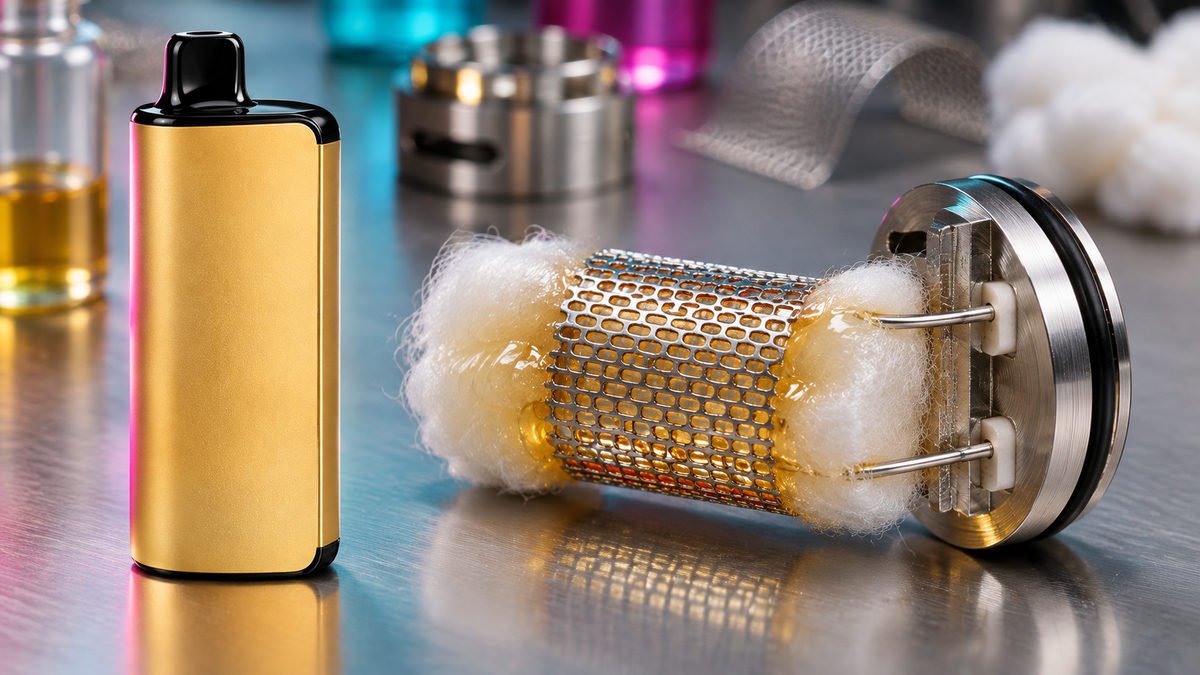
Why can a thin, perforated metal strip heat faster and more evenly than a much thicker wound coil? Mesh Coils: Construction and Technical Principles provide the answer through electrical pathways, surface area, and controlled metal geometry. However, resistance ratings and wattage ranges reveal only part of the engineering story. Wicking pressure, airflow, material choice, and device compatibility matter just as much.
Mesh terminology can seem confusing because similar-looking elements may behave very differently. For instance, two 0.2-ohm coils may use different alloys, dimensions, and recommended power ranges. Therefore, resistance alone cannot predict flavor, vapor output, or safe operating power. You must consider the complete coil specification.
This guide explains how manufacturers build mesh vape coils and how electrical current creates heat within them. Moreover, it connects technical principles with practical selection, operation, and maintenance. The aim is straightforward: understand the component before applying power. That knowledge helps prevent dry hits, overheating, leaks, and premature coil failure.
1. Mesh Coils: Construction and Technical Principles
What Makes a Heating Element “Mesh”?
A mesh coil uses a perforated, stamped, expanded, or woven metal heating element. Unlike round-wire coils, it does not rely on several turns of cylindrical wire. Instead, manufacturers shape a flat sheet or network into a curved heating surface. Therefore, the finished element can touch a broad section of wick.
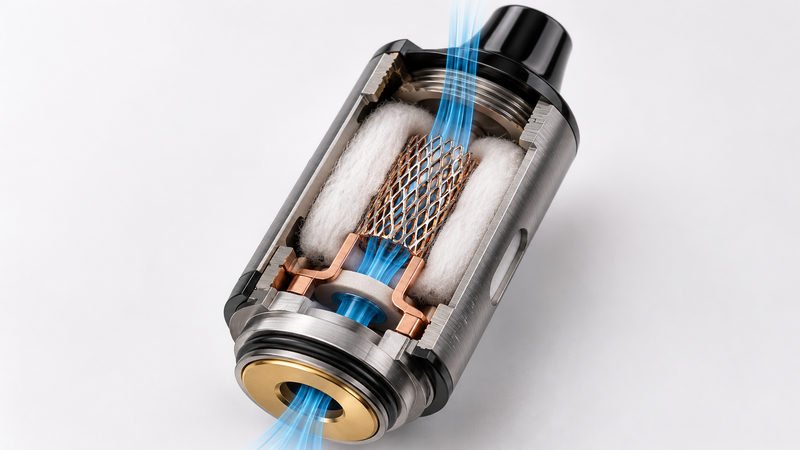
The word mesh describes several related constructions rather than one universal pattern. For instance, expanded mesh starts as sheet metal with precisely cut openings. The sheet then stretches into a connected diamond pattern. Meanwhile, stamped mesh uses controlled punches or cutting tools to create repeatable openings and conductive paths.
Woven mesh uses intersecting metal strands, although many replaceable vape coils use stamped or expanded structures. Specifically, each method changes the element’s thickness, open area, flexibility, and current paths. These properties influence resistance and heat distribution. Consequently, two products labeled “mesh” may deliver noticeably different performance.
How Electrical Energy Becomes Heat
When the device activates, electrical current travels through the resistive metal. The metal opposes that current and converts electrical energy into heat. In simple terms, applied power determines the total heating energy delivered each second. However, geometry decides where that energy concentrates across the element.
The mesh transfers heat into the cotton or other approved wick touching its curved surface. Liquid within the wick absorbs that heat and begins changing into vapor. Additionally, airflow carries vapor away and cools both the coil and nearby components. This cycle repeats throughout each puff.
Good operation requires balance among power, liquid supply, and airflow. If power exceeds the wick’s liquid delivery, part of the cotton can dry quickly. As a result, its temperature rises and produces a harsh taste. Continued operation may permanently scorch the wick.
Mesh does not create energy more efficiently through a special electrical effect. Instead, it distributes heat across a broad, carefully designed contact area. Moreover, its relatively low mass can respond quickly when power starts or stops. Those features explain its fast ramp-up and consistent vaporization.
- Resistive element: Converts electrical energy into heat.
- Wick: Stores and transports e-liquid toward the heating surface.
- Airflow: Moves vapor while managing coil temperature.
- Housing: Positions the element and connects it safely to the device.
2. Mesh Coil Materials and Manufacturing Methods
Kanthal, Stainless Steel, and Nichrome
Kanthal commonly refers to iron-chromium-aluminum resistance alloys used in power-regulated vaping coils. It offers high resistivity, good oxidation resistance, and dependable performance at elevated temperatures. Moreover, its protective oxide layer supports durability under normal specified use. Kanthal generally suits wattage mode rather than temperature-control operation.

Stainless steel has lower resistivity than Kanthal, so manufacturers adjust its dimensions and pattern accordingly. It usually ramps quickly and offers strong corrosion resistance. Additionally, suitable stainless grades can work in wattage mode or supported temperature-control modes. The device must recognize the exact material and provide the correct setting.
Nichrome usually contains nickel and chromium, with specific proportions varying by grade. Its lower resistivity often supports rapid ramp-up and responsive heating. However, manufacturers must control element dimensions carefully to achieve the intended resistance. Users with known nickel sensitivity should review product materials before use.
- Kanthal: Durable, oxidation-resistant, stable, and commonly intended for wattage mode.
- Stainless steel: Responsive, corrosion-resistant, and compatible with certain temperature-control systems.
- Nichrome: Fast-ramping, relatively low in resistivity, and commonly used for responsive power delivery.
Why Manufacturing Precision Matters
Manufacturers may punch, laser-cut, etch, weave, or expand metal into the required pattern. Each process must maintain consistent strand width and sheet thickness. Specifically, small variations can change conductive area along the current path. Uneven sections may then run hotter than neighboring regions.
Metal grade also affects the relationship between resistance and temperature. A controlled alloy composition gives designers predictable electrical behavior. In fact, temperature-control systems depend on measurable resistance changes as the metal heats. An incorrect material setting can produce inaccurate temperature estimates.
Edge quality matters because burrs or damaged sections can disturb current flow. Moreover, cracks may grow during repeated heating and cooling cycles. Reliable products use controlled forming, cleaning, assembly, and inspection processes. These steps support stable resistance and uniform wick contact.
The coil housing also influences performance. Terminals must grip the element securely without creating excessive contact resistance. Meanwhile, insulators must separate conductive parts and tolerate the product’s specified operating conditions. Poor connections may cause unstable readings, intermittent firing, or localized heating near a terminal.
Manufacturing consistency cannot make every coil last for an identical period. E-liquid, power, airflow, and puff habits remain important. However, consistent metal thickness and secure connections reduce avoidable variation. They also help each replacement coil behave near its published rating.
3. How Mesh Geometry Controls Resistance and Heating
The Main Resistance Variables
Electrical resistance depends on the material’s resistivity, current-path length, and conductive cross-sectional area. Longer pathways generally increase resistance, while thicker or wider pathways generally reduce it. However, mesh contains many interconnected routes rather than one simple conductor. Designers must evaluate the network as a complete element.
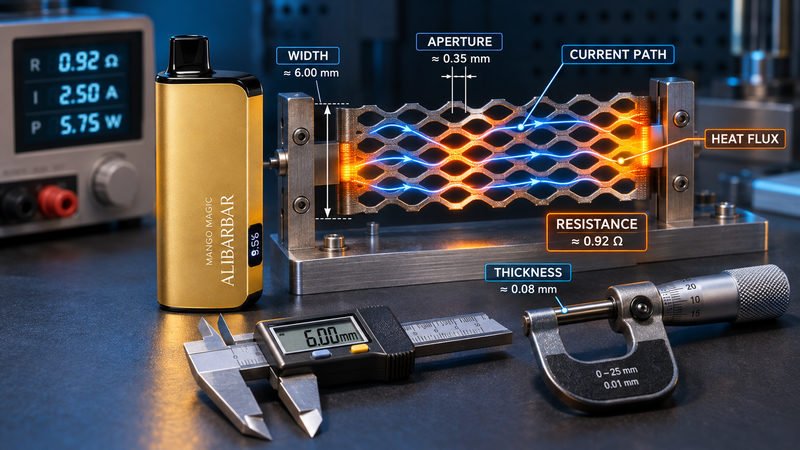
Temperature also changes resistance. Specifically, metals show a characteristic temperature coefficient, which describes that change during heating. Stainless steel usually changes enough for compatible devices to estimate coil temperature. Kanthal changes less, so most devices do not use it for temperature control.
Contact resistance appears where the mesh joins terminals and where the coil connects with the device. Clean, secure contacts keep this contribution small and stable. Conversely, liquid contamination, loose installation, or worn contacts can cause fluctuating readings. A resistance value that jumps unexpectedly deserves immediate attention.
Parallel Paths and Current Density
Current divides among the mesh’s interconnected conductive paths. Wider sections can carry more current with lower local resistance. Meanwhile, narrow bridges experience greater current density when carrying a similar share of current. Greater current density can create higher local heat flux.
Designers use repeating openings to distribute current across the element. For example, diamond-shaped apertures can create many linked paths from one terminal to another. Moreover, strand width and opening size help tune total resistance. A precise pattern promotes predictable heating across the wick-contact area.
A defect can disrupt that balance. If one bridge bends, cracks, or becomes contaminated, current may shift toward surrounding paths. As a result, nearby sections can heat more intensely. This effect helps explain why damaged mesh should not remain in service.
Resistance Does Not Define Wattage Alone
Ohm’s law links voltage, current, and resistance. Electrical power can also be calculated from those quantities. For instance, a regulated device adjusts voltage to reach the selected wattage. However, the coil’s safe range still depends on its wick, housing, geometry, and airflow.
Consider two coils rated at 0.15 ohms. One may recommend 60 to 75 watts, while another may recommend 40 to 55 watts. Their resistance matches, yet their surface area and liquid supply differ. Therefore, never transfer a wattage setting based only on resistance.
Resistance ratings also include manufacturing tolerances. A coil marked 0.20 ohms might display a nearby value after installation. Additionally, room temperature, device accuracy, and contact cleanliness affect the reading. Large or unstable differences may indicate incompatibility, damage, or a poor connection.
Temperature changes further complicate comparisons. A cold reading provides the baseline for many regulated devices. Therefore, install and identify a compatible coil while it remains near room temperature. Never accept a new baseline while the element is still hot.
- Material resistivity and temperature coefficient
- Effective length of the interconnected current paths
- Thickness and width of each conductive bridge
- Opening size, pattern, and overall element dimensions
- Terminal and device contact resistance
- Operating temperature and manufacturing tolerance
4. Surface Area, Ramp-Up Time, and Vaping Performance
Broad Contact and Low Thermal Mass
A curved mesh element can contact a wide band of cotton. Conventional wire touches the wick along narrower lines around each turn. In contrast, mesh spreads energy across many connected metal sections. Therefore, it can vaporize liquid over a broader area during each puff.
Mesh elements also use relatively thin metal. Their low thermal mass allows temperature to rise quickly after activation. Moreover, the element cools quickly when power stops and airflow continues. This response can reduce the delay between pressing the button and producing vapor.
Fast ramp-up does not mean every mesh coil needs extreme wattage. A larger surface can distribute moderate power effectively. In fact, excessive power can overwhelm liquid delivery despite the broad contact area. The printed operating range remains the best starting reference.
Flavor, Vapor, and Airflow
Uniform heating can vaporize e-liquid consistently across the saturated wick. As a result, flavor may remain stable throughout a normal puff. Localized hot spots create the opposite effect. They can overheat one area while another produces little vapor.
Greater active surface area can increase vapor output when the wick supplies enough liquid. However, that vapor requires adequate airflow. Air cools the element, carries aerosol from the chamber, and shapes draw temperature. Restricted airflow at high power can make vapor uncomfortably hot.
For instance, a coil operating comfortably at 45 watts may feel much hotter after closing airflow significantly. The electrical power has not changed, but cooling has decreased. Therefore, users should balance airflow with the manufacturer’s recommended wattage. Airflow should also remain free from condensation or obstruction.
Flavor consistency depends on more than mesh geometry. Liquid composition, wick condition, chamber design, and user technique also matter. Moreover, long puffs deliver more total energy than brief puffs at identical wattage. Chain vaping can raise the system’s starting temperature before each activation.
- Broad wick contact supports distributed vaporization.
- Low metal mass supports rapid heating and cooling.
- Uniform current paths reduce severe temperature differences.
- Adequate airflow manages temperature and transports vapor.
- Reliable liquid supply prevents dry sections during repeated puffs.
5. Mesh Coil Wicking, Wattage, and Safe Operation
Uniform Wick Contact
Mesh needs firm, even wick contact across its curved inner surface. Any gap can leave a section without enough liquid or cooling. Consequently, that section may overheat before the surrounding area. A small contact problem can create a sharp, burnt taste.
However, excessive compression creates a different problem. Densely packed cotton can restrict capillary flow from the reservoir. The wick may look saturated outside while drying near the hottest surface. Therefore, approved replaceable coils use carefully selected wick density and geometry.
Users should not force, reshape, or rewick a sealed replacement coil. Such changes can damage the mesh, insulators, or terminal connections. Additionally, they can alter liquid flow in unpredictable ways. Replace the complete coil when its integrated wick fails.
Priming and Gradual Power Adjustment
Proper priming allows e-liquid to reach the full wick before heating begins. Apply liquid only where the manufacturer directs, then fill the tank correctly. Moreover, wait for the specified saturation period before firing. Thick liquids or large coils may require more time.
Start near the lower end of the printed wattage range. Take short, gentle puffs and check flavor, temperature, and liquid supply. Then increase power in small steps if needed. This gradual approach helps the wick stabilize without sudden thermal stress.
For example, a coil marked 40 to 60 watts should not begin automatically at 60 watts. Starting around 40 watts gives the fresh wick a gentler first heat cycle. Additionally, a five-watt increase can reveal changes clearly. Stop increasing power when flavor and temperature feel balanced.
Device, Airflow, and Battery Safety
The device must support the coil’s resistance and required power. Regulated devices should recognize the coil without displaying warnings or unstable values. However, safety protections do not replace correct compatibility. Never bypass resistance, temperature, short-circuit, or power-limit warnings.
Battery capability must match the device’s electrical demand. Use only the battery type and configuration specified by the device manufacturer. Furthermore, inspect removable battery wraps and insulators regularly. Replace damaged batteries through an appropriate battery supplier or recycling route.
Airflow must remain open enough for the selected power and coil design. Specifically, higher vapor production generally needs greater air movement. Do not fire a mesh coil while its wick lacks liquid. Also, stop using any device that becomes unusually hot outside the normal coil area.
- Confirm the exact coil model and device compatibility.
- Check the printed resistance and recommended wattage range.
- Prime the wick according to the manufacturer’s instructions.
- Allow enough time for complete saturation.
- Begin at the lower end of the recommended range.
- Increase power gradually while monitoring flavor and temperature.
- Maintain suitable airflow and keep liquid above required levels.
- Stop immediately after warnings, unstable readings, or abnormal heat.
Mechanical devices require detailed knowledge of battery current, resistance, and connection safety. This guide does not provide rebuilding or mechanical-device instructions. Therefore, use manufacturer-approved coils with regulated, compatible equipment. Seek qualified guidance whenever product documentation remains unclear.
6. Maintenance, Lifespan, and Mesh Coil Troubleshooting
What Determines Coil Lifespan?
No fixed puff count accurately predicts mesh coil lifespan. Sweeteners and dark flavorings can leave deposits on the heating surface. Moreover, high power accelerates liquid consumption and thermal cycling. Frequent long puffs can also outpace the wick’s resaturation speed.
E-liquid viscosity matters because thicker liquid moves more slowly through some wicks. Airflow and ambient temperature can also affect performance. Additionally, repeatedly running the tank nearly dry exposes the wick to inconsistent saturation. Good habits often extend useful service life.
A lightly sweetened liquid at moderate power may keep a coil usable longer. Conversely, a heavily sweetened liquid can create dark deposits quickly. This difference does not necessarily indicate a defective coil. It often reflects residue accumulation and changing wick permeability.
Approved Maintenance Practices
Keep the tank, chimney, airflow passages, and electrical contacts clean according to product instructions. Remove condensation with suitable lint-free material after disassembly. However, never allow liquid inside the device or battery compartment. Let approved washable tank parts dry fully before reassembly.
Do not scrape, burn, or mechanically clean a sealed mesh element. These actions can tear thin metal or damage its wick. Moreover, dry firing can produce extreme local temperatures without liquid cooling. Replace the coil instead of attempting unsafe restoration.
When changing coils, inspect seals and connection surfaces. A twisted or worn seal can cause leaking around a new coil. Additionally, confirm that the coil seats fully without excessive force. Cross-threading or misalignment can damage both the coil and tank.
Common Symptoms and Responses
A burnt taste usually indicates insufficient saturation, excessive power, poor contact, or a spent wick. Stop firing immediately and let the coil cool. Then check liquid level, airflow, installation, and wattage. Replace the coil if the burnt taste remains after proper resaturation.
Gurgling often suggests excess liquid in the coil chamber. Leaking seals, overfilling, or unsuitable liquid viscosity may contribute. Meanwhile, weak vapor can result from low power, restricted airflow, depleted liquid, or heavy deposits. Check one factor at a time rather than changing everything together.
Fluctuating resistance requires special caution. Remove power, let the coil cool, and inspect its seating and contacts. If readings continue to jump, replace the coil. Furthermore, stop using the device if the problem continues with a verified compatible replacement.
- Burnt flavor: Stop, cool, inspect saturation, and replace a scorched coil.
- Gurgling: Check filling level, seals, condensation, and coil installation.
- Leaking: Inspect seals, tank damage, coil seating, and liquid suitability.
- Weak output: Review power, airflow, deposits, battery charge, and liquid supply.
- Hot vapor: Reduce power, increase suitable airflow, and shorten puff duration.
- Unstable resistance: Stop use and inspect connections before replacing the coil.
7. Choosing a Mesh Coil: Terminology and FAQ
Compatibility Checklist
Begin with the exact coil family approved for your tank or pod. Similar dimensions do not guarantee matching terminals, seals, or airflow channels. Therefore, compare model codes rather than appearance alone. A coil that fits physically may still connect incorrectly.
- Resistance: Confirm that the device supports the printed ohm rating.
- Wattage range: Ensure the device can operate within the recommended range.
- Device power limits: Check maximum output and supported coil resistance.
- Airflow: Match the coil’s vapor output with the available air path.
- E-liquid viscosity: Follow guidance for the coil’s wick openings and liquid type.
- Dimensions: Verify length, diameter, seals, and housing shape.
- Connection type: Match threads, push-fit contacts, or proprietary connectors exactly.
- Temperature control: Confirm both the mesh material and device mode support it.
Essential Mesh Coil Terminology
Resistance measures opposition to electrical current and appears in ohms. Wattage describes electrical power delivered to the coil. Meanwhile, ramp-up describes how quickly the element reaches an effective temperature. These terms interact, but none works as a complete performance rating.
Surface area describes the heating structure available for wick contact and heat transfer. Thermal mass describes how much material must heat and cool. Additionally, current density describes current relative to conductive area. High local current density can create concentrated heating.
Temperature coefficient of resistance describes how resistance changes as metal temperature changes. Compatible devices use this behavior for temperature estimation. However, the device needs the correct material setting. Selecting the wrong mode can produce unreliable control.
Frequently Asked Questions
Are lower-resistance mesh coils always more powerful?
No. Resistance affects electrical requirements, but geometry and recommended wattage also control performance. Therefore, compare complete product specifications rather than choosing the lowest number.
Can any mesh coil use temperature control?
No. Temperature control requires a suitable material and compatible device software. Specifically, supported stainless steel mesh may work, while Kanthal generally does not.
Why does a new coil taste burnt?
The wick may lack complete saturation, or initial power may be too high. Moreover, an incorrect installation can reduce liquid flow. A permanently scorched wick usually requires replacement.
Can a sealed mesh coil be cleaned and reused?
Follow the manufacturer’s instructions only. However, scraping, dry burning, or dismantling sealed coils can damage thin metal and insulation. Replacement offers the safer response to persistent deposits.
Why does resistance change after heating?
Metal resistance naturally changes with temperature. Small predictable movement may be normal for certain materials. Conversely, large or erratic changes can indicate loose contacts or damage.
Does more airflow always improve performance?
Not always. More airflow cools vapor and supports higher heat loads, but excessive airflow can weaken flavor. Therefore, adjust airflow within the product’s intended range.
How often should a mesh coil be replaced?
Replace it when flavor declines, deposits restrict performance, or the wick develops persistent burnt notes. Additionally, replace coils showing damage or unstable resistance. Never wait for complete failure.
Conclusion
Mesh coils use broad, low-mass metal structures to spread heat across a large wick-contact area. Their material and geometry control resistance, ramp-up, and local heat distribution. Moreover, airflow and liquid supply determine whether that heat produces consistent vapor. Every part of the system must remain balanced.
Safe performance depends on firm wick contact, complete saturation, suitable airflow, and power within published limits. Additionally, the device and battery must support the exact coil. Maintenance should follow manufacturer-approved methods only. Replace damaged, scorched, or electrically unstable coils promptly.
Before installation, check the exact coil model, resistance, recommended wattage range, material, and device compatibility. Then prime the wick thoroughly and allow complete saturation. Most importantly, begin at low recommended power and increase it gradually. That careful process supports better flavor, longer service life, and safer operation.
