

How can one small box carry several company names, unfamiliar symbols, and multiple codes without explaining their relationships? KUZ Nova 16000 Puffs: Packaging Symbols and Manufacturer Information becomes clearer when you read the carton panel by panel. However, packaging varies between markets, importers, flavours, and production runs. This guide uses a publicly documented Australian retail example, while marking unseen details as unverified. Therefore, compare every statement with your physical box before assigning a company role or trusting a code.
The documented example clearly shows the KUZ name, NOVA 16000 model family, flavour, and operating claims. However, available retail photography does not reveal every panel at readable resolution. The manufacturer line, origin statement, batch code, barcode, and complete symbol row remain unconfirmed for that example. Consequently, this guide never fills those gaps with assumptions. Instead, it shows exactly how to document and interpret the information printed on your own carton.
1. KUZ Nova 16000 Puffs Packaging Symbols and Manufacturer Details at a Glance
Begin by photographing the entire retail box before opening it. Place the carton on a plain surface under soft, even light. Specifically, capture the front, back, left side, right side, top flap, and bottom flap. Take one full-panel photograph and one close-up of every small label. This process preserves evidence that might disappear when a security seal tears.
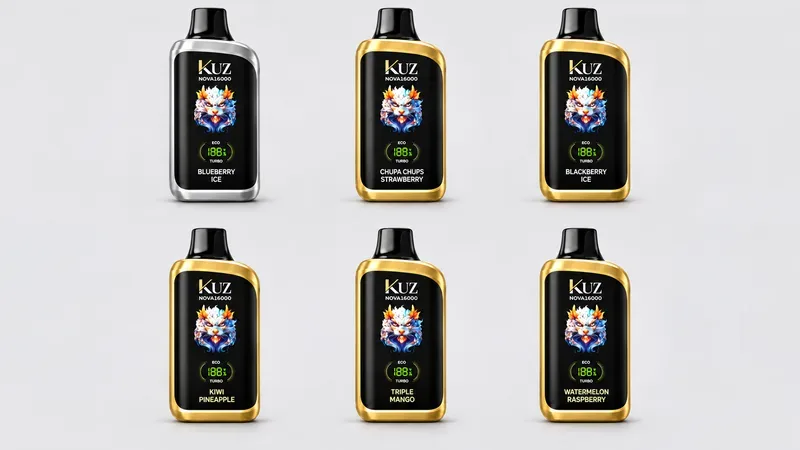
The documented retail example appears in Australian product listings and carries English front-panel wording. However, the carton itself does not establish its intended market within the available photograph. Therefore, record the example as Australian retail listing; packaging market unverified. Its production run and packaging revision also remain unknown. A seller’s location does not prove that the manufacturer prepared that box specifically for the same market.
Next, assign a simple reference to every surface. Call the front “Panel A,” the back “Panel B,” and the two sides “Panels C and D.” Additionally, label the top and bottom flaps “Panel E” and “Panel F.” Use those references in photograph filenames and written notes. For example, “Panel F, lower seam” gives readers a more useful location than “near the bottom.”
- Panel A: KUZ branding, NOVA 16000 name, flavour artwork, and headline performance claims.
- Panel B: Check for warnings, ingredients, specifications, symbols, and business information.
- Panels C and D: Look for nicotine wording, contact details, barcodes, and legal roles.
- Panels E and F: Inspect seals, QR labels, lot codes, dates, and ink-stamped characters.
On the documented front panel, “KUZ” identifies the displayed brand. “NOVA 16000” identifies the product family and advertised puff category. However, neither phrase automatically names the legal manufacturer. A manufacturer should appear beside direct wording such as “Manufacturer” or “Manufactured by.” Without that wording, the brand and model remain product identifiers only.
2. What the Warning, Recycling, and Battery Disposal Symbols Mean
Warning symbols and nicotine label
Inventory each warning exactly as it appears, including punctuation and capital letters. Do not replace the printed text with a familiar warning from another product. For instance, one market may require a nicotine addiction statement, while another uses different wording. The publicly available front image does not show a complete readable warning. Therefore, no nicotine warning can be quoted reliably from the documented example.

Check for an exclamation mark inside a triangle, an age restriction symbol, or a crossed-out child figure. Additionally, look for pregnancy warnings, poison marks, and “keep out of reach” wording. Record symbols and nearby text together because their meaning may depend on that wording. If an icon has no caption, photograph it closely. Mark it as unidentified until an applicable standard confirms its purpose.
A number inside a crossed circle often communicates an age restriction. However, “18,” “21,” and other numbers reflect different rules or voluntary label choices. Do not describe every circular age mark as a universal legal symbol. Instead, transcribe the number and record the market stated elsewhere on the carton. Furthermore, a missing age symbol does not prove that a product complies with local sales rules.
Nicotine strength also needs careful reading. A percentage, milligrams per millilitre, total milligrams, and ingredient reference describe different measurements. Specifically, never infer nicotine strength merely because an ingredient list mentions benzoic acid. The acid may support a nicotine-salt formulation, but it does not independently establish concentration. Use only an explicit nicotine statement printed on the documented package or device.
Recycling and disposal marks
Recycling marks can apply to different parts of the product. A loop of three arrows may concern the cardboard carton or another packaging material. Meanwhile, a resin code usually identifies a plastic type rather than guaranteeing local recycling. Check whether each symbol sits beside “box,” “paper,” “plastic,” or another material name. Placement alone can suggest a connection, but nearby wording provides stronger evidence.
The familiar “Tidyman” figure asks users to dispose of packaging responsibly. However, it does not prove that the material belongs in a recycling bin. Likewise, a Mobius loop may indicate recyclability or recycled content, depending on its accompanying number and wording. Therefore, copy the complete mark before explaining it. Local collection services ultimately decide which packaging materials they accept.
A crossed-out wheeled bin normally tells users not to place electrical equipment with unsorted household waste. Specifically, it concerns the electronic device rather than an ordinary paper carton. A bar beneath the bin can carry a separate regulatory meaning in certain markets. However, do not claim European compliance solely because that icon appears. Counterfeit or broadly distributed packaging can reproduce familiar marks.
The KUZ Nova contains electronic components and a battery, so ordinary litter disposal creates fire and environmental risks. Moreover, damaged lithium batteries can ignite inside collection vehicles or sorting equipment. Keep the used device intact, dry, and away from heat. Do not puncture, crush, or dismantle it to remove the cell. Follow a local battery or electronic-waste program that accepts vaping devices.
Australian readers can review national information about responsible battery recovery through the Australian Government’s battery stewardship guidance. However, acceptance rules differ among collection points. Contact the program before bringing a sealed device containing liquid. Most importantly, never place the device in household recycling unless local guidance expressly permits it.
3. Who Is Listed as the Manufacturer, Importer, or Distributor?
Manufacturer name and contact details
Find the line that explicitly assigns manufacturing responsibility. Strong examples include “Manufactured by,” “Manufacturer,” or an equivalent phrase in another language. Then transcribe the company name, street address, city, postal code, country, telephone number, email, and website. Preserve spelling and punctuation exactly. Additionally, note the panel and line position beside your transcription.
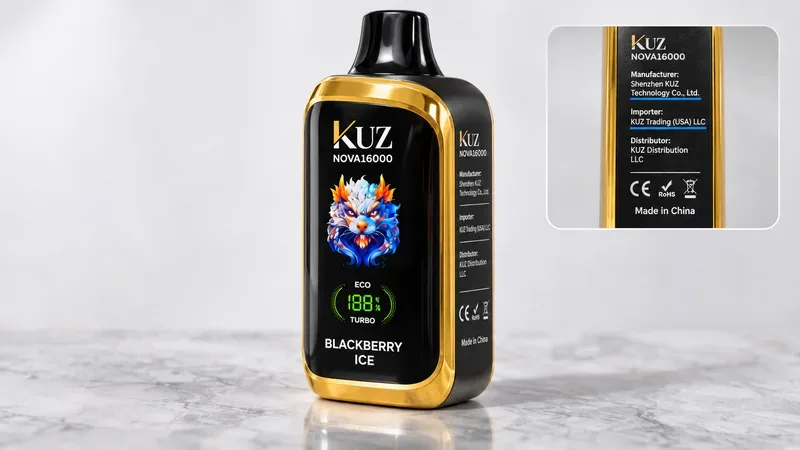
For the documented retail example, available front-panel photography does not expose a readable manufacturer statement. Therefore, the manufacturer’s legal name, address, and direct contact details remain unverified. The large KUZ logo cannot fill that gap. A brand may belong to a manufacturer, brand owner, licensee, or marketing business. Consequently, describing “KUZ” alone as the manufacturer would exceed the visible evidence.
Use a structured record when inspecting your own box. For example, write “Panel D, lines 4–6: Manufacturer: [exact wording].” Additionally, photograph the text straight-on and without flash glare. Small letters often become readable after enlarging a sharp image. If part of the address remains hidden beneath a seal, write “[obscured by seal]” instead of guessing the missing characters.
Contact details deserve the same caution. A web address printed near a logo might serve marketing or product verification. However, it may not belong to the legal manufacturer. Likewise, a customer-service email can belong to an importer or retailer. Assign the contact only when layout or explicit wording connects it to a named business. Leave uncertain relationships unassigned in your notes.
Brand owner, importer, and distributor
List every additional business on a separate line. Include the exact introductory phrase and panel location. Specifically, distinguish “manufactured for” from “manufactured by.” The former usually names the party commissioning or owning the marketed product. The latter directly identifies the stated maker. However, local law can define responsibilities differently, so the carton wording remains your starting evidence.
- “Manufactured by”: attributes production to the named company.
- “Manufactured for”: names the commissioning party, not necessarily the factory operator.
- “Imported by”: identifies the business bringing the product into the stated market.
- “Distributed by”: identifies a supply-chain business, not automatically the maker.
- “Marketed by”: assigns a promotional role without proving manufacturing responsibility.
A distributor’s website may describe itself as “official,” but that claim requires independent confirmation. Moreover, a retailer appearing on a shipping label does not become the product importer. Treat outer shipping materials separately from the factory retail carton. Record stickers that cover original text because they may add market-specific importer details. However, note clearly that the information came from an applied label.
The available Australian retail example shows the KUZ brand but no readable role statement in the documented front view. Consequently, no manufacturer, importer, distributor, or brand owner can be conclusively named from that image. A retailer’s product page also cannot replace the box transcription. If your carton lists only a company name, logo, or address, preserve the text while leaving its role unassigned.
4. Where to Find the Country of Origin, Model, and Batch Number
Country of origin and model identifier
Country information often appears in the smallest legal text. Check both side panels, the back-panel footer, and each end flap. Look for phrases such as “Made in,” “Manufactured in,” or “Country of origin.” Transcribe the complete phrase because a company address does not necessarily identify the production country. Likewise, a barcode prefix does not reliably establish where manufacturing occurred.
No readable country-of-origin statement appears in the available front view of the documented example. Therefore, its production country remains unverified for this guide. Do not substitute a seller’s location, website domain, or assumed factory country. If your box says “Made in China,” record that exact phrase and its panel. However, apply that finding only to the inspected packaging version.
Separate the branded name from any formal model identifier. “KUZ” functions as the visible brand, while “NOVA 16000” names the displayed product family. A separate code may appear beside “Model,” “Type,” “Item,” or “SKU.” For example, an online listing may use a stock code for its own catalogue. That seller-created code does not become the carton’s model number unless the package prints it.
Batch or lot code
Inspect the carton under angled light because ink-stamped codes can appear faint or glossy. Specifically, check the top flap, bottom flap, glued seam, barcode area, and security sticker. A batch identifier may begin with “LOT,” “Batch,” “B,” or another prefix. However, manufacturers use different formats. Photograph the code in context before opening the flap or scratching a verification panel.
The documented public front image does not reveal a readable batch or lot code. Therefore, this guide cannot provide a genuine sample code from that particular box. It also cannot confirm whether the code sits on an end flap or another panel. This limitation matters because fabricated examples can mislead readers. Your physical carton remains the controlling source for its own production identifiers.
Placement and labels help separate similar strings. A code beside “LOT” provides stronger batch evidence than an unexplained number near the barcode. Meanwhile, a date may follow a recognizable year-month-day pattern. A model identifier usually repeats across many boxes, while a lot code commonly groups a production run. An individual security code may change on every unit.
Do not decode prefixes without supporting documentation. For instance, “B” could mean batch, a production line, a colour, or something else. Additionally, numbers resembling dates may use a factory sequence instead. Record the characters exactly, including spaces, hyphens, and leading zeros. If carton and device codes differ, photograph both. Then ask the explicitly named manufacturer or importer to explain their relationship.
5. What the QR Code and Barcode Can Tell You About Authenticity
Identify what each code does
A box may contain a QR code, a linear barcode, and a scratch-covered security code. Each can serve a different purpose. The QR code may open a verification page, product page, campaign, or customer-service site. Meanwhile, the barcode may identify a product variation for retail systems. Neither code automatically provides a batch number or individual-device identity.
Before scanning, photograph the complete code and nearby wording. Then use a scanner that previews the destination address before opening it. Specifically, check the spelling of the host name and watch for added characters or unusual subdomains. Allow the page to finish redirecting. Record both the first address and final domain, since a shortened link can hide its destination.
Public retail descriptions report a scratch-and-scan security label on some KUZ Nova boxes. However, the available evidence does not expose a specific code for independent testing. Therefore, no final verification domain or page result can be confirmed for the documented example. Treat any domain printed on your box as unverified until you inspect its address, security certificate, and ownership information.
A barcode scanner may return a GTIN, EAN, UPC, or seller database match. However, a database result can reflect information submitted by a retailer rather than the brand owner. Compare the returned brand, model, flavour, and package size with the carton. If no record appears, report “no confirmed match.” Do not interpret absence alone as proof of counterfeiting.
- QR destination: Record the final domain and page purpose.
- Security code: Note whether the page accepts a unique printed value.
- Barcode result: Save the identifier and matching product description.
- Redirect behaviour: Record warnings, errors, or unexpected domains.
Interpret an authenticity result
A verification page may say that a code is valid, invalid, or previously checked. Read the result literally. A valid response usually confirms that the submitted value exists in that verification system. However, it may not prove where the physical device was made. The result becomes stronger when a concealed, unit-specific code matches another identifier on the device.
A “first scan” message can add useful context, but it still needs caution. Printed codes, QR artwork, and complete boxes can be copied. Furthermore, counterfeiters can direct customers to imitation verification pages. Compare the final domain with a domain printed beside an independently identified manufacturer contact. Avoid trusting a site merely because its design looks polished.
If the same security code reports many previous scans, save a screenshot showing the date and result. Additionally, photograph the carton seal, device markings, flavour name, and lot code. Contact the company explicitly labelled as manufacturer or importer. Send clear images rather than typing only the disputed number. This evidence helps the business compare packaging, production, and distribution records.
If the box provides no independently attributable contact, the mismatch may remain unresolved. A retailer can explain its supplier chain, but that explanation differs from manufacturer confirmation. Therefore, state the conclusion narrowly: “The code did not verify through the scanned destination.” Do not claim the device is counterfeit without additional evidence. Most importantly, stop using any device that leaks, overheats, or appears damaged.
6. Why Two KUZ Nova 16000 Puffs Boxes May Have Different Labels
Compare documented examples
Two boxes can look similar on the front while differing elsewhere. One may carry an importer sticker, while another prints company details directly on the carton. Additionally, warning language, age marks, disposal symbols, flavour spelling, and code placement can change. Compare matching panels rather than placing one box front beside another box back. This method prevents false differences caused by incomplete documentation.
Start with a comparison table in your notes, although the published evidence should remain photograph-led. Record Panel A against Panel A, then repeat the process through Panel F. Specifically, compare wording letter by letter. A changed font or colour matters less than a changed company name, warning, origin statement, or verification domain. Photograph seals before disturbing them.
- Identity: Brand, product family, model code, flavour, and stated puff modes.
- Safety: Nicotine wording, age marking, warning icons, and disposal instructions.
- Businesses: Manufacturer, brand owner, importer, distributor, and their contacts.
- Traceability: Origin statement, lot code, dates, barcode, and security code.
- Construction: Seal type, sticker position, print quality, and carton dimensions.
Only one partially documented retail box supports this guide. Its public front image confirms the visible KUZ and NOVA 16000 presentation. However, it does not provide readable photographs of every legal panel. Therefore, no reliable second-box comparison can establish a packaging change, distributor variant, or market revision here. Readers should treat the example as a documentation method, not a universal label template.
Explain what the evidence supports
Market requirements can produce different warnings, language, importer details, and disposal marks. Furthermore, a packaging revision can move codes or change product artwork. A local distributor may also apply an additional label. Yet these remain possible explanations until dated examples or company records connect each variation to a particular market or production run.
A difference does not automatically prove that one box is counterfeit. Conversely, close visual similarity does not prove authenticity. Examine the complete evidence set, including seals, exact legal wording, code behaviour, and seller records. Additionally, compare the device markings with the carton. A genuine package and an unrelated device can sometimes become paired after opening or resale.
Flavour versions may also use different colours and fruit images while retaining the same legal information. However, do not assume every difference comes from flavour artwork. Check whether the model code, nicotine statement, operating claims, and company roles remain consistent. If one box names an importer and another does not, record that fact. Avoid assigning a reason without supporting documentation.
The strongest comparison uses two physical boxes photographed under similar lighting. Ideally, each record includes purchase market, seller, purchase date, flavour, and unopened seals. Moreover, retain receipts without publishing personal information. These details establish provenance without pretending to prove manufacturing history. When evidence stops, the conclusion should stop too.
Conclusion
Start with the symbol row, then locate each named business and its exact role wording. Next, inspect the side panels and end flaps for origin, model, batch, QR, and barcode details. Packaging can support an authenticity check, but copied artwork limits what a visual match proves. Therefore, photograph every label panel on your box. Record the lot code and wording beside each company name, then compare those details with the documented example.
