
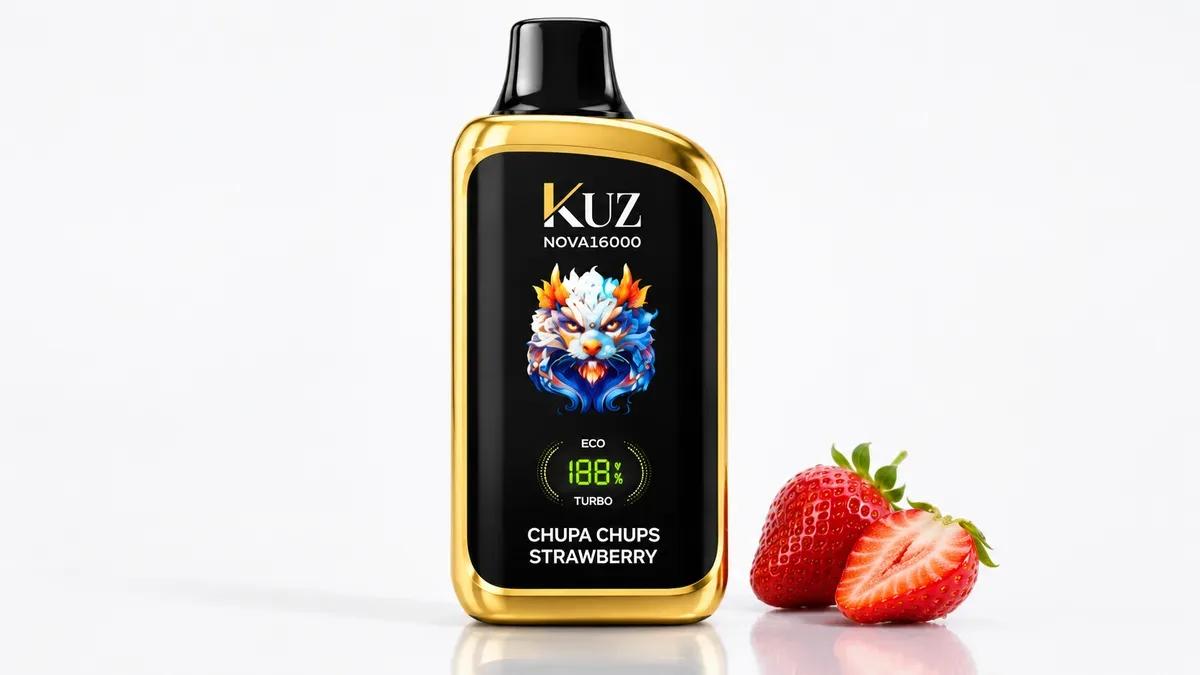
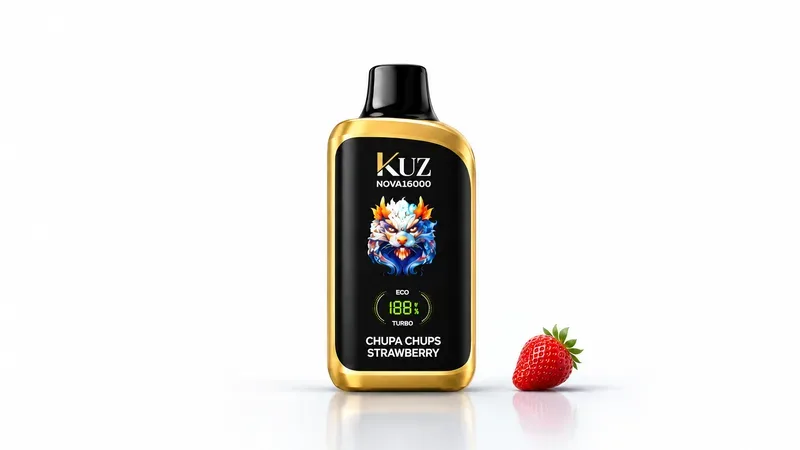
What does a label reveal when it mixes a device name, 16,000 puffs, and a famous strawberry lollipop? KUZ Nova 16000 Puffs Chupa Chups Strawberry: Confectionery-Inspired Product Naming combines four different pieces of information. KUZ identifies the vape brand, while Nova names the product line. Meanwhile, 16000 Puffs states an advertised capacity, and Chupa Chups Strawberry identifies the listed flavor.
However, the wording does not answer every reasonable question. The candy reference suggests a sweet strawberry-lollipop profile, but it does not prove identical ingredients or taste. Likewise, the five-digit count does not predict an exact ownership period. Most importantly, using a familiar name does not automatically establish a license or partnership.
Therefore, readers should separate what the label says from what they might infer. That means examining the flavor wording, the puff-testing conditions, and any evidence from the rights holder. Those checks produce a clearer and more defensible interpretation.
1. What Does KUZ Nova 16000 Puffs Chupa Chups Strawberry Mean?
Brand and product line
The easiest approach is to divide the complete name into four parts. Each part performs a different job, even though retailers may present everything as one continuous title. Specifically, the first two parts identify the product family. The remaining terms describe capacity and flavor.
| Label element | Meaning | What it establishes |
|---|---|---|
| KUZ | Vape brand | Identifies the brand shown on the listing |
| Nova | Product line | Places the device within the Nova family |
| 16000 Puffs | Advertised puff count | States the promoted maximum capacity |
| Chupa Chups Strawberry | Flavor designation | Signals a strawberry confectionery association |
The KUZ Nova product page displays “KUZ NOVA 16000” as the main model name. It also groups the item within a Nova 16000 product category. Therefore, KUZ and Nova function as stable family identifiers across different flavor selections.
For instance, imagine a shelf containing ten Nova devices with different flavor labels. “KUZ Nova” helps a shopper recognize that they belong to the same broader range. However, that shared family name does not mean every variant has identical flavoring. The final flavor wording distinguishes one selection from another.
Puff claim and flavor designation
“16000 Puffs” communicates a stated device count rather than a laboratory guarantee for every user. In fact, the KUZ page qualifies the figure with “up to” language. It lists up to 16,000 puffs in Eco mode and 12,000 in Turbo mode. Therefore, operating mode already changes the promoted figure by 4,000 draws.
“Chupa Chups Strawberry” works as the variant’s displayed flavor designation. A retailer listing uses the full title “KUZ Nova 16000 Puffs Chupa Chups Strawberry.” Its specifications separately identify “KUZ Nova 16000” as the product name. Additionally, they identify “Chupa Chups Strawberry” as the flavor.
The official product page arranges the core model wording as “KUZ NOVA 16000.” Meanwhile, the retailer places “Puffs” after the number and adds the flavor afterward. Both structures point toward the same named model and variant. However, matching titles alone cannot verify manufacturing details or trademark authorization.
Word order can change because stores build titles for their own catalog systems. One shop may lead with the model, while another may emphasize capacity or flavor. As a result, readers should compare the individual elements instead of demanding an identical title. This method also helps separate a genuine specification from extra promotional language.
2. What Flavor Does the Chupa Chups Strawberry Reference Suggest?
The strawberry lollipop association
“Strawberry” alone normally suggests a recognizable red-fruit profile. Adding “lollipop” would shift that expectation toward cooked sugar, candy sweetness, and a smoother fruit impression. A named confectionery reference makes the association even more specific. Consequently, many readers will expect strawberry candy rather than fresh berries.
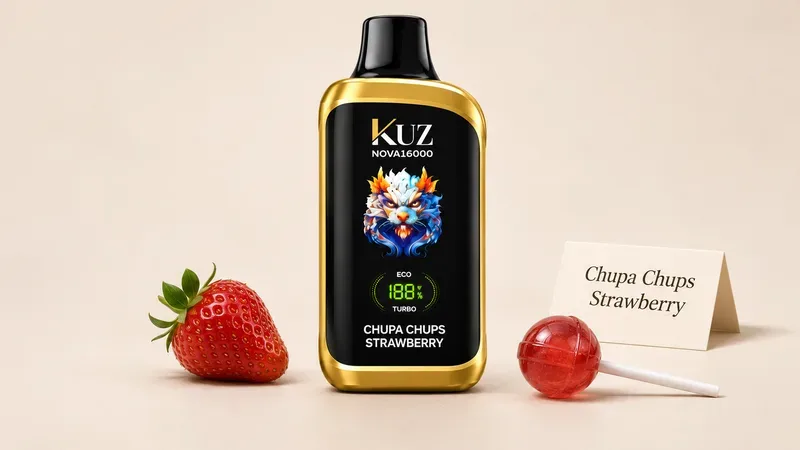
The official Chupa Chups product catalog places the brand within lollipop and confectionery categories. Moreover, a Perfetti Van Melle announcement identifies strawberry among its lollipop flavors. These sources support the underlying strawberry-lollipop association. They do not describe the formula inside the KUZ device.
Consider the difference between biting a fresh strawberry and tasting strawberry hard candy. The fruit may seem tart, juicy, and slightly floral. On the other hand, candy usually emphasizes sweetness and a simplified fruit note. Therefore, the vape name encourages the second expectation without scientifically proving it.
That distinction matters because expected taste remains an interpretation. A reader may imagine creaminess, syrup, or a sugary finish based on personal memories. However, another reader may associate the name with a brighter or sharper strawberry note. A familiar label creates a reference point, not a universal sensory result.
What the vape listings establish
The KUZ product page establishes the model and presents a selectable flavor range. Meanwhile, the retailer explicitly displays “Chupa Chups Strawberry” in its title and flavor specification. The retailer also describes the variant as sweet, candy-inspired, fruity, and sugary. Those extra sensory claims belong to that retailer’s description.
In fact, readers should keep three different questions separate. First, what flavor name appears on the listing? Second, what does the seller say the vapor tastes like? Third, what ingredients or formulation evidence supports that description?
- Displayed name: The listing uses “Chupa Chups Strawberry” as the flavor wording.
- Sensory description: The retailer describes sweetness, strawberry character, and a candy-inspired finish.
- Formula evidence: The reviewed pages do not provide a complete ingredient comparison with the confectionery.
Therefore, the name supports an expected sweet strawberry-lollipop direction. It does not establish that the device recreates a particular confectionery recipe. Furthermore, taste depends on formulation, power, airflow, and individual perception. Direct chemical or formulation evidence would be necessary for a stronger equivalence claim.
The careful conclusion is simple. The wording suggests a confectionery-style strawberry flavor, while the retailer supplies a more detailed promotional description. However, neither point independently confirms identical ingredients or an exact taste match. Readers should treat those stronger ideas as unverified unless documentation supports them.
3. Is There an Official Chupa Chups Affiliation?
What the public wording supports
The available listings establish one clear fact: the familiar confectionery name appears within the vape flavor designation. They also show how sellers present the product to shoppers. However, those facts do not independently prove a commercial partnership. The reviewed sources leave an official KUZ affiliation with Chupa Chups unverified.
Repeated listings may make the wording look established across the market. Likewise, package photographs can show that a name or visual element appears on a product. Similar descriptions can also reveal that retailers copied or standardized catalog information. Nevertheless, repetition does not confirm permission from a trademark owner.
A useful comparison comes from Perfetti Van Melle’s Chupa Chups announcement. It directly names the company, the product, its flavors, and its intended market. Moreover, it explains Perfetti Van Melle’s role in manufacturing and marketing the brand. That is the kind of attributable statement missing from the reviewed vape listings.
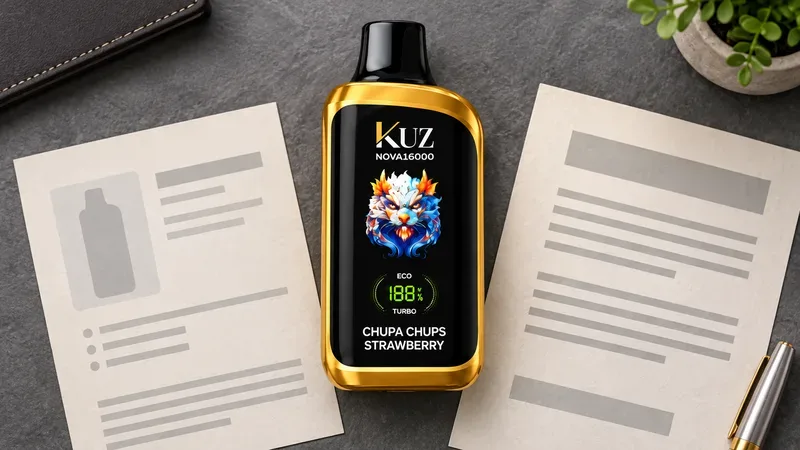
Packaging imagery also has strict evidentiary limits. It may demonstrate how the seller photographed or represented the item at one moment. However, an image cannot explain the underlying legal arrangement. It also cannot show whether authorization applies across every country, seller, or product version.
Therefore, writers should avoid turning presentation into proof of endorsement. A defensible sentence would say the device is listed under the “Chupa Chups Strawberry” flavor name. An unsupported sentence would call it an official collaboration without further evidence. That small wording change prevents a large factual leap.
Evidence that could confirm a license
A confirmed license normally requires documentation that connects both businesses. Ideally, a rights-holder announcement would name KUZ and identify the relevant product category. A public licensing disclosure could provide similar support. Furthermore, packaging may include formal ownership or licensed-use language that researchers can verify.
Readers should look for several precise details:
- A statement from Chupa Chups, Perfetti Van Melle, KUZ, or an identified licensing representative.
- The names of both parties and a clear description of their commercial relationship.
- A reference to vaping devices, flavor branding, or the specific Nova product range.
- The countries, sales channels, or territories covered by the authorization.
- The relevant product version and, where stated, the agreement’s effective period.
Market coverage matters because licensing rights can differ between territories. For instance, permission for confectionery merchandise in one country may not cover vaping products elsewhere. Additionally, authorization for apparel or accessories would not automatically cover an inhaled device. The documentation must match the product category and market under discussion.
Timing also deserves attention. A statement may cover an earlier campaign but not a later product revision. Similarly, an expired agreement may not explain current packaging. Therefore, researchers should check dates, model names, and territorial language before describing an affiliation as official.
If the available trail ends with flavor wording, retailer pages, and package images, the status remains unverified. That conclusion does not prove that no agreement exists. Instead, it accurately describes the limits of the reviewed public evidence. Most importantly, it leaves room for stronger documentation to change the assessment.
4. What Does the 16000 Puffs Claim Mean in Practice?
How the stated count is presented
The number 16,000 is an advertised puff count attached to the device. It should not be read as a personal-use forecast or guaranteed minimum. Specifically, the KUZ page describes “up to” 16,000 puffs in Eco mode. The retailer gives the same Eco figure and lists up to 12,000 in Turbo mode.
A second retailer’s KUZ Nova mode specifications also presents mode-dependent figures. Therefore, the headline count represents the higher-capacity operating scenario. Turbo mode lowers the stated maximum while promising stronger output. That trade-off makes power mode essential context.
Suppose one person takes one-second draws, while another takes four-second draws. Counting both actions as one puff hides a substantial difference in operating time. Moreover, a stronger draw can move more air through the device. Those differences can change liquid use, battery demand, and aerosol production.
A meaningful test report should describe at least five conditions:
- Puff duration: How many seconds does each machine draw last?
- Airflow or puff volume: How much air moves through the device?
- Draw interval: How long does the machine wait between puffs?
- Operating mode: Does the test use Eco, Turbo, or another setting?
- Stopping rule: Does counting end with low aerosol, empty liquid, or battery failure?
The laboratory study of disposable electronic cigarettes illustrates why those details matter. Researchers used a mechanical system and controlled the puffing procedure. They also developed depletion criteria for the tested products. However, that investigation examined five older disposable products, not the KUZ Nova 16000.
Consequently, the study supplies a methodological lesson rather than a KUZ verification. A count gains meaning only when the test defines a puff and an endpoint. Without those conditions, readers cannot reproduce or fairly compare the result. The headline number remains a manufacturer or seller claim.
Why actual puff counts can vary
Draw duration directly affects the coil’s active time. A longer draw generally keeps the heating system working longer than a short draw. As a result, it can consume more energy and liquid per counted puff. Power mode can intensify that effect by increasing output.
Airflow adds another variable. A gentle draw and a forceful draw may activate the device differently or produce different aerosol volumes. Furthermore, device resistance and sensor behavior can shape the effort needed for activation. Users rarely reproduce one exact draw thousands of times.
The study of user puffing behavior measured Blu Cigs and V2 Cigs during controlled sessions. It found nine usage patterns among 20 participants. Average puff duration reached 2.65 seconds, while the average interval reached 17.9 seconds. Notably, individual behavior varied even within that small sample.
Those devices were cartridge-style products, not this KUZ model. Therefore, their numerical results should not predict KUZ Nova performance. Instead, they demonstrate that users differ in duration, flow, volume, and timing. Any universal puff estimate must simplify those human differences.
A separate disposable-device performance study tested nine older electronic cigarette and electronic hookah products. Researchers used 4.3-second machine puffs at one-minute intervals. They tested BluCig, NJOY King, Square 82, V2 Cig, and five electronic hookah brands. Again, the KUZ Nova was not among them.
That study found performance differences between button-activated and airflow-activated devices. It also reported variation within some models and found that battery life limited puff counts. Moreover, none of its tested products reached the advertised puff number. These findings offer caution, but they do not establish the KUZ Nova’s actual count.
Modern hardware may differ greatly from those earlier devices. The Nova listing describes dual modes, a rechargeable battery, and a dual-mesh coil. However, newer design features do not remove the need for transparent testing. Each model requires its own reproducible evaluation.
Imagine two users taking 300 draws each day. One uses short Eco draws, while the other takes longer Turbo draws. Although their counters may record equal puffs, their liquid and battery consumption can differ. Therefore, dividing 16,000 by daily draws provides only a rough scenario, not a dependable lifespan.
The practical reading is straightforward. Treat 16,000 as an advertised upper figure associated with Eco mode. Then look for the test protocol before comparing it with another device. Most importantly, expect personal results to vary with draw style, settings, device condition, and the chosen endpoint.
5. Why Vape Product Names Use Familiar Confectionery References
A familiar name communicates a flavor expectation
Flavor names work like compressed descriptions. The word “strawberry” supplies a broad fruit cue but leaves sweetness and texture open. “Strawberry lollipop” adds a confectionery format and stronger sweetness expectation. Meanwhile, a named candy reference may trigger memories of a particular childhood taste.
For instance, “strawberry” could suggest fresh fruit, jam, milkshake, or sour candy. Adding “lollipop” narrows the mental picture toward hard candy and concentrated sweetness. A recognized confectionery name narrows it further through branding and personal experience. However, those associations still occur in the reader’s mind.
This naming technique helps shoppers imagine an unfamiliar flavor quickly. Additionally, it gives retailers an easy vocabulary for describing sweetness and nostalgia. Yet the efficiency of that wording creates a risk. Readers may infer more precision than the listing actually substantiates.
The three naming levels communicate different amounts of information:
- Strawberry: A broad fruit expectation with no defined candy character.
- Strawberry lollipop: A sweet, confectionery interpretation of the fruit.
- A named confectionery reference: A stronger memory cue that may also imply brand involvement.
Familiar wording can imply a relationship
The KUZ Nova example shows how quickly flavor communication can resemble a collaboration claim. A shopper may assume endorsement because the recognizable name appears directly beside the model. Another may expect a shared recipe or officially supplied flavor formula. However, the listing itself does not verify those conclusions.
Packaging can strengthen the impression when it repeats familiar colors, lettering, or candy imagery. Furthermore, multiple retailers may use identical descriptions. Those details demonstrate consistent presentation, but they cannot reveal contractual permission. Only suitable documentation can bridge that evidentiary gap.
Readers can apply three questions whenever a product borrows familiar confectionery wording:
- What does the wording suggest? Identify the fruit, candy format, sweetness, and emotional associations.
- What does the listing substantiate? Separate the printed name and specifications from promotional taste descriptions.
- What would confirm a connection? Seek a rights-holder statement, licensing disclosure, or equivalent documentation naming both parties.
This framework keeps interpretation useful without overstating the evidence. It allows readers to say that a name evokes strawberry lollipops. Meanwhile, it prevents an unsupported jump to endorsement or recipe equivalence. As a result, product descriptions become clearer and easier to verify.
Most importantly, familiar wording should prompt curiosity rather than certainty. Ask what the seller directly shows, what the manufacturer claims, and what the rights holder confirms. If those sources answer different questions, report each answer separately. That approach works for candy, beverage, dessert, and other recognizable flavor references.
Conclusion
KUZ Nova 16000 Puffs Chupa Chups Strawberry contains four readable elements. KUZ names the vape brand, Nova identifies the range, 16000 Puffs states an advertised maximum, and the final words designate the flavor. Moreover, the candy reference suggests a sweet strawberry-lollipop profile, but it does not prove identical taste or ingredients.
Actual puff totals can vary with draw duration, airflow, intervals, operating mode, and the test’s stopping rule. Therefore, 16,000 should not become a guaranteed personal result. Likewise, familiar wording and repeated listings do not confirm a license. A rights-holder statement or comparable disclosure must identify KUZ, the product category, and the relevant market.
When checking a listing, record the exact flavor wording. Additionally, look for a mode and testing conditions beside the puff count. Finally, check for a rights-holder statement before citing any official affiliation.
