

What can you confidently learn from “Blackberry Ice” and “16000 Puffs” before turning the box over? The label for KUZ Nova 16000 Puffs Blackberry Ice: Berry and Cooling Flavour Labelling offers a useful starting point. It names a berry flavour, signals cooling, and presents an advertised puff count. However, you’ll need more information to establish the flavour’s intensity, the liquid’s ingredients, or the device’s actual performance.
KUZ Nova 16000 Puffs Blackberry Ice Label Meaning
Read the product name in three parts. KUZ Nova identifies the product line, while Blackberry Ice identifies the flavour variant. Meanwhile, 16000 Puffs presents the advertised usage figure associated with the device. Each part answers a different question, so it helps to consider each one separately.

- KUZ Nova tells you which product line to look for when comparing the box with documentation.
- Blackberry Ice tells you the named flavour and gives you a broad clue about the intended sensation.
- 16000 Puffs tells you the advertised count to look for when checking the device’s performance information.
For instance, imagine two KUZ Nova boxes with the same puff figure and different flavour names. The flavour wording helps you tell those variants apart, even when the product line looks identical. Likewise, two boxes can share the words “Blackberry Ice” while carrying different model names. The full wording gives you a better starting point for finding the specifications that apply.
Read the display wording alongside the specifications
The front panel puts the model, flavour, and puff figure where you can see them quickly. However, a side panel or leaflet may give a more precise description of the same claim. For example, the number on the front might appear alongside “up to” elsewhere. That qualification matters because it changes how you should interpret the number.
Similarly, a flavour name gives you the manufacturer’s description of the intended sensory profile. A separate ingredient statement serves a different purpose and can name substances the flavour description leaves unspecified. Meanwhile, technical information may tell you which setting the puff claim applies to. Check the wording and scope of each disclosure as you read it.
If you’re comparing information online, start by matching the complete model name and the flavour printed on your box. Then check any version or market identifiers you can find on the packaging. A listing that matches only “KUZ Nova” may cover several variants or package versions. Therefore, use the front wording to identify your product before using a listing to interpret its specifications.
What Flavour Does Blackberry Ice Describe?
“Blackberry Ice” describes a blackberry-named berry flavour with an intended cooling sensation. The blackberry part gives you the flavour reference, and the ice part adds a sensory cue. However, the wording leaves plenty of room for interpretation. It gives no sweetness rating or indication of how the berry and cooling sensations balance.

For instance, one person might associate blackberry with a tart bite from fresh fruit. Someone else might picture a sweet blackberry cordial or a boiled sweet. Both associations come from familiar foods, and each creates a different expectation. Yet the flavour name alone gives you no basis for choosing among those profiles.
What the berry name leaves open
A more detailed tasting description might discuss sweetness, tartness, or a ripe fruit character. It could also describe whether the flavour seems juicy or resembles a blackberry sweet. However, those details require evidence beyond the two words on the front. A manufacturer’s tasting notes can establish its intended description, while an individual review describes that person’s experience.
- Sweetness and tartness. The label gives no indication of which quality, if either, comes through more clearly.
- Ripeness and juiciness. The name gives no clue whether the flavour aims to evoke ripe fruit or a juicy character.
- Fruit or candy character. The name leaves open whether the intended profile resembles fresh berries, confectionery, or another blackberry flavour.
- Cooling intensity. The word “Ice” signals the intended sensation and leaves its strength unspecified.
Likewise, two people can describe the same flavour differently. One might notice the cooling first, while another pays more attention to the berry note. Both accounts can help explain how the product came across to those readers. However, neither account changes what the label itself establishes.
If you’re comparing Blackberry Ice with another berry variant, pay attention to what the names actually distinguish. For example, “Blackberry Ice” and “Blueberry Ice” point to different named berries and share a cooling descriptor. The shared word provides no way to rank which one feels cooler. In practice, the simplest reading remains a blackberry-named flavour with cooling.
What Does Ice Mean on the KUZ Nova Label?
On a vape flavour label, “Ice” ordinarily signals an intended cooling sensation. Here, it modifies the blackberry flavour name and describes part of the intended experience. However, the label gives no scale for the effect. You can read “Ice” as a cooling cue while leaving its strength open.
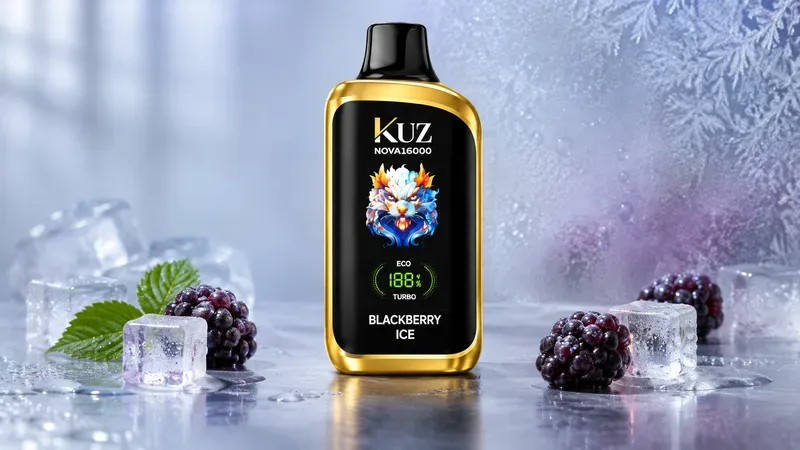
For instance, a reader might expect a light cool finish after noticing the berry flavour. Another might picture a pronounced cooling sensation that dominates each puff. The same word could give rise to either expectation. Meanwhile, the Blackberry Ice name offers no detail about timing, duration, or which sensation comes through first.
How to interpret cooling descriptions
Words such as “mild,” “moderate,” and “strong” add more detail when a product description uses them. However, those adjectives remain qualitative unless the source explains how it rates cooling. For example, a reviewer’s “strong” might mean stronger than the last flavour they tried. A manufacturer’s “strong” might refer to a comparison within its own range.
Similarly, look at what a description actually says about when the sensation appears. “Cool finish” suggests cooling towards the end, while “cool throughout” describes a different intended experience. You would need that extra wording to draw either conclusion about Blackberry Ice. The single word “Ice” leaves both possibilities open.
If you find a cooling description online, first check that it refers to the exact flavour and model. Then note who supplied the description and whether it reports a comparison or a personal impression. For instance, a shop’s description may summarise the flavour in its own words. A manufacturer’s description gives you its stated intention for that variant.
Finally, keep the cooling sensation separate from the chemistry behind it. Cooling strength and ingredient identity are two different questions, so you need different evidence for each. A precise tasting note can tell you more about the intended sensation. To establish what produces that sensation, look for a disclosure that names the substance.
Does Ice Mean Menthol or Reveal the Ingredients?
Menthol can produce a cooling sensation, which explains why some people associate it with the word “Ice.” However, “Ice” describes an intended effect and leaves the substance behind that effect unspecified. The flavour name cannot establish whether this version contains menthol or another cooling agent. To establish either, look for a product-specific disclosure that names the substance.
The same distinction applies to the word “Blackberry.” It names the berry the flavour aims to evoke and leaves the source of that flavour open. For instance, “Blackberry Ice” does not establish that the liquid contains blackberry juice or extract. To confirm either ingredient, look for a statement that identifies it directly.
What counts as an ingredient disclosure?
Start with the exact package and any leaflet that comes with it. Next, look for a manufacturer specification or safety document that clearly identifies the same version. Check the date or revision if the document includes one. This matters when a product line shares a name across different formulations or markets.
- Ingredient list. Look for a named substance and check that the list applies to the Blackberry Ice variant.
- Packaging statement. An explicit statement such as “contains menthol” provides evidence for the specific package that carries it.
- Safety document. Match the product identifier and read the scope of the ingredients or substances it lists.
- Manufacturer specification. Look for a clear statement naming the substance and tying it to the exact model and flavour.
The scope of the disclosure matters as much as the name on the front. For example, a listed category such as “flavourings” tells you the type of ingredient the source discloses. It leaves the individual flavouring substances unspecified. Likewise, a document that lists selected substances may provide only part of the formulation.
Suppose a product page calls the finish “menthol-like,” while the box lists only “flavourings.” The first phrase describes an impression, and the second gives a broad ingredient category. Together, they still leave menthol’s presence unconfirmed. However, a matching manufacturer specification that explicitly lists menthol would support reporting it for that version.
General references can help you understand the difference between a flavour name and an ingredients statement. For example, the CDC’s E-Cigarette, or Vaping, Products Visual Dictionary describes common categories of e-liquid components, including flavourings. Those categories provide background for reading a label. For the contents of this particular product, rely on documentation tied to its exact version.
Most importantly, keep the wording as precise as the evidence. If the supplier discloses a cooling agent by name, you can report that name for the version covered. However, if all you can verify is the flavour wording, the cooling ingredient remains unconfirmed. The same standard applies to any claim about actual blackberry.
What Does the KUZ Nova 16000 Puff Count Mean?
“16000 Puffs” is the advertised or nominal puff count associated with the KUZ Nova model. It reflects the conditions the supplier used to establish the claim. However, the number alone does not tell you how the supplier counted a puff. It also gives no exact total that every user can expect.
For instance, imagine a test that counts one-second draws and someone who regularly takes three-second draws. In both cases, a single draw counts as one puff, although the device operates for different lengths of time. However, that example does not establish a conversion between the two totals. The actual result depends on the device and the conditions of use.
What can change the puff total?
- Puff duration. A longer draw can keep the device operating longer than a shorter draw.
- Puff frequency. Back-to-back draws differ from draws spaced throughout the day, so usage patterns may differ from a test schedule.
- Device settings. If the exact version offers more than one mode, check which setting the advertised count refers to.
- Device conditions. Charge level and the liquid remaining in the device can affect continued operation and when a user stops counting.
Additionally, look for a definition of when the count ends. A test description might specify what the device must deliver for a draw to qualify. It might also explain whether testing continues after recharging, if the version supports that feature. Without that context, two puff figures can describe different test conditions.
Pay attention to qualifiers anywhere the packaging repeats the number. For example, if a leaflet says “up to 16,000 puffs,” keep the words “up to” when describing the figure. Likewise, if documentation ties the figure to a particular mode, retain that detail. These qualifications tell you how the supplier frames its claim.
It’s tempting to divide 16,000 by your usual daily count and mark a date on the calendar. For example, 200 puffs a day yields 80 days on paper. However, the calculation assumes you’ll get the full advertised total and maintain the same daily pattern. The arithmetic illustrates that assumption and gives no reliable estimate of this unit’s lifespan.
Therefore, use 16,000 to identify the advertised figure and compare only what the available documentation supports. If you find a test method, check how it describes puff length, spacing, settings, and the endpoint. If those details remain unavailable, leave the method unconfirmed. Your own puff total can vary from the figure on the box.
How to Verify KUZ Nova Blackberry Ice Product Claims
Start with the packaging for the exact unit you’re checking. Turn the box over and read the side panels, base, and any leaflet. Then compare the full product name and flavour with the manufacturer’s documentation. Include the version, market, or batch identifier wherever the packaging supplies one.
For example, imagine an online listing and your box both say “Blackberry Ice,” but show different nicotine figures. First, compare the units beside each number and read exactly what the figures describe. Then check whether the listing applies to the same model and market. If the discrepancy remains, seek clarification using the identifiers on your package.
Use this checklist for the exact product version
- Model and flavour. Match the complete KUZ Nova model name and Blackberry Ice wording across the box and supporting documents.
- Nicotine. Look for an explicit nicotine statement and record the strength with its unit, such as milligrams per millilitre.
- Ingredients. Read the disclosed ingredient list and check whether it names any cooling agent or blackberry-derived ingredient.
- E-liquid capacity. Look for the volume in millilitres and check whether the figure describes one reservoir or the total capacity.
- Battery. Find the battery specification for your version, including the stated capacity if the manufacturer provides it.
- Charging. Check whether the version supports charging and follow the charging information supplied for that model.
- Performance. Record the complete puff-count claim, including qualifiers, applicable settings, and any available explanation of the test.
When you compare two sources, keep each claim with its unit and qualifier. For instance, “mL” describes volume, while “mAh” describes battery capacity. Meanwhile, “mg/mL” expresses a concentration. Writing down the full wording makes it easier to spot when two sources discuss different measurements.
Also, check whether an online document describes the full range or identifies Blackberry Ice specifically. A model-wide battery specification may apply across flavours if the manufacturer says so. However, an ingredient statement for another flavour gives you no basis for assigning the same formulation to Blackberry Ice. Match the scope of the document to the detail you’re checking.
Finally, keep a photo of the relevant panel if you need clarification. That image can help the manufacturer identify the version and respond to your specific question. Ask for the missing detail directly, whether it concerns menthol, nicotine strength, or the puff-count test. Until you find an explicit answer for your version, treat the detail as unconfirmed.
Conclusion
On the KUZ Nova label, “Blackberry” identifies the intended berry flavour and “Ice” signals an intended cooling sensation. However, the wording leaves the cooling strength unspecified and does not confirm menthol. Neither term establishes that the liquid contains actual blackberry or identifies a particular cooling ingredient.
Meanwhile, “16000 Puffs” gives you an advertised performance figure. Your actual count can vary with puff duration, frequency, device settings, and device conditions. Before relying on a product-specific claim, compare your exact unit’s packaging with current manufacturer documentation. Treat any detail that those sources leave unspecified as unconfirmed.
