
How can one inhale make a sealed device produce aerosol almost instantly? Understanding How Disposable Vape Devices Work reveals a coordinated process involving airflow, electronics, liquid movement, and heat. However, the simple exterior hides several small components working within fractions of a second.
The sealed design can make puff estimates, warning lights, and failures difficult to understand. Moreover, users may overlook important risks involving nicotine, damaged batteries, leaks, and improper disposal. This practical guide explains the technology neutrally, without suggesting that vaping is safe or suitable for everyone.
1. What Is a Disposable Vape Device?
A disposable vape is a compact device supplied with e-liquid and a built-in battery. Most models require no filling, coil changes, or power adjustments. Instead, the user inhales through the mouthpiece until the liquid or usable battery capacity runs out. Therefore, manufacturers market these products as convenient, low-maintenance devices.

Traditional cigarettes work through combustion, meaning tobacco burns and produces smoke. A disposable vape uses electricity to heat liquid and create an aerosol. Consequently, it does not burn tobacco during normal operation. However, that difference does not make the resulting aerosol harmless.
How disposables differ from refillable systems
Refillable pod systems usually include a rechargeable battery and a replaceable or refillable liquid container. Users may also replace coils, clean contacts, and choose power settings. In contrast, disposable models combine most parts inside one casing. As a result, routine maintenance remains minimal, but repair options remain extremely limited.
- Traditional cigarettes: Burn tobacco, require a flame, and produce ash and combustion smoke.
- Disposable vapes: Electrically heat pre-filled liquid and usually provide no replaceable internal parts.
- Refillable pod systems: Use rechargeable hardware with refillable pods, replaceable pods, or serviceable coils.
The cost pattern also differs between these products. A disposable has a lower initial price, yet repeated purchases can become expensive. Meanwhile, refillable systems cost more initially but spread that hardware cost across many refills. Notably, every discarded disposable also adds a battery, circuit, and casing to the waste stream.
The word disposable describes the intended product life, not the correct disposal method. These devices contain lithium-ion cells and electronic components. Therefore, users should never treat them like ordinary wrappers or empty plastic containers. Appropriate battery or electronic-waste collection provides a safer end-of-life route.
2. Disposable Vape Anatomy and Internal Components
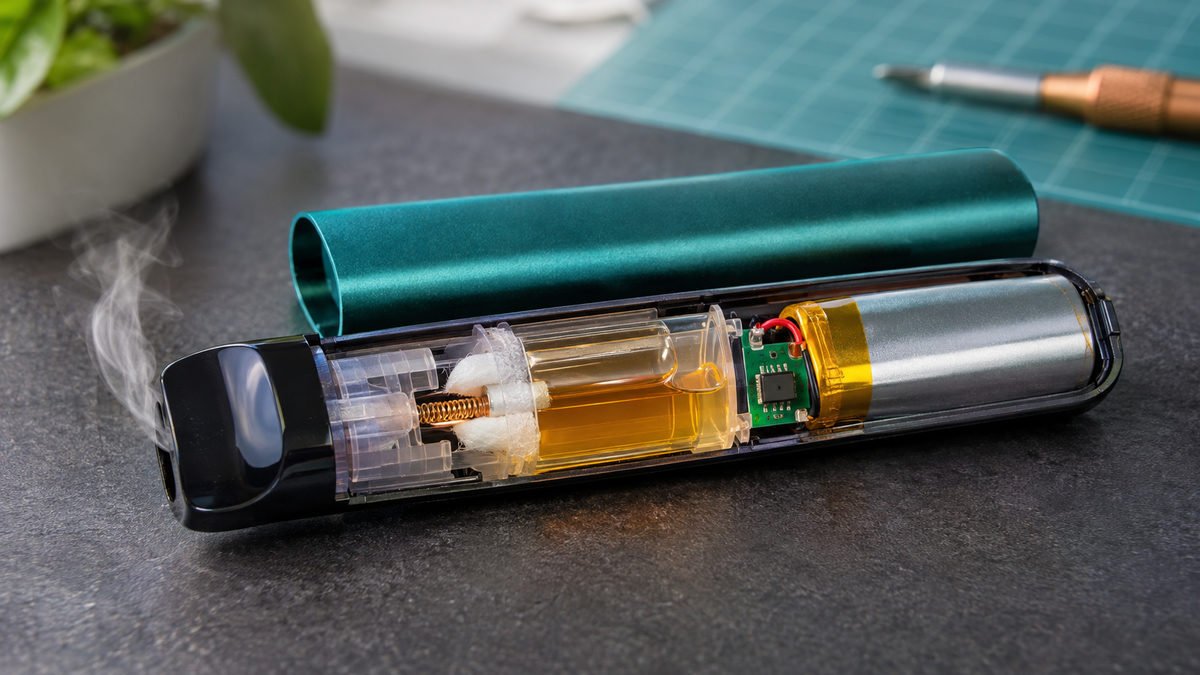
A disposable vape may look like a simple tube or box. Inside, tightly arranged parts control airflow, liquid delivery, heating, and electrical power. Specifically, each component performs a narrow task within a compact space. A failure in one part can affect the entire device.

Major parts inside the casing
- Mouthpiece: Provides the outlet through which the user draws aerosol.
- Air channel: Guides incoming air past the sensor and heated area.
- E-liquid reservoir: Stores the device’s supply of liquid.
- Absorbent wick: Carries liquid toward the heating surface through capillary action.
- Heating coil or atomizer: Converts electrical energy into heat.
- Airflow sensor: Detects the pressure or airflow change created during inhalation.
- Control circuit: Activates the coil and manages basic electrical protections.
- Lithium-ion battery: Supplies the electrical current needed for heating.
- Indicator light: Communicates activation, low power, charging, or fault conditions.
- Outer casing: Holds the assembly together and protects it during ordinary handling.
The reservoir may use a liquid chamber, saturated absorbent material, or a combination of both. Meanwhile, the wick touches or surrounds part of the coil. Capillary action pulls liquid through tiny spaces in the wick without a mechanical pump. Therefore, the heating area receives another small liquid supply after each puff.
The coil contains a conductive material with measurable electrical resistance. When current passes through it, that resistance converts electrical energy into controlled heat. Additionally, the wick limits how much liquid reaches the coil at one time. Proper saturation helps the coil create aerosol without overheating the wick.
The control circuit acts as a compact electronic manager. It receives the sensor signal, connects battery power, and limits activation time. Moreover, some circuits monitor charging, short circuits, or unusually low voltage. These protections reduce risk, but they cannot make damaged hardware completely safe.
The indicator light may glow during a puff or blink when something goes wrong. However, blink patterns vary between brands and models. One device may use ten flashes for a depleted battery, while another uses that pattern for a fault. Therefore, users should consult the supplied instructions instead of guessing.
3. How Disposable Vape Devices Work When You Inhale
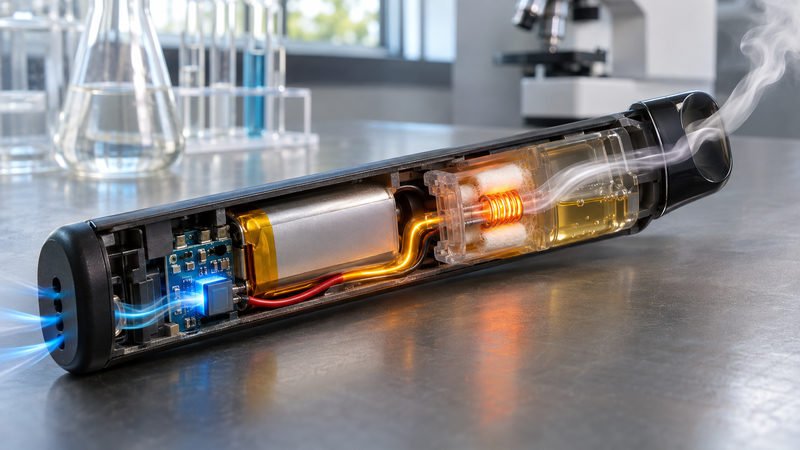
Understanding how disposable vape devices work starts with the user’s draw. Inhalation pulls air through one or more small inlet holes. Consequently, airflow changes the pressure inside the device’s air path. The sensor detects that change and sends a signal to the control circuit.
The activation sequence
- The user draws air through the mouthpiece.
- The moving air creates a pressure difference near the airflow sensor.
- The sensor signals the control circuit to begin activation.
- The circuit allows the battery to deliver current to the coil.
- Electrical resistance heats the coil within a short period.
- Liquid near the coil forms vapor, which mixes with incoming air.
- The resulting aerosol travels through the air channel and mouthpiece.
This process describes draw-activated vape operation. No manual button is necessary because airflow serves as the activation command. In fact, the sensor and circuit may respond almost immediately. That rapid response makes the process feel mechanical, although electronics control the heating event.
The air pathway also cools and transports the newly formed aerosol. Air enters through vents, moves near the coil, and continues toward the mouthpiece. However, blocked vents can change pressure and reduce airflow. Covering those openings may cause a tight draw, weak output, or unwanted liquid movement.
The wick, coil, battery, and sensor must work together during every puff. The wick supplies liquid while the battery supplies energy. Meanwhile, the coil transforms that energy into heat, and the sensor controls when heating begins. A weakness in any link can reduce aerosol production or stop it completely.
Most control circuits include an automatic puff-time limit. For instance, a device may stop heating after several seconds of continuous activation. This feature helps limit overheating and battery drain. Nevertheless, users should stop using a device that stays active after inhalation ends.
When the user stops drawing, airflow returns toward its resting condition. Therefore, the sensor withdraws its activation signal, and the circuit cuts power to the coil. The coil then cools, while the wick begins replenishing liquid near its surface. Short pauses between puffs can support this re-saturation process.
4. How E-Liquid Becomes Aerosol Instead of Smoke
The saturated wick holds e-liquid against the heated coil. As coil temperature rises, volatile ingredients near its surface enter a gas phase. Incoming air carries this warm mixture away from the coil. Subsequently, cooling causes much of that material to condense into fine liquid droplets.
Those suspended droplets form an aerosol that the user inhales. People commonly call it vapor because part of the process involves vaporization. Technically, however, the visible cloud contains tiny droplets, gases, and other constituents. Therefore, aerosol gives a more accurate description of the inhaled mixture.
Aerosol compared with combustion smoke
Smoke forms when material burns and undergoes combustion. That process creates hot gases, solid particles, and numerous chemical by-products. Disposable vapes normally avoid tobacco combustion because the coil heats liquid instead. However, heating can still create or release substances that users inhale.
Temperature control strongly affects aerosol formation. Too little heat produces weak output and may leave larger liquid droplets in the air channel. On the other hand, excessive heat can degrade ingredients or scorch a dry wick. A well-functioning device balances power, airflow, and liquid delivery within its designed operating range.
Common ingredients in e-liquid
- Propylene glycol: A thin carrier liquid that supports flavor delivery and a more noticeable throat sensation.
- Vegetable glycerin: A thicker carrier that commonly produces a denser visible cloud.
- Flavorings: Formulated ingredients that create fruit, mint, tobacco, dessert, or other flavor profiles.
- Nicotine: An optional addictive substance available in different forms and concentrations.
The ratio between propylene glycol and vegetable glycerin changes liquid thickness and aerosol characteristics. Specifically, thicker liquid may move through some wicks more slowly. Device makers select coil resistance and wick design around the intended formulation. Therefore, adding another liquid can disrupt performance and create safety problems.
The absence of smoke does not mean the aerosol contains only harmless water vapor. Aerosol may include nicotine, flavoring chemicals, ultrafine droplets, and substances formed during heating. Moreover, contamination and manufacturing quality can affect what a product delivers. Users cannot reliably judge chemical exposure from cloud size, smell, or flavor alone.
5. Nicotine, E-Liquid Types, and Disposable Vape Lifespan
Many disposable vapes contain nicotine salt formulations. These liquids combine nicotine with an acid to alter sensory characteristics and formulation behavior. At certain concentrations, they may feel less harsh than comparable freebase nicotine products. As a result, a smooth draw can still deliver a substantial nicotine dose.
Nicotine-free disposables also exist, although availability depends on the market. However, package claims may not always match laboratory findings or local requirements. Product quality, regulation, and labeling practices vary widely. Therefore, consumers should use reputable sources and follow applicable local rules.
What puff-count numbers really mean
A stated puff count is an estimate, not a guaranteed number of identical inhalations. Manufacturers often test devices under controlled machine-draw conditions. Real users rarely match those exact settings. Consequently, two people can empty the same model at very different rates.
- Puff duration: A four-second draw consumes more liquid and energy than a one-second draw.
- Inhalation strength: Stronger airflow can alter activation time, cooling, and liquid consumption.
- Airflow design: Restricted and open devices can produce different output per puff.
- Coil efficiency: Coil resistance and heat transfer influence energy and liquid use.
- Battery capacity: The cell must retain enough voltage to power the coil effectively.
- E-liquid volume: A larger reservoir can support more use when other factors remain equal.
- Storage conditions: Heat, cold, and long storage can affect liquid and battery performance.
- Manufacturing variation: Small differences in filling, seals, sensors, and coils can change lifespan.
Consider two users sharing the same advertised 5,000-puff model. One takes brief, occasional draws, while the other takes long draws throughout the day. Notably, the second device may run out much sooner. The printed number cannot predict either person’s exact experience.
Some devices stop because the battery reaches its usable voltage limit. Others stop when the reservoir becomes empty or the wick no longer receives enough liquid. Meanwhile, a clogged airway or failed sensor can make a partly filled device seem depleted. The weakest remaining component effectively determines the usable lifespan.
For that reason, lifespan may range from days to considerably longer. Frequency, draw length, storage, and device capacity all matter. Additionally, repeated long puffs can consume liquid quickly and increase coil temperature. Puff estimates should support comparison, not function as precise promises.
6. Rechargeable Designs, Warning Signs, and Troubleshooting
Non-rechargeable disposables use their original battery charge until the voltage becomes too low. Once depleted, the entire device reaches its intended endpoint. Rechargeable disposables include a charging port that extends battery use. However, charging does not make their sealed reservoirs or coils safely refillable or replaceable.
A rechargeable model may contain more liquid than one battery charge can aerosolize. Therefore, charging lets the original battery continue using the factory-filled supply. Users should use only compatible charging equipment and follow the manufacturer’s instructions. They should also place the device on a stable, nonflammable surface while monitoring it.
Common symptoms and likely causes
- Blinking light: The battery may be low, the puff limit may have activated, or the circuit may detect a fault.
- Weak aerosol: Low charge, restricted airflow, depleted liquid, or declining coil performance may reduce output.
- No aerosol: A dead battery, failed sensor, blocked airway, empty reservoir, or internal fault may prevent operation.
- Clogging: Condensed liquid, debris, or thickened e-liquid may obstruct the air channel.
- Leaking: Damaged seals, heat exposure, pressure changes, or oversaturation may force liquid from the device.
- Burnt taste: A dry wick, depleted reservoir, frequent long puffs, or excessive heat may scorch the wick.
- Auto-firing: Condensation, sensor failure, debris, or internal damage may keep the coil active without inhalation.
Some minor airflow problems may improve when the user keeps the mouthpiece clean and holds the device upright. However, sharp tools should never enter the air channel. They can damage seals, the sensor, or the battery assembly. Users should avoid striking, squeezing, or forcefully shaking a clogged device.
A burnt taste often means the wick lacks sufficient liquid near the coil. A short rest may help after unusually frequent puffs. Nevertheless, a persistent burnt taste usually signals depletion or damage. Continuing use can overheat the wick and produce unpleasant breakdown products.
Leaking liquid should not touch skin, eyes, children, or pets. Specifically, users should stop handling a leaking device unnecessarily and wash exposed skin promptly. Manufacturer guidance can provide product-specific instructions. Medical or poison-control advice may be necessary after significant exposure or accidental swallowing.
Auto-firing, swelling, hissing, unusual heat, or a chemical odor requires immediate attention. Stop using and charging the device, then move away from it if safe. Furthermore, do not hold a dangerously hot device or place it near combustible materials. Follow local emergency guidance when fire or battery failure appears possible.
7. Health, Battery, Storage, and Disposal Safety
Vaping is not risk-free. Aerosol may contain nicotine and other potentially harmful substances, including compounds created during heating. Moreover, nicotine can cause dependence and may affect developing brains. Product composition and individual exposure can vary substantially.
These products are inappropriate for underage people and non-smokers. They may also conflict with medical advice, workplace rules, travel restrictions, or local law. Specifically, pregnant people and those with relevant health conditions should seek qualified medical guidance. A flavored product or smooth draw does not remove these concerns.
Handling and storage precautions
- Never open, puncture, crush, burn, short-circuit, or modify a disposable vape.
- Never refill a sealed reservoir or replace a component not designed for user service.
- Keep devices away from children and pets, including after the device appears empty.
- Store them away from direct sunlight, heaters, hot vehicles, and freezing conditions.
- Keep devices dry and away from sinks, pools, rain, and other water sources.
- Avoid loose storage beside keys, coins, tools, or other conductive metal objects.
- Stop using any device that becomes swollen, damaged, unusually hot, or badly discolored.
A lithium-ion cell stores considerable energy inside a small package. Crushing or puncturing it can damage the internal separator and create a short circuit. As a result, the battery may release heat, vent gases, or ignite. Water exposure and extreme temperatures can also damage the cell or control circuit.
Children and pets face additional risks from residual e-liquid and small components. Even an apparently empty device may retain nicotine-containing liquid inside its wick. Therefore, users should store spent devices in a secure location before disposal. They should also avoid leaving them in bags, cars, or accessible household drawers.
Responsible disposal
Disposable vapes should not enter household trash or curbside recycling. Waste equipment can crush batteries during collection and sorting, creating fire hazards. Furthermore, ordinary recycling facilities may not handle embedded lithium-ion cells safely. The remaining liquid can also complicate processing.
Instead, users should contact a local battery, hazardous-waste, or electronic-waste collection service. Retail take-back programs may also accept these products where regulations allow. Notably, acceptance rules differ between locations and facilities. Users should describe the item accurately before visiting a collection point.
Do not dismantle the device to separate its battery unless an authorized facility provides specific instructions. Opening the casing can expose liquid, sharp parts, electrical contacts, and the battery pouch. Therefore, keep the device intact and protect it from crushing during transport. Facility staff can then manage it through an appropriate waste process.
Conclusion
A disposable vape uses inhalation-triggered electronics to connect its battery to a heating coil. The wick feeds e-liquid to that coil, while airflow carries the resulting aerosol through the mouthpiece. Therefore, the device creates aerosol without burning tobacco. Its simple exterior conceals a closely coordinated electrical and fluid system.
Real lifespan depends on liquid volume, battery capacity, coil performance, storage, and individual use. Moreover, blinking, leaking, weak output, burnt taste, or auto-firing can indicate depletion or a fault. Puff-count claims remain estimates because draw length and strength vary. A device should never require forceful repair or unauthorized modification.
Most importantly, follow the manufacturer’s instructions and stop using any damaged or malfunctioning device. Keep every device away from children, pets, water, heat, and loose metal objects. Finally, take used disposables to an appropriate battery or electronic-waste collection point. Safe handling matters during use, storage, transport, and disposal.
