

A box promises 10,000 puffs, but will it last ten days or ten weeks? GROO Max 10000 Puffs: Understanding the Advertised 10,000 Puff Rating and Safety Labels starts with that important question. The large number attracts attention, while the smaller print provides essential context. However, neither part can predict your exact experience.
The headline count says little about puff duration, daily frequency, nicotine exposure, or laboratory conditions. Moreover, packaging can differ between flavors, production runs, and intended markets. GROO publicly advertises an upper estimate, yet the reviewed listings do not explain its testing method. Therefore, you must read the rating, nicotine declaration, warnings, and symbols as separate pieces of information.
1. What the GROO Max 10000 Puffs Rating Means
How to read “up to 10,000 puffs”
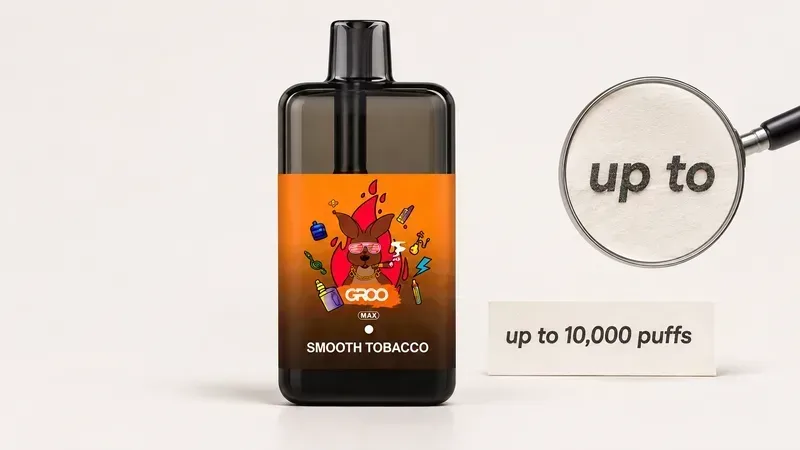
GROO advertises “up to 10000 puffs” for its Smooth Tobacco variant. Its Coffee variant listing makes the same claim. The words “up to” matter because they describe an advertised ceiling. They do not establish a guaranteed minimum or an expected average.
For instance, imagine a package advertising a car’s maximum driving range. That figure might come from controlled conditions with specific speeds and temperatures. However, hills, traffic, weather, and driving habits change the result. A vape puff rating also needs test conditions before readers can make a meaningful comparison.
A puff is not a fixed unit like one milliliter or one minute. One person might inhale for one second, while another inhales for four seconds. Additionally, the second person could consume more liquid and battery energy during each activation. Counting both activations as one puff hides that difference.
Therefore, the 10,000 figure works best as a product claim, not a personal lifespan forecast. It identifies the capacity category GROO uses when marketing these variants. However, it cannot tell you how many satisfying draws your individual device will provide. Manufacturing variation, storage, and usage patterns may all affect the outcome.
What GROO discloses about testing
The reviewed GROO pages provide the headline figure but no detailed testing protocol. Specifically, they do not state the programmed puff duration, airflow, or puff volume. They also omit the waiting time between activations and the number of devices tested. Consequently, readers cannot independently reproduce the advertised result from those listings.
The pages also leave the testing endpoint unclear. A test might stop when aerosol output falls below a threshold. Alternatively, it might continue until the battery cuts off or the device stops activating. Those endpoints can produce different totals, especially when output declines gradually near the end.
Most importantly, the public listings reviewed leave the method behind the rating unverified. GROO should receive attribution for specific conditions only when documentation covers this exact model. A protocol for another device would not prove how GROO tested this one. Until matching documentation appears, treat 10,000 as an upper advertising estimate.
2. How Vape Puff Counts Are Measured and Why Yours Can Differ
What a machine counts
A repeatable bench test uses a machine instead of relying on human inhalation. The equipment draws air through a device for a fixed period. Moreover, technicians can control puff volume, flow rate, and the interval between draws. Those settings make repeated measurements easier to compare.
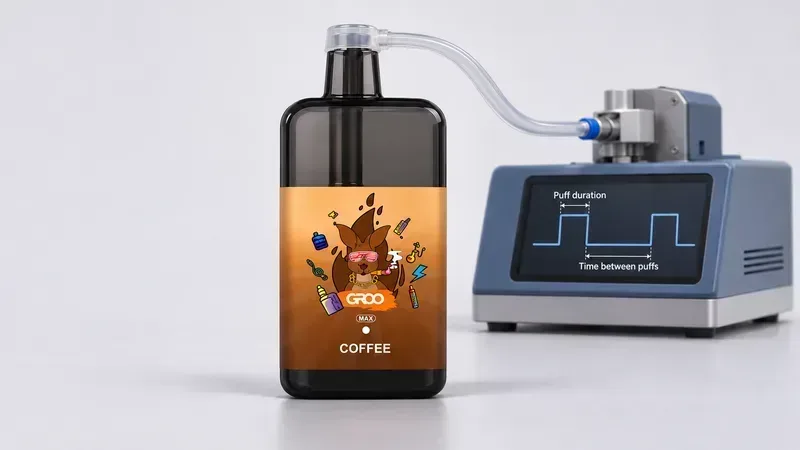
For example, a machine might take a three-second draw every 30 seconds. Each completed activation could add one puff to the counter. However, changing the draw to five seconds would create a different test. The longer program could use liquid and battery capacity faster per counted puff.
A published disposable e-cigarette performance study tested several products under controlled laboratory conditions. The studied products included Blu, NJOY, V2, and White Cloud disposable models. Researchers used repeatable puffing procedures to compare device performance and aerosol delivery. Notably, those models are not the GROO Max.
That distinction prevents a common mistake. Research on other disposables can illustrate how laboratory counting works. However, it cannot validate GROO’s advertised total or reveal GROO’s unpublished settings. Device design, liquid composition, battery behavior, and airflow can differ substantially between products.
The endpoint also shapes the final count. A machine could stop after sustained aerosol loss, repeated failed activations, or a battery cutoff. Furthermore, researchers might define failure through aerosol mass rather than visible vapor. A stricter output threshold could end the test earlier than a simple activation count.
Therefore, two laboratories could obtain different totals from identical devices. Both might follow consistent procedures, yet use different puff profiles or stopping rules. A useful rating needs both the number and the method behind it. Without that method, comparison remains limited.
What changes during real-world use
People rarely puff with machine-like consistency. Some take short draws throughout the day, while others take longer draws less often. In fact, a study of human puffing behavior demonstrates that puff patterns vary. Such differences affect aerosol generation and resource use per activation.
Longer puffs generally keep the heating system active for more time. As a result, one long draw may consume more energy and liquid than one short draw. Counting each as a single puff makes them appear equal. Physically, however, they place different demands on the device.
Airflow can also affect activation and aerosol production. A strong draw may move more air through the system than a gentle draw. Meanwhile, very weak inhalation may not trigger some draw-activated devices reliably. Device geometry and sensor sensitivity influence what happens in each case.
Intervals between puffs matter as well. The wick needs time to move liquid toward the heating element. Additionally, rapid repeated use can retain more heat around the coil. These conditions may alter aerosol output, flavor, and liquid consumption during a session.
Some devices let users adjust voltage, power, or airflow. Specifically, higher power can increase aerosol and nicotine yield under certain conditions. A device voltage and nicotine yield study illustrates why operating conditions matter. However, its findings do not establish the performance of GROO Max.
Adjustable airflow can change draw resistance and the air moving past the coil. Likewise, selectable power modes can change heating intensity. Those features may alter the relationship between activations and resource consumption. Nevertheless, the reviewed GROO listings provide no verified selectable mode for this model.
Storage and device condition can introduce further variation. Excessive heat may degrade liquid or stress a battery, while physical damage may disrupt normal operation. Moreover, leaks can reduce the liquid available for aerosol production. For that reason, a headline count cannot account for every individual device.
3. Can a 10,000-Puff Rating Tell You How Many Days a Vape Will Last?
A simple equation provides an estimate: usable puffs divided by average daily puffs equals estimated days. However, both inputs can vary. The advertised number does not confirm the usable count for your device. Your daily frequency may also change between weekdays, weekends, and social occasions.
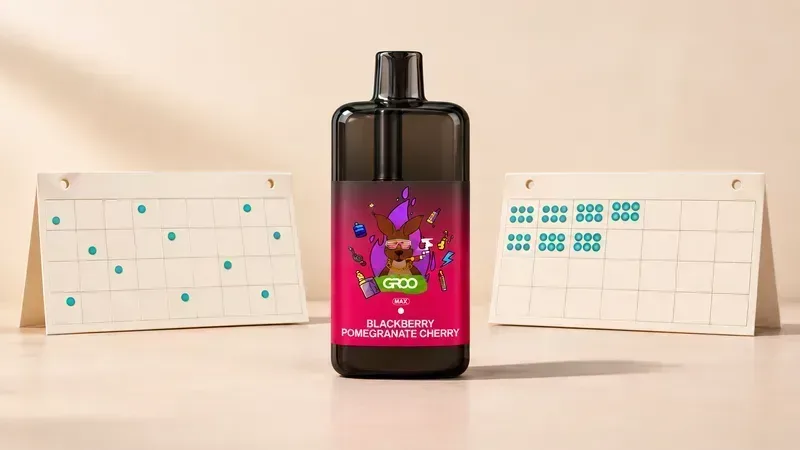
Consider a hypothetical device that actually provides 8,000 usable puffs under one person’s routine. At 200 puffs daily, the arithmetic gives 40 days. Specifically, 8,000 divided by 200 equals 40. This example does not predict a GROO Max lifespan.
Now keep the same assumed 8,000-puff total but double daily use. At 400 puffs per day, the estimate falls to 20 days. Therefore, doubling daily frequency halves the estimated duration under the same assumption. The calculation works mathematically, but its inputs remain personal and uncertain.
- Calendar A: 8,000 assumed usable puffs ÷ 200 daily puffs = 40 estimated days.
- Calendar B: 8,000 assumed usable puffs ÷ 400 daily puffs = 20 estimated days.
- Important limit: Neither calendar confirms what a GROO device will actually deliver.
Moreover, daily counts alone overlook puff duration. Two people might each record 200 activations, yet consume different amounts of liquid. One may take brief draws, while the other takes long draws. Consequently, their devices may not last equally long.
You can create a rough personal estimate by tracking activations for several ordinary days. However, treat the result as a planning tool, not a promise. Stop using any device that leaks, overheats, becomes damaged, or behaves unexpectedly. A remaining theoretical puff count never outweighs safe handling.
4. Where to Find Nicotine Strength and How to Read mg/mL and Percent
Locate the declaration on the exact package
Start with the product in your hand, not a photograph from another seller. Check the front, side, and back panels for a nicotine declaration. Additionally, inspect any enclosed leaflet or outer sleeve. Look for a percentage, mg/mL value, or wording such as “contains nicotine.”
The reviewed Smooth Tobacco and Coffee listings advertise 5% nicotine. However, legible packaging for a specific market has not been verified here. Website information may not reproduce every panel printed on a retail package. Therefore, do not treat the listing as a transcription of your box.
Before recording package wording, confirm three details. Check the flavor variant, model designation, and intended sales market. Moreover, compare the importer or distributor information when available. These identifiers help distinguish regional packaging from a similar-looking product.
- Front panel: Check the model name, flavor, nicotine figure, and unit.
- Side panels: Look for ingredients, importer details, warnings, and storage instructions.
- Back panel: Check legal text, disposal marks, manufacturer details, and batch information.
- Leaflet: Review operating instructions, precautions, and local contact information.
Small unit differences can change the meaning substantially. For example, 5 mg/mL is not the same concentration as 5%. Likewise, “5 mg per device” would describe a quantity rather than concentration. Read the number together with its unit and surrounding wording.
Read concentration separately from exposure
The unit mg/mL means milligrams of nicotine per milliliter of liquid. For example, 20 mg/mL means each milliliter contains 20 milligrams of nicotine. However, that statement describes liquid concentration before use. It does not tell you how much nicotine reaches the bloodstream.
A 5% mass-per-volume declaration means 5 grams per 100 milliliters. Since 5 grams equals 5,000 milligrams, the conversion gives 50 mg/mL. Specifically, divide 5,000 milligrams by 100 milliliters. This conversion applies only when the percentage uses mass per volume.
A percentage by weight uses a different basis. It describes nicotine mass relative to the total liquid mass. Therefore, converting it accurately into mg/mL requires the liquid’s density. Assuming every printed percentage uses the same convention can produce an incorrect result.
Three nicotine quantities deserve separate treatment. The first is the concentration printed for the liquid. The second is the amount emitted in aerosol during a puff. Finally, the third is the amount the user absorbs.
Device design and operating conditions can affect aerosol yield. Furthermore, puff duration, power, and inhalation behavior can influence delivery. The cited voltage study found that changing voltage affected nicotine yield in the tested equipment. However, it did not test the GROO Max described here.
Puff count cannot establish nicotine exposure by itself. Ten short activations may not produce the same aerosol as ten long activations. Additionally, emitted nicotine does not automatically equal absorbed nicotine. Individual inhalation and retention patterns introduce another layer of variation.
Therefore, avoid multiplying 10,000 by an assumed nicotine amount per puff. The reviewed listings supply no verified GROO-specific value for that calculation. Even a laboratory average would not guarantee personal absorption. The package concentration remains useful, but it answers a narrower question.
5. What Vape Packaging Warnings and Battery Symbols Communicate
Nicotine warnings and market-specific wording
A nicotine warning communicates a health risk rather than product performance. Typically, it alerts readers that nicotine can cause addiction. However, exact wording and presentation depend on the jurisdiction. A warning from one country should not automatically describe requirements in another.
Use the package’s model designation and business information to identify its intended market. Specifically, check the importer’s address, local contact details, language, and regulatory references. A regional distributor label may provide additional clues. Nevertheless, packaging alone may not always settle the question.
For a United States example, the FDA explains labeling and warning requirements for covered tobacco products. Its required nicotine warning states that the product contains nicotine and that nicotine is addictive. This serves as a market-specific example, not a verified transcription from a GROO package.
Do not reconstruct unreadable wording from a blurred product image. Instead, examine the physical package under bright light or use a magnifier. Moreover, compare the text with the relevant regulator’s official page. This approach avoids assigning another market’s language to your product.
Warnings also deserve attention beyond compliance. Nicotine products should remain away from children and pets. Additionally, liquid exposure may require prompt action, especially after swallowing or significant skin contact. Follow the package instructions and contact local medical services when exposure causes concerning symptoms.
Battery and storage precautions
Handling instructions tell you what to do, while warnings explain a hazard. For example, “keep away from heat” provides an action that reduces battery risk. Likewise, “keep out of children’s reach” identifies a clear storage step. Such wording can be more useful than an unfamiliar pictogram.
Disposable vapes contain an electronic power source and liquid reservoir. Therefore, crushing, puncturing, or exposing the device to high heat can create hazards. Do not attempt to open the casing merely to inspect its contents. Furthermore, do not modify or charge a device unless its matching instructions explicitly permit charging.
The EU Tobacco Products Directive illustrates how market rules can require information and leaflets for electronic cigarettes. However, regional requirements do not prove what appears on a particular GROO box. Always verify the matching variant and sales market. Also check whether an importer added a local compliance label.
Use extra caution when a device becomes unusually hot, swollen, damaged, or wet. Specifically, stop using it and keep it away from combustible materials. Follow local emergency guidance if it smokes or catches fire. Do not resume use simply because the device cools later.
Attribute a precaution or pictogram to GROO only when it appears legibly on the matching package. Alternatively, rely on official instructions that identify the exact model. Generic vape guidance can explain possible meanings, but it cannot confirm package content. That distinction protects readers from false product claims.
6. How to Tell Disposal Symbols From Conformity Marks
Disposal symbols and local collection
A crossed-out wheeled bin has a specific waste-management purpose in the European Union. It directs users toward separate collection for electrical and electronic equipment. The EU WEEE marking guidance explains this label. However, the symbol does not identify a universal collection location.
Search your local authority’s website for electronic waste, battery waste, or vape disposal. Additionally, call the facility before visiting and ask whether it accepts intact disposable vapes. Some programs accept batteries but reject devices containing nicotine liquid. Therefore, describe the item accurately when requesting instructions.
In the United States, the EPA recommends household hazardous waste collection for e-cigarettes. It advises against placing them in household trash or curbside recycling. Lithium batteries can ignite after damage, while nicotine can harm people and the environment. Local programs may still set their own acceptance procedures.
Keep the device intact while arranging disposal. Moreover, protect it from crushing, heat, and accidental activation. Do not pour remaining liquid into a sink or onto the ground. If a facility gives packaging instructions, follow those instructions carefully.
Conformity markings and certification claims
A conformity mark does not provide disposal instructions. Where CE marking applies, it communicates the manufacturer’s declaration that applicable EU requirements have been addressed. The European Commission’s CE guidance explains the manufacturer’s responsibilities. It does not describe CE as general government approval of product quality.
Independent certification requires separate supporting evidence. Likewise, a government authorization claim needs documentation from the relevant authority. A printed logo alone may not prove either claim. Therefore, verify the responsible business, product identity, and supporting record.
The following table separates three common label functions. These are general examples unless the relevant GROO packaging shows them clearly. Notably, one package may display several marks with unrelated purposes. Read each mark independently before deciding what action to take.
| Label function | General example | Reader action or verification step |
|---|---|---|
| Handling | Keep away from heat or keep out of children’s reach | Follow the stated precaution and confirm it appears on the matching package or instructions. |
| Disposal | Crossed-out wheeled bin | Find a local facility that specifically accepts intact vapes, batteries, and nicotine-containing devices. |
| Conformity | CE marking where applicable | Identify the responsible manufacturer and seek the applicable declaration or supporting compliance documentation. |
Symbols can be small, distorted, or confused with decorative graphics. For instance, a recycling-style mark may identify material rather than an accepted local recycling route. Additionally, battery marks may accompany disposal text with more precise instructions. Photograph the panel clearly before researching an unfamiliar symbol.
Most importantly, local rules determine the correct disposal destination. A symbol helps classify the device, but it does not override municipal requirements. Contact your waste authority when online instructions remain unclear. Never place an intact vape into ordinary recycling merely because part of it contains recyclable materials.
Conclusion
GROO advertises up to 10,000 puffs for the reviewed Smooth Tobacco and Coffee variants. However, the public listings do not disclose enough testing conditions to verify that total independently. Puff duration, airflow, intervals, device condition, and usage habits can change real-world results. Therefore, the rating cannot guarantee a specific number of days.
The nicotine declaration answers a different question. It describes the liquid’s concentration when the unit and percentage basis are clear. Meanwhile, aerosol yield and personal absorption depend on additional factors. Puff count alone cannot establish either quantity.
Warnings, handling instructions, disposal symbols, and conformity marks also serve distinct purposes. Specifically, they may identify health risks, safe actions, collection routes, or manufacturer declarations. Their meaning can depend on the product’s intended market. Consequently, confirm unfamiliar wording through the relevant local authority.
Check the nickname or model designation, nicotine units, warning text, and symbols on your own package. Moreover, verify the flavor, importer, intended market, and relevant panel before transcribing anything. Finally, look up local disposal instructions for intact vapes. Those steps reveal far more than the large puff number alone.
