

You turn over a box marked GROO Max 10000 Puffs Coffee. How much can those words reveal about taste, ingredients, and device life? GROO Max 10000 Puffs Coffee: Understanding Coffee-Inspired Flavour Labelling starts with separating three distinct claims. The name identifies a product line, an intended flavour, and an advertised puff figure.
However, the front label cannot answer every practical question. It may not confirm coffee extract, caffeine content, or the complete liquid composition. Moreover, nicotine strength needs its own declaration because flavour and nicotine describe different product features. The same separation applies when estimating how long one device might last.
GROO describes Coffee as a dark, espresso-inspired flavour with roasted notes and mild bitterness. Additionally, the company lists a 5% nicotine concentration and up to 10,000 puffs on its public product page. Those statements describe GROO’s listed version, not necessarily every package sold in every market. Therefore, you should match your exact device with its carton, identifiers, and supporting disclosure.
1. What Coffee Means on the GROO Max 10000 Puffs Label
How to read the front of the pack
The wording becomes clearer when you read each part separately. GROO Max identifies the product line, while Coffee identifies the flavour name. Meanwhile, 10000 Puffs presents the advertised number of draws. These elements serve different purposes, even when they appear together in large print.

For instance, imagine two GROO Max boxes carrying different flavour names. The shared GROO Max wording connects them to the same general range. However, Coffee distinguishes one intended sensory profile from options such as fruit, mint, or tobacco-inspired flavours. The puff figure then describes a capacity claim rather than a flavour characteristic.
Spacing and typography can make the three parts look like one promise. In fact, each part needs its own supporting information. The product line may connect to particular hardware and liquid capacity. Additionally, the flavour needs a sensory description, while the puff claim needs testing context.
What the flavour name tells you
Coffee signals a taste inspired by familiar coffee characteristics. You might reasonably expect roasted aromas, darker tones, or some bitterness. However, one word cannot explain the exact roast character, sweetness, creaminess, or aftertaste. Those details require a fuller description from the manufacturer.
Moreover, the flavour name does not prove that the liquid contains brewed coffee or coffee extract. Manufacturers can create coffee-like profiles using different flavouring ingredients. Therefore, a sensory name should not serve as an ingredient declaration. You need a complete disclosure or written confirmation to answer composition questions.
Likewise, Coffee does not automatically mean the product contains caffeine. A flavour can resemble espresso without sharing espresso’s natural stimulant content. Most importantly, never use packaging imagery, bean graphics, or aroma descriptions as chemical evidence. Check the exact variant’s documentation instead.
2. How GROO Describes the Coffee Flavour
Roast and bitterness
GROO presents Coffee as a warm, full-bodied flavour inspired by dark espresso beans. Specifically, the brand describes a roasted profile, mild bitterness, and a deep aroma. It also characterises the experience as smooth and rich. These are sensory descriptions rather than laboratory findings or ingredient disclosures.
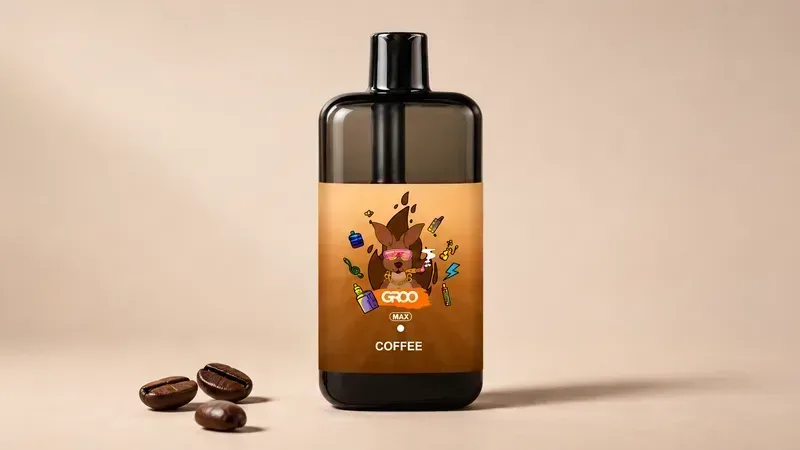
The espresso comparison offers a useful taste reference. For instance, it suggests a darker profile than a mild breakfast blend might provide. Moreover, the mention of mild bitterness sets expectations beyond a sweet coffee candy. The pronounced aroma also forms an important part of the profile GROO intends to communicate.
However, taste remains personal and depends on more than written descriptions. One adult might notice the roasted quality first, while another might focus on bitterness. Additionally, device temperature, airflow, and recent food or drink can affect perception. The brand’s description provides a starting point, not a guaranteed experience.
You can review the wording on the GROO Max Coffee product page. Notably, the page also says the flavour lacks fruity or candy-like tones. That comparison helps position Coffee within the broader range. Still, it does not reveal the substances used to create those sensations.
Sweetness and coffee style
GROO places Coffee in the lowest sweetness tier of its published flavour chart. In fact, Coffee receives one sweetness symbol within the brand’s three-tier scale. Therefore, the chart suggests relatively restrained sweetness compared with several fruit flavours. It does not provide a measured sugar or sweetener concentration.
The chart also gives Coffee the lowest stated cooling level. However, sweetness and cooling rankings describe intended sensory intensity, not a full recipe. Moreover, a one-symbol rating does not mean every user will experience identical sweetness. Personal sensitivity and previous flavours can change the comparison.
The label also leaves the exact coffee style open to interpretation. One person may think of unsweetened black coffee. On the other hand, someone else may perceive a lightly sweetened espresso or a milk-based drink. GROO’s roasted and mildly bitter description supports an espresso direction, but it cannot settle every comparison.
Therefore, use the GROO Max Coffee flavour chart as a relative guide. Compare Coffee with other flavours using the same published scale. Most importantly, do not translate a sweetness position into an ingredient claim. Only a separate disclosure can identify sweeteners or other liquid components.
3. Does a Coffee Vape Flavour Contain Coffee Extract or Caffeine?
What confirms coffee extract
An espresso-inspired taste does not confirm the presence of coffee extract. Flavour specialists can reproduce roasted, bitter, and aromatic notes through various flavouring materials. Therefore, a vivid coffee description can exist independently from the underlying recipe. The product name alone cannot resolve that distinction.

Look for an ingredient disclosure tied to the exact version in your hand. Specifically, check whether it names coffee extract, coffee-derived flavouring, or another identifiable coffee ingredient. A general term such as “flavourings” provides less detail. In that situation, request written confirmation from the manufacturer or responsible distributor.
Furthermore, make your question precise when contacting the company. Ask whether the liquid contains any material derived from coffee beans or other parts of the coffee plant. You can also ask whether the flavour uses natural coffee extract, synthetic flavouring, or a mixture. A focused question reduces the chance of receiving a general taste description.
What confirms caffeine
Caffeine requires a separate check because it is a specific chemical substance. Coffee extract and caffeine are related questions, but they are not interchangeable. For instance, a coffee-derived ingredient might contain caffeine, have caffeine removed, or appear at an undisclosed concentration. Conversely, caffeine could theoretically appear without conventional coffee extract.
The public GROO Max Coffee listing describes flavour, sweetness, cooling, liquid capacity, nicotine, and advertised puffs. However, that page provides no caffeine figure and no complete ingredient list. As a result, the listing does not confirm caffeine or coffee extract. Silence on the page should not become proof of presence or absence.
If your disclosure lists only generic flavourings, ask about caffeine by name. Specifically, request a clear answer stating whether caffeine is present in the finished liquid. Additionally, ask for its concentration and measurement units if the answer is yes. Keep the response with photographs of your packaging and batch information.
Do not infer caffeine from sensations such as alertness, throat hit, or a strong aroma. Nicotine, expectations, and other factors can influence how a user feels. Moreover, sensory impressions cannot identify a substance reliably. The GROO Max Coffee product page remains useful for flavour context, but not for confirming caffeine.
4. Where to Check Ingredients and Nicotine for the Exact Variant
Match the packaging to the listing
Begin with the product line and flavour printed on the carton. Confirm that both GROO Max and Coffee match the listing you are reviewing. However, do not stop after finding those two names. Different market versions can share branding while carrying different labels, strengths, or regulatory information.
Next, compare any country or market designation shown on the package. Additionally, look for a product code, barcode, SKU, importer name, or distributor details. These identifiers can distinguish closely related versions. They also help the manufacturer locate the correct records when answering questions.
Then record the batch or lot number, if available. You may find it on a carton flap, side panel, device base, or printed sticker. Moreover, capture the manufacturing or expiry information when the package provides it. Clear photographs can prevent transcription mistakes involving similar letters and numbers.
Before relying on an online page, inspect every carton panel and any enclosed leaflet. Specifically, search for ingredient wording, nicotine warnings, liquid volume, and manufacturer contact information. Packaging sometimes carries market-specific disclosures that a general sales page lacks. Therefore, your physical pack should remain central to the comparison.
- Product identity: Confirm GROO Max and the Coffee flavour name.
- Market version: Check country labels, warnings, importer details, and language.
- Item identifiers: Record the SKU, product code, barcode, batch, or lot number.
- Pack disclosures: Review every panel and the enclosed leaflet before drawing conclusions.
Find the nicotine declaration
GROO’s public Coffee listing states that the displayed product comes with 5% nicotine. The same page also describes 12 ml of e-liquid. However, you should verify the declaration printed on your own pack. Online information may refer to another market version or change independently from existing stock.
Pay close attention to the units and wording. A percentage, milligrams per millilitre, and total milligrams describe nicotine in different ways. Therefore, do not compare numbers without considering their units. Likewise, do not convert between declarations unless you have enough reliable product information.
For example, a package might display a percentage prominently and another statement within a warning panel. Compare both carefully and photograph them together. If the declarations appear inconsistent, pause before relying on either one. Additionally, contact the manufacturer with the product and batch identifiers.
You can compare your package with the GROO Max Coffee product FAQ. That page answers yes to nicotine and states a 5% concentration. Nevertheless, the declaration on the exact product remains essential. Ask for clarification whenever the pack and webpage differ.
Ask for a variant-specific ingredient disclosure
If neither the pack nor the brand page provides a complete ingredient list, request variant-specific documentation. Name the full product as GROO Max Coffee and include its advertised puff figure. Moreover, state the country where you purchased it. Those details narrow the request and reduce ambiguity.
Attach readable photographs of the front, back, sides, and bottom of the carton. Additionally, include the device label and any enclosed leaflet. Make sure the batch number, barcode, and nicotine declaration remain visible. However, hide personal order information that the company does not need.
Ask three separate questions instead of one broad question. First, request the full ingredient disclosure for that exact variant. Second, ask whether it contains coffee extract or any coffee-derived ingredient. Third, ask whether it contains caffeine and request the nicotine concentration in the printed units.
- Does this exact batch contain coffee extract or another coffee-derived ingredient?
- Does the finished liquid contain caffeine, and at what stated concentration?
- What nicotine concentration applies to this market version and batch?
- Can you provide the ingredient disclosure or supporting document for this specific variant?
Most importantly, keep the written reply with your packaging photographs. A response linked to identifiers offers more value than a general statement about the entire range. If the company cannot match the batch, ask which identifier it needs. This process creates a clearer record for future reference.
5. What 10000 Puffs Means and Why the Actual Count Can Vary
Read the full claim
GROO describes the Coffee device as delivering up to 10,000 puffs. The phrase “up to” makes the number an advertised upper figure. Therefore, it should not function as a promise that every device delivers exactly 10,000 draws. Individual use and testing conditions can produce different results.
The public listing does not state the puff duration used for that figure. Additionally, it gives no puff interval, draw volume, airflow setting, or end-of-test criterion. Those missing details matter when comparing laboratory regimens with everyday use. Without them, readers cannot reproduce the advertised count from the page alone.
An end-of-test criterion explains when a count stops. For example, a test could stop after aerosol output drops, liquid runs out, or the device no longer activates. However, the Coffee page does not identify such a rule. Therefore, the published number gives capacity guidance without a complete testing method.
The GROO Max Coffee product FAQ repeats the “up to 10000 puffs” wording. It also describes the device as suitable for regular daily use. Still, “daily use” does not establish a fixed number of days. Each adult follows a different draw pattern and frequency.
Explain how draw patterns affect the count
A puff is not always a standard-sized unit. One person may take short, gentle draws with long pauses. Meanwhile, another may take longer draws and use the device more frequently. Those patterns can consume liquid and battery capacity differently.
Longer draws generally activate the heating system for more time. As a result, they can turn more liquid into aerosol during each puff. Shorter draws may use less liquid during each activation. However, neither description supports a reliable personal total without controlled product-specific testing.
Puff volume also matters. A deeper draw can move more air through the device than a shallow draw. Moreover, airflow design and pressure can influence how the device responds. These variables show why two puffs can count equally while producing different aerosol amounts.
Spacing changes conditions between puffs. Longer intervals can allow the heating element and surrounding liquid to cool or redistribute. On the other hand, closely spaced draws may keep the system warmer. Device protection features may also affect performance during repeated use.
The CORESTA guide to vaping regimes for e-vapour devices discusses variables used to define machine puffing. These include puff duration, volume, frequency, and shape. In fact, such parameters help researchers describe a repeatable regimen. Everyday users rarely reproduce one fixed machine pattern exactly.
Consider a simple qualitative comparison. User A takes brief draws and pauses between them. User B takes longer draws and returns sooner. Therefore, their devices may reach an endpoint after different draw counts, even if both started with the same model.
However, assigning either person a predicted total would create false precision. Device variation, storage history, airflow, and activation behaviour can also matter. Additionally, the user may stop when flavour or aerosol output declines. Another user might continue until the device no longer activates.
- Draw duration: Longer activation can use more liquid during one counted puff.
- Puff volume: Deeper and shallower draws may produce different aerosol quantities.
- Spacing: The interval between draws can change heating and liquid movement.
- Usage frequency: Daily puff count determines how quickly a device reaches its endpoint.
- Stopping point: Users may stop at different stages of declining performance.
Keep puff count and nicotine measures separate
An advertised draw count cannot establish a fixed number of usage days. To calculate days, you would first need a reliable personal puff rate and a comparable total. However, the advertised upper figure does not guarantee that total. Therefore, dividing 10,000 by an assumed daily number can mislead.
The puff claim also cannot establish nicotine delivered during each draw. Nicotine concentration describes the liquid, while delivery depends on device behaviour and puff conditions. Moreover, absorption by the user introduces another distinct question. These measures should not be treated as interchangeable.
For instance, knowing that a listing states 5% nicotine does not reveal an exact dose per puff. You would need suitable emissions data from a defined testing regimen. Additionally, individual inhalation patterns can differ from that regimen. The front label does not provide enough information for that calculation.
Therefore, return to the separate nicotine declaration when checking strength. Match its units and variant identifiers with your physical pack. Most importantly, avoid using “10,000 puffs” as a substitute for concentration information. One claim concerns an advertised draw total, while the other concerns the stated liquid strength.
Conclusion
Coffee names the intended flavour, not a confirmed list of ingredients. GROO describes that flavour as roasted, mildly bitter, aromatic, and inspired by dark espresso. Moreover, the brand places it within the lowest sweetness tier of its published chart. Those details explain the intended taste but do not confirm coffee extract or caffeine.
Up to 10,000 puffs is the advertised upper count. However, puff duration, volume, spacing, and stopping criteria can change real-world results. The number cannot establish exact usage days or nicotine delivery per draw. Instead, consult the product’s separate nicotine declaration for its stated concentration.
Finally, match your pack to GROO’s Coffee listing using every available product and batch identifier. Check all carton panels, the device label, and any enclosed leaflet. If coffee extract or caffeine remains unclear, request the exact variant’s ingredient disclosure. Additionally, ask about both substances by name and keep the written response with your packaging records.
