
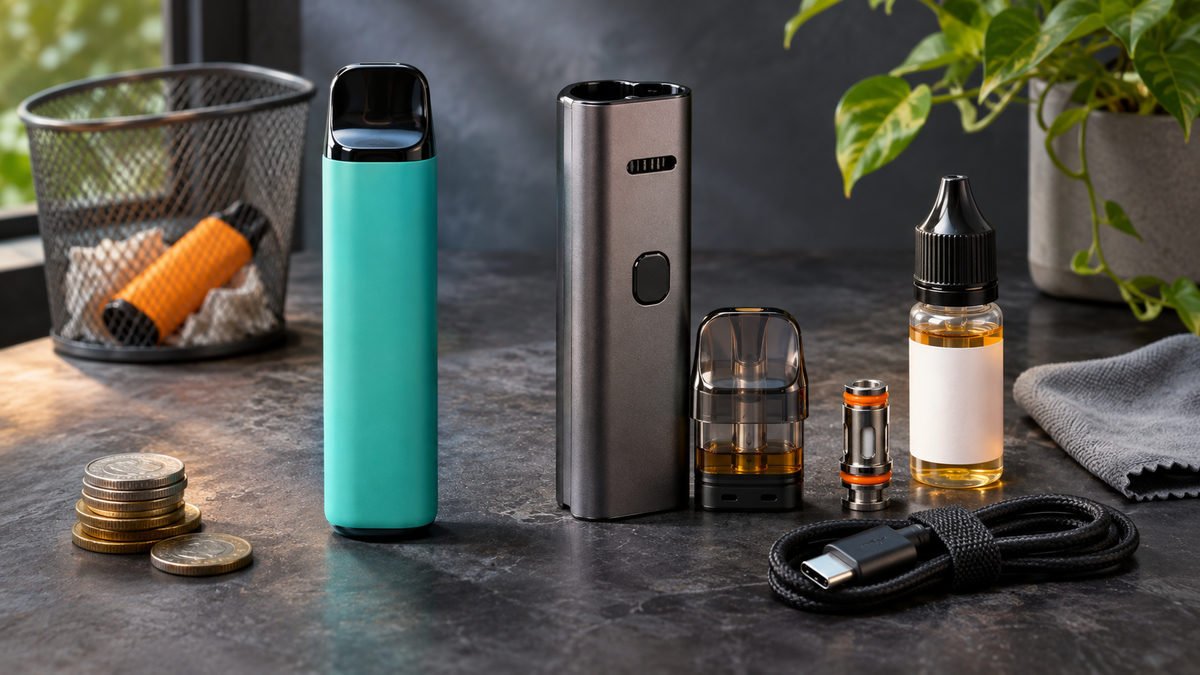
Two pocket-sized devices can look identical while delivering very different ownership experiences. Disposable Vape vs Pod System: Technical Differences become clearer once you examine the battery, coil, cartridge, airflow, and power controls. Moreover, labels like “rechargeable” and large puff counts can hide important limitations. Adult buyers should compare the complete device, not its shape or packaging.
A true disposable usually reaches the end of its life when its liquid or battery becomes unusable. However, pod systems keep the main battery body and replace or refill the cartridge. This guide compares both formats by convenience, performance, maintenance, recurring cost, and waste. It does not treat either format as safe or risk-free.
1. Disposable Vape vs Pod System: Technical Differences at a Glance
A disposable vape combines its main components inside one integrated unit. These parts usually include the battery, reservoir, coil, wick, sensor, airflow path, and mouthpiece. When the liquid finishes or the device stops functioning, the user generally discards the entire unit. Therefore, repair and routine servicing are rarely practical.
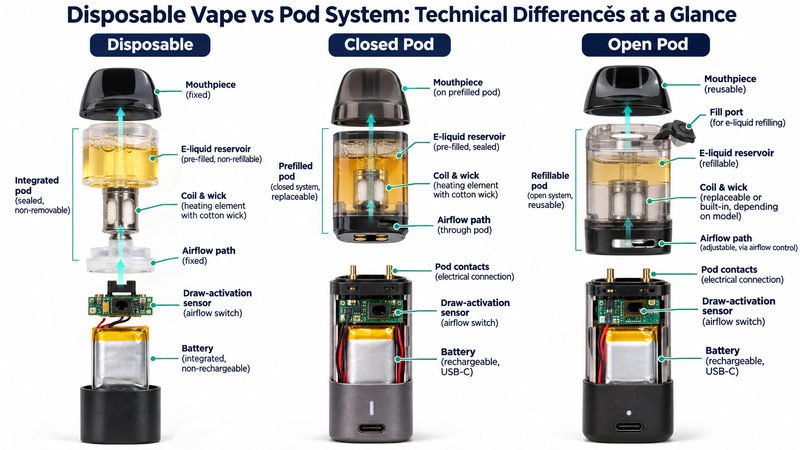
A prefilled pod system uses a rechargeable battery body with replaceable factory-filled cartridges. Manufacturers often call this design a closed pod system. The cartridge arrives sealed, so users cannot normally choose another liquid for it. However, replacing the empty pod allows continued use of the battery body.
A refillable pod system has cartridges that users fill from a bottle. Some cartridges contain a permanent coil, while others accept separately replaceable coils. This design is also called an open pod system. Consequently, it offers more choice in flavor, nicotine strength, resistance, and liquid composition.
Rechargeable disposables occupy a confusing middle ground. Their charging port helps users consume the factory-filled liquid before the battery dies. However, these products remain disposable because users cannot properly refill or maintain them. Charging capability alone does not make a device a reusable pod system.
| Feature | Disposable vape | Prefilled closed pod | Refillable open pod |
|---|---|---|---|
| Construction | Integrated single unit | Reusable body and sealed pod | Reusable body and refillable pod |
| E-liquid capacity | Fixed at purchase | Fixed per cartridge | Limited by refillable pod size |
| Battery capacity | Usually compact | Rechargeable and reusable | Rechargeable, often larger |
| Charging | None or limited recharging | Regular charging | Regular charging |
| Power regulation | Usually fixed or minimal | Fixed or automatically matched | Automatic or adjustable |
| Coil options | None | Limited by available pods | Several pods or coils possible |
| Airflow adjustment | Usually fixed | Usually fixed or limited | Often adjustable |
| Maintenance | Almost none | Charging and contact cleaning | Charging, filling, and cleaning |
| Device lifespan | One liquid supply | Many replacement pods | Many refills and coils |
| Recurring cost | New complete devices | Factory-filled cartridges | Liquid plus pods or coils |
| Waste | Whole device discarded | Pods and eventual battery body | Coils, pods, bottles, and eventual body |
Capacities and nicotine strengths vary greatly between products. Additionally, labeling rules and legal availability depend on the market. Buyers should verify local specifications instead of assuming every device follows the same limits.
2. How Disposable Vapes and Pod Systems Work
The inhalation-to-aerosol sequence
Most compact devices begin working when inhalation changes the pressure inside the airflow channel. A draw sensor detects that pressure change and signals the control circuit. Next, electrical current heats the coil while the wick supplies e-liquid. The resulting aerosol then moves through the chimney and mouthpiece.

Both formats share several basic components despite their different lifespans. These include a lithium-ion cell, control board, pressure sensor, reservoir, wick, coil, airflow channel, and mouthpiece. In fact, the most important distinction concerns how manufacturers package and replace those components. A disposable seals almost everything together, while a pod system separates the cartridge from the battery body.
Draw activation removes the need to find or press a button. Therefore, it simplifies operation and reduces the number of visible controls. Some pod systems also include a fire button, display, selectable mode, or adjustable wattage. Those controls provide flexibility, but they also require users to understand compatible settings.
Power delivery and regulation
Simple disposables may provide minimally regulated output based largely on battery voltage and circuit limits. As the cell discharges, its voltage falls and the output may weaken. Consequently, vapor can become cooler or thinner near the end of the charge. Coil condition and remaining liquid can make that decline more noticeable.
Regulated pod chipsets aim to maintain a selected wattage or consistent power level. They adjust electrical delivery as battery voltage changes within safe operating limits. As a result, vapor can remain steadier until the device reaches its low-voltage cutoff. The device then stops firing and signals that charging is required.
Some pod systems are more powerful than compact disposables, but category names never guarantee performance. Actual output depends on wattage, supplied voltage, coil resistance, airflow, and chipset limits. Moreover, a high-capacity battery does not automatically produce stronger vapor. Capacity describes stored charge, while the control system determines power delivery.
Sealed disposables favor predictable operation and simple construction. Meanwhile, removable pods let users replace the liquid chamber and coil without discarding the battery. Open systems extend that flexibility through refillable cartridges and broader coil choices. However, every additional connection introduces another possible source of wear, leakage, or contamination.
3. Battery, Coil, Wattage, and Airflow Performance
Battery capacity and charging
Battery capacity commonly appears in milliamp-hours, written as mAh. A larger mAh rating generally stores more charge under comparable conditions. However, runtime also depends on wattage, resistance, puff duration, efficiency, and usage frequency. A 1,000 mAh pod can drain quickly when powering a demanding low-resistance coil.

Traditional disposables use a non-rechargeable cell sized for their factory-filled liquid. Rechargeable disposables may use a smaller cell that users charge several times. By comparison, pod systems commonly use larger rechargeable batteries designed for repeated charging cycles. Their useful lifespan still declines through age, heat exposure, and normal cell wear.
USB-C can provide a convenient physical charging connection, but the port alone does not guarantee faster charging. Charge time depends on battery size, charging current, temperature, and circuit design. Some pods support pass-through use during charging, while others disable firing. Therefore, users should follow the manufacturer’s instructions instead of assuming that feature exists.
Responsible hardware commonly includes overcharge, over-discharge, short-circuit, overcurrent, and firing-time protections. These controls reduce predictable electrical risks but cannot prevent every failure. Additionally, damaged cells, wet ports, extreme heat, and unsuitable power accessories can defeat normal safeguards. Users should stop using any device that becomes unusually hot, swollen, damaged, or erratic.
Resistance, coil design, and wattage
Coil resistance appears in ohms and affects current flow through the heating element. Together, voltage and resistance influence wattage, heat, vapor density, throat sensation, and battery consumption. Lower resistance often permits greater power, but it does not automatically produce better results. The chipset must safely support the coil and requested output.
Conventional coils use wound resistance wire around or near the wick. Mesh coils use a perforated or woven metal sheet with greater heating surface area. Consequently, mesh can heat quickly and distribute heat more evenly. It may also deliver consistent flavor and longer useful life, although liquid and usage habits remain important.
A low-resistance mesh coil can consume more liquid and battery power at higher wattage. Conversely, a higher-resistance coil may suit cooler, lower-power mouth-to-lung use. Users should stay within the manufacturer’s compatible coil and wattage range. An unsuitable setting can cause weak output, overheating, flooding, or burnt wick material.
Airflow and declining performance
Fixed airflow prioritizes simplicity, while an adjustable control changes how much air reaches the coil. A tighter draw often supports mouth-to-lung use and lower vapor volume. Meanwhile, a more open draw can cool the coil and support greater vapor production. Airflow must still match the coil, power level, and liquid supply.
Several conditions can reduce performance before a device appears empty. Battery discharge can lower available power, while coil deposits interfere with heating. Additionally, poor wick saturation can produce dry or burnt hits. Excess liquid may cause gurgling or spitback instead.
An almost-empty reservoir can expose part of the wick and interrupt liquid delivery. Blocked airflow may increase draw resistance and trigger inconsistent auto-draw behavior. Notably, opening the airflow cannot repair a worn coil or exhausted battery. Diagnosis requires checking charge, liquid level, pod seating, airflow, and coil condition together.
4. E-Liquid, Puff Counts, Flavor, and Pod Replacement
Liquid choice and compatibility
Disposable reservoirs arrive with a fixed liquid volume, flavor, and nicotine strength. Prefilled cartridges offer replaceable selections, but buyers remain limited to compatible factory options. Refillable pods provide much broader choice because users purchase liquid separately. However, the chosen liquid must suit the device’s coil, power range, and recommended PG/VG ratio.
Both disposable and pod formats can use nicotine-salt formulations. Manufacturers commonly pair these liquids with low-power devices and tighter mouth-to-lung airflow. Specifically, that combination can create a compact aerosol output with a restricted draw. This observation does not establish health benefits or make the product a cessation treatment.
High-VG liquid is thicker and may wick slowly through small openings in compact pods. As a result, rapid repeated puffs can outrun liquid delivery and scorch the wick. Very thin liquid creates the opposite problem in unsuitable hardware. It may seep through seals or flood the coil chamber.
Why puff counts vary
Advertised disposable puff counts usually reflect controlled testing assumptions. They do not guarantee the same total during everyday use. A long, forceful draw consumes more liquid and energy than a brief test puff. Therefore, two adults can receive very different totals from identical devices.
Actual puff count depends on several interacting variables:
- Draw duration and inhalation strength
- Device wattage and coil resistance
- Airflow setting and sensor sensitivity
- Battery condition and circuit efficiency
- Available liquid and wick saturation
- Maximum firing or cutoff duration
A device can also stop working before every visible drop becomes usable. For instance, the battery may fail, the coil may burn, or liquid may remain beyond the wick’s reach. Consequently, calculations based only on advertised puffs can distort cost comparisons. Liquid volume often provides a more transparent starting point.
Flavor consistency and replacement signs
A sealed disposable may taste consistent early in its life, then weaken as charge and liquid decline. Prefilled pods offer a fresh coil with every cartridge replacement. Refillable cartridges can maintain good flavor when users fill them correctly and replace worn coils. Nevertheless, sweeteners, deposits, heat, and low liquid levels gradually change performance.
Replace a pod or coil when problems persist after charging and basic cleaning. Common warning signs include:
- A persistent burnt or harsh flavor
- Muted taste or sharply reduced vapor
- Repeated flooding, gurgling, or spitback
- Leakage around intact connections
- Unusually dark liquid inside the pod
- A sudden increase in draw resistance
No fixed replacement schedule works for every user. Coil life changes with liquid sweetness, power, puff frequency, filling habits, and coil design. For example, heavily sweetened liquid may create deposits faster than a simpler formulation. Therefore, cautious buyers should question rigid promises based only on a stated number of days.
5. Maintenance, Reliability, Cost, and Environmental Impact
Routine care and common failures
Disposables require almost no routine maintenance beyond proper storage and, where applicable, charging. Pod systems require charging, filling, cartridge replacement, contact cleaning, and condensation removal. Additionally, refillable models need enough liquid to keep the wick saturated. That extra care can improve consistency, but it demands regular attention.
Users can reduce pod leakage through several simple practices:
- Avoid filling beyond the marked capacity.
- Close silicone plugs and fill ports completely.
- Keep the device upright whenever practical.
- Use liquid recommended for the hardware.
- Replace cracked pods, damaged seals, or distorted plugs.
Both formats can develop leakage, spitback, burnt hits, blocked airflow, charging faults, or premature battery depletion. Auto-draw sensors may also fail after condensation reaches the airflow channel. Meanwhile, reusable devices can suffer from worn contacts or poorly seated pods. Regular inspection helps users notice these issues before performance becomes unreliable.
Disposables reduce filling mistakes and mismatched coil settings. However, users usually cannot repair them when one component fails. Pod systems offer replaceable consumables, but their contacts and seals create additional failure points. Neither design eliminates the possibility of a defective battery, coil, or control circuit.
A transparent ownership-cost example
Consider a 30-day comparison using illustrative prices rather than universal market figures. Suppose one disposable costs $15 and contains 10 milliliters. Four devices would cost $60 and provide 40 milliliters. However, real usable volume may be lower if a device fails or retains inaccessible liquid.
Now suppose a refillable pod kit costs $25, two replacement pods cost $10, and 40 milliliters of liquid costs $16. The first month totals $51, plus a very small charging cost. A later month may cost only $26 if the battery body remains usable. Conversely, accidental pod damage or faster coil wear would raise that amount.
A closed system might use five factory-filled pod packs costing $12 each. That example totals $60, excluding the reusable starter battery. Therefore, buyers should include every cartridge, coil, bottle, and device needed during the same period. Comparing only starter prices produces an incomplete result.
Use these simple formulas for clearer comparisons:
- Cost per milliliter = total ownership cost ÷ usable liquid volume.
- Estimated cost per puff = total ownership cost ÷ realistic puff total.
- Monthly recurring cost = pods, coils, liquid, and replacement hardware used that month.
Per-puff estimates remain uncertain because advertised counts rely on standardized draw assumptions. In fact, cost per milliliter often creates a fairer comparison between formats. Occasional users may value a low initial price and avoid buying bottles or spare coils. Frequent users may recover a refillable kit’s higher upfront cost through lower recurring expenses.
Waste and responsible disposal
A discarded disposable contains a battery, circuit board, coil, plastic shell, wick, and possible residual liquid. Users throw these components away together unless a suitable collection program accepts the device. By contrast, a pod system reuses its battery body across many refills or cartridges. This design can reduce the number of batteries entering the waste stream.
However, reusable systems are not waste-free. Empty pods, worn coils, liquid bottles, packaging, and the eventual battery device still require disposal. Closed pods can also create frequent plastic and metal waste. Therefore, the lowest-waste option depends on device longevity, consumption, and access to appropriate collection services.
Users should not place lithium-powered devices in household trash or curbside recycling unless local rules explicitly allow it. Damaged cells can create fire risks during collection and sorting. Instead, users should consult local battery or electronic-waste programs for accepted products and preparation requirements. Acceptance varies, so no disposal route works universally.
6. Disposable or Pod Vape: Choosing for Your Priorities
Match the format to real usage
Start with five factors: convenience, performance control, recurring cost, maintenance tolerance, and waste reduction. Ranking them reveals more than comparing packaging claims. For instance, someone who dislikes filling may accept higher cartridge costs. Another user may prefer weekly maintenance to gain broader liquid and coil choices.
An occasional adult user may prioritize compactness and zero setup. A disposable can serve that preference, although an unused unit can lose charge or deteriorate during long storage. Moreover, liquid can darken and seals can age over time. Buying several devices far in advance may therefore provide little practical benefit.
A frequent user may find a refillable pod more economical and consistent. However, those savings require charging, filling, cleaning, and timely component replacement. Closed pods provide a middle option by retaining reusable hardware without bottle filling. Their cartridge prices and limited selections can still affect long-term value.
Travel adds several practical questions. Buyers should consider compactness, leakage risk, charging access, and how they will protect the device. Additionally, airline battery-transport rules and destination laws can restrict possession or use. Travelers must verify current carrier, airport, nicotine, and vaping requirements before departure.
Compare features and monthly costs
Budget-conscious buyers should model one realistic month of use. They can estimate consumed milliliters, replacement pods, coils, cartridges, and possible device failures. Therefore, a $15 product may not remain cheaper if several complete units are needed. A costly starter kit may offer better value only when its battery survives sustained use.
Open pod systems generally provide more choices for airflow, wattage, resistance, and flavor. However, greater control introduces compatibility decisions. Beginner-friendly devices reduce that burden through automatic power matching and clearly marked fill ports. Visible liquid levels and simple pod installation also prevent common mistakes.
Useful beginner features include:
- Reliable draw activation
- Clearly marked and secure fill ports
- A visible liquid-level window
- Simple magnetic or click-in pod installation
- Automatic power matching for compatible coils
- Widely available replacement cartridges
Charging and hardware safety checks
Rechargeable pod buyers should look for authentic hardware and protected charging circuitry. Charge-status indication, timeout protection, and low-voltage cutoff also provide useful safeguards. Furthermore, compatible pods and coils should have clear markings. Manufacturer instructions should explain charging, filling, operating limits, and fault indicators.
Users should avoid damaged batteries, incompatible chargers, unsuitable cartridges, and unauthorized modifications. They should also avoid unattended charging and extreme heat. Most importantly, liquid-contaminated charging ports need careful drying and inspection before further use. A device that overheats or behaves unpredictably should remain unused.
No format is universally superior. Disposables maximize immediate convenience, while closed pods balance simplicity with reusable hardware. Open pods usually provide the greatest control and potential long-term value. Still, actual results depend on the specific battery, chipset, coil, wattage, airflow, and liquid.
Nicotine products are intended only for adults of legal age. They are not risk-free, and nicotine can be addictive. Moreover, this comparison does not present vaping as safe or as an approved smoking-cessation method. Anyone seeking cessation support should consult an appropriate healthcare professional.
Conclusion
Disposable vapes integrate the battery, reservoir, and coil into a mostly single-use unit. Pod systems reuse the battery body while users replace or refill the cartridge. Therefore, disposables emphasize simplicity, closed pods reduce setup, and open pods provide greater control. Open systems may also lower recurring costs when the hardware lasts.
Performance never comes from the category name alone. Battery condition, chipset behavior, coil resistance, wattage, airflow, and liquid compatibility all influence the result. Additionally, puff counts cannot replace real consumption data. Buyers should compare usable liquid volume and realistic monthly costs.
Before buying, compare three specific models using verified specifications. Check liquid capacity, battery size, charging details, coil options, replacement costs, safety protections, and local disposal routes. Most importantly, confirm local age and product rules. Nicotine products are for legal-age adults only, are not risk-free, and this guide provides no medical or cessation advice.
