
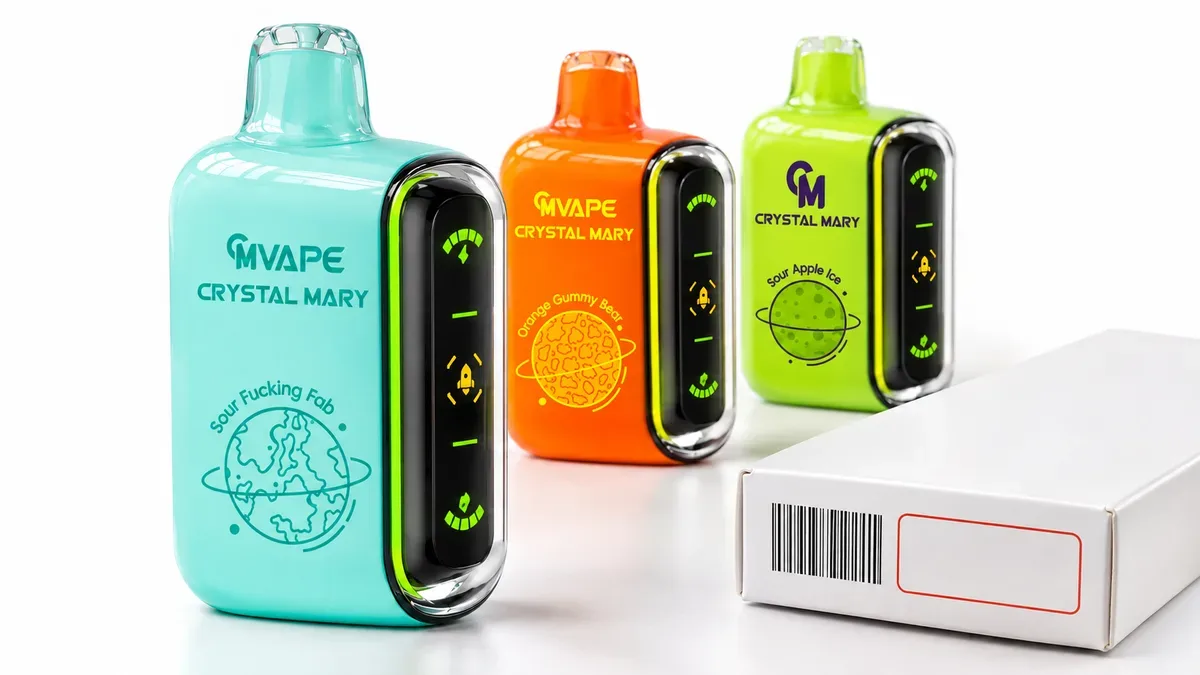
What does a 20,000-puff claim tell you about the device in your hand? Crystal Mary Pulse 20000 Puffs: Understanding the Advertised 20,000 Puff Rating and Safety Labels starts with reading the listing alongside the box. The listing gives you the brand’s puff claim, while the packaging can identify the nicotine strength and production lot. However, neither can predict how many days your device will last from the puff number alone.
What the Crystal Mary Pulse 20000 Puffs Rating Means
What the official Pulse 20K listing says
Crystal Mary’s official listing names the exact model Crystal Mary Pulse 20K and advertises up to 20,000 puffs. Specifically, the feature list uses “up to 20K puffs,” while the product description spells out the number. The phrase “up to” matters when a retailer shortens the title to “20,000 puffs.” The shorter wording can make an advertised upper figure sound like a fixed count.
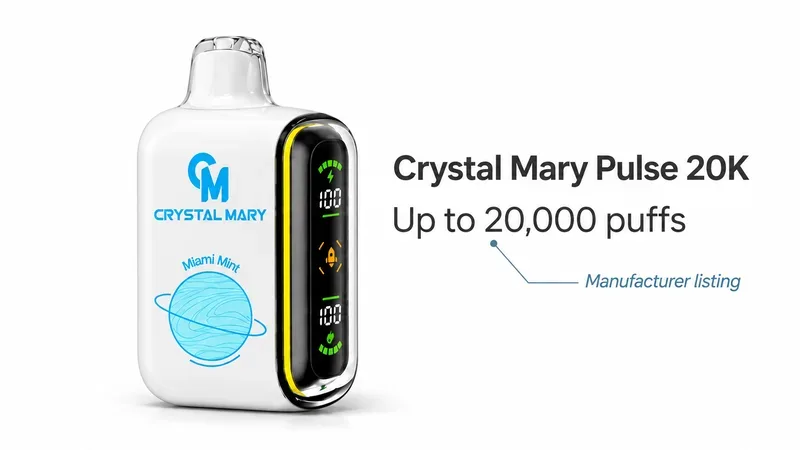
The same listing names a 650 mAh battery, a dual mesh coil, and a full-screen display. However, those features each describe a different part of the device. The battery figure describes its charge capacity, while the coil specification describes part of the heating system. The listing gives no formula for translating those specifications into the number of draws a person will get.
Start by matching the full model name on your carton to the model name on the brand’s page. For instance, a shared brand name or a similar box design can make two listings look like the same product. Moreover, even an exact name match leaves a separate question about which market the listing covers. Keep the listing’s specifications and your carton’s declarations separate when you write them down.
What the listing leaves open
No public model-specific puff-count protocol turned up in a review of the brand’s materials. Specifically, the listing gives no draw duration, air volume, interval between draws, or minimum aerosol output for a counted puff. It also leaves the sample size, variation between units, and charging schedule unspecified. Therefore, readers cannot reproduce the 20,000 figure from the information on the page.
Imagine two testers who both report 20,000 draws from a device. One could count every successful activation, while the other could count only draws that produce a defined amount of aerosol. Similarly, one tester could recharge during the run, while the other could stop when the battery first runs down. Each result would describe a different test, even if the totals happened to match.
The wording also gives no average, range, or breakdown by market variant. As a result, the clearest description is that Crystal Mary advertises up to 20,000 puffs for the Pulse 20K. That identifies the source and scope of the claim without assigning a test method to it.
How Vape Puff Counts Are Measured and Why Actual Counts Vary
A repeatable test defines each draw
A puffing machine draws air through a device according to a programmed pattern. Specifically, a protocol can set the air volume, draw duration, airflow profile, and time between the starts of successive draws. Those details let another laboratory repeat the same pattern and compare its results. The protocol also needs to say what qualifies as a successful puff.
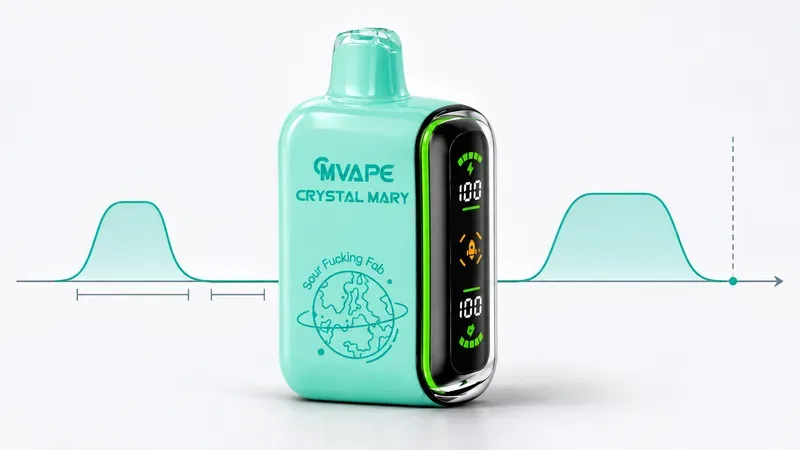
For instance, CORESTA’s recommended machine method for aerosol collection uses a 55 mL draw over three seconds. A new draw starts every 30 seconds, and the machine aims for an approximately constant flow during each draw. However, that example describes an analytical aerosol collection method. Crystal Mary’s listing does not identify it as the method behind the Pulse 20K claim.
Even a fully specified draw pattern leaves the question of when counting stops. For instance, a test could stop at the first failure to produce aerosol or after several consecutive failures. Another protocol could stop when output falls below a measured threshold. Consequently, two tests can use identical draws and still report different totals.
Charging rules can also change what a test measures. For instance, a test that stops at the first low-battery cutoff measures the draws available before that cutoff. If the device supports recharging, a test that allows it can continue until a different endpoint. Therefore, a report should say whether the tester recharged the unit and what ultimately ended the run.
Human draws vary, and settings can change output
People rarely take identical draws all day. For instance, the heating element may stay on longer during a four-second draw than during a two-second draw. If that longer activation uses more liquid and battery energy, the device may deliver fewer draws before reaching the endpoint. However, the amount of change depends on how the device responds.
Draws may also come in bursts, with long breaks between them. Similarly, a stronger draw can change airflow through the device compared with a gentler draw. Timing and airflow can affect coil cooling, aerosol output, and whether the device activates. Therefore, counting draws by itself leaves out several conditions that influence what each draw produces.
Where a device documents selectable output modes, a comparison should use the same mode or identify the setting for each result. For instance, a higher-output setting can use liquid faster if it produces more aerosol per draw. However, the Pulse 20K listing does not name a test mode for its 20,000-puff figure. A display or dual mesh coil alone gives no basis for assigning a puff count to a setting.
When comparing puff claims, look for matching draw conditions and a matching endpoint. Otherwise, the two numbers describe advertised totals whose test conditions may differ.
Can 20,000 Puffs Tell You How Many Days the Vape Will Last?
Days depend on two separate numbers
A lifespan estimate needs two inputs: the total usable draws and the average number of draws per day. The advertised count supplies neither a verified personal total nor a daily pattern. For instance, someone may take few draws on one day and many more on the next. Moreover, their draw length and the gaps between draws can change from day to day.
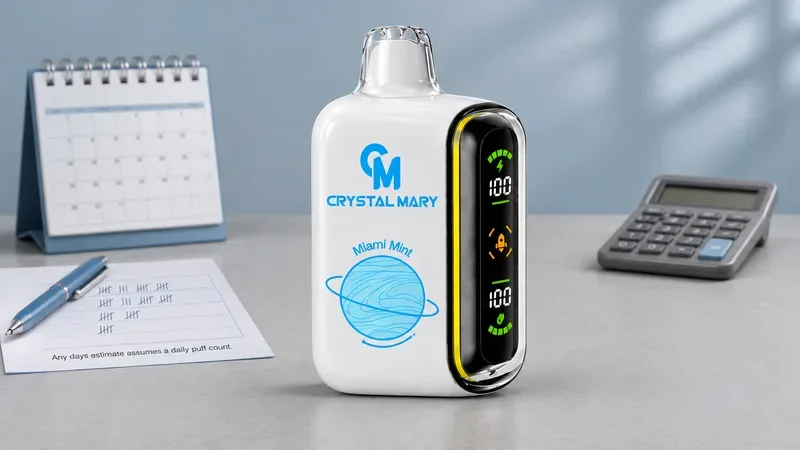
Consider a generic counter that records 840 usable draws across seven days. That works out to 120 draws per day over the period observed. However, the tally cannot show how many usable draws remain unless the remaining capacity is independently known. Even a careful daily count leaves that second number uncertain.
Likewise, dividing 20,000 by a daily average assumes the full advertised total applies to those draws. It also assumes your future daily average will match the one you entered. Consequently, an exact-looking result from a calculator can rest on two uncertain inputs. The puff claim gives no calendar end date on its own.
Puff count alone cannot quantify exposure or safety
Nicotine exposure depends on what the device delivers and what the body absorbs. Specifically, liquid strength, aerosol output, and a person’s draw pattern can influence exposure. Two people can log the same number of puffs and inhale different amounts of nicotine. Moreover, a puff tally cannot show how much of the inhaled nicotine reaches the bloodstream.
Similarly, the 20,000 figure gives no measurements of aerosol composition, battery safety, or nicotine delivery. The US Food and Drug Administration notes that nicotine is highly addictive and that e-cigarette aerosol can contain harmful chemicals. A count therefore cannot establish a safe number of draws or confirm that a product meets local requirements. Checking market status requires separate evidence about the exact product and jurisdiction.
If you want to compare two packages, write down the nicotine strength with its units and read each warning. Those details give you information the advertised puff count cannot supply.
Where to Find Crystal Mary Pulse 20000 Safety Labels and Nicotine Strength
Read the retail carton in your hand
Start with the exact model name and variant on the carton. Next, turn the box over and read the smaller print on its back, side panels, and end flaps. Look for an importer or distributor address, local-language text, or an explicit market designation. These clues can help you identify which market the package appears to address.
Specifically, look for nicotine, nicotine strength, mg/mL, or a percentage tied to nicotine. Copy the entire declaration, including any nearby wording that explains the units. For instance, “20 mg/mL” and “20 mg” communicate different things because only the first states an amount per millilitre. If the package lists liquid volume, record that figure separately in mL.
Meanwhile, check the front and back for a clearly marked health warning. Read any enclosed leaflet for additional information about ingredients, handling, or storage. If the carton carries a translated sticker, copy its text and note any visible differences from the original print. Photographs of the panels can preserve the wording and show where each declaration appears.
Keep the following details together if you need to compare the package with another source:
- Product identity. Record the exact model, variant, and any visible details about the intended market.
- Nicotine declaration. Copy the number, its units, and any wording that explains the basis of a percentage.
- Health warning. Record the complete wording and the panel where it appears.
- Traceability markings. Record any lot or batch number and note whether the carton provides separate verification instructions.
Why the market matters
Public materials for the Pulse 20K did not provide a verified set of complete packaging panels for each market. Therefore, the brand’s listing cannot settle the exact warning placement, nicotine declaration, or code format for every carton. A shop image may show a different sales region or only the front panel. Use photographs to compare details when the model, variant, and market match.
For instance, UK tobacco product regulations specify a nicotine addiction warning and batch information for products within their scope. Similarly, the US FDA publishes warning requirements for covered tobacco products, including a nicotine addiction statement where applicable. These rules explain why warning wording and presentation may differ across markets. They offer no direct evidence about the carton you have.
However, if the retailer lists one strength and the carton shows another, keep both declarations with their units. The mismatch could involve a different variant, a listing error, or an unclear percentage. Ask the seller or named importer to identify the exact package and explain the difference. Until they clarify it, the strength remains uncertain.
How to Read Vape Nicotine Strength in mg/mL and Percent
Check what the percentage measures
Milligrams per millilitre describes a mass of nicotine in a volume of liquid. For instance, a declaration of 20 mg/mL means each millilitre contains a nominal 20 milligrams of nicotine. The mL in the denominator is essential. It tells you that the figure describes concentration.
A percentage needs a definition before you convert it. Specifically, if a label declares 2% weight per volume, that means two grams of nicotine per 100 mL of liquid. Two grams equals 2,000 milligrams, so dividing by 100 gives 20 mg/mL. Therefore, multiplying the percentage number by 10 works when the basis is weight per volume.
However, 2% by weight means two grams of nicotine per 100 grams of liquid. That is 20 mg per gram of liquid. To convert to mg/mL, you also need the liquid’s density in grams per millilitre. For instance, a hypothetical density of 1.1 g/mL would give 22 mg/mL.
If your label prints a bare percentage, look nearby or in the leaflet for its basis. Similarly, if the package prints both percentage and mg/mL, record both before comparing them with another product. When the figures appear inconsistent, ask which basis and rounding the manufacturer used. A retailer’s arithmetic cannot substitute for a clear declaration on the exact variant.
Concentration, total nicotine, and absorbed nicotine
Imagine a generic liquid labelled 12 mg/mL in a container holding 2 mL. Multiplying the two figures gives 24 mg of nominal total nicotine in that liquid. Specifically, the millilitres cancel out, leaving milligrams. These figures illustrate the calculation and describe no Crystal Mary Pulse 20K variant.
Keep these three quantities in mind when reading a label:
- Liquid concentration. The example contains 12 mg of nicotine per millilitre of liquid.
- Nominal total nicotine. The declared concentration and volume imply 24 mg in the full liquid supply.
- Absorbed nicotine. The amount that reaches the body depends on delivery, inhalation, and uptake.
Meanwhile, some liquid may remain in a device when it stops producing aerosol. The nicotine carried into the aerosol and the amount someone inhales are separate measurements. Therefore, dividing the nominal total by an advertised puff count cannot give you a personal dose per puff. That calculation assumes complete transfer and uniform output across all counted draws.
If the carton gives a volume but no clear concentration, you cannot calculate nominal total nicotine from the volume alone. Likewise, a clear concentration still needs a matching liquid volume for that calculation.
What a Vape Batch Number or Verification Code Can Tell You
A lot number identifies a production group
Look for wording such as LOT, BATCH, or Batch No. near a printed or stamped string. For instance, it may appear close to a date, an end flap, or a barcode. Copy the full string, including leading zeros and punctuation. Photograph the surrounding print so the issuer can see which identifier you mean.
A manufacturer or importer can use its records to connect a batch to a production group. Depending on what the issuer records, that can lead to packing details, distribution records, or a recall notice. However, a lot number may cover many individual units. The characters alone usually reveal little without the issuer’s records or decoding instructions.
Similarly, a retail barcode can identify a product type that many packages share. A production date can help narrow down a search when it appears alongside a lot number. Therefore, keep each marking in its own field if you contact the producer or importer.
A verification result answers a narrower question
A verification code can also appear under a scratch panel or beside a QR code. However, a QR code can lead to ordinary product information, so check the packaging instructions first. If the brand offers a verifier for your market, open it through the brand’s official instructions. Then compare any model or variant returned with the details on your carton.
Specifically, a recognized result shows that the system accepted or recognized the submitted code under its own rules. A copied code can also appear on more than one package. Moreover, a repeat-scan message matters only in the context of the issuer’s explanation of repeat checks. A successful lookup provides no independent measurement of nicotine strength, product safety, or compliance.
If a code returns an error, check your transcription and whether you used the correct market verifier. If the result still looks wrong, record the message and contact the issuer with the model and lot details. Keep the full verification code out of public photos.
Conclusion
Crystal Mary advertises up to 20,000 puffs for the Pulse 20K, and no public model-specific test protocol turned up. Actual counts depend on how draws are taken and when counting stops. Meanwhile, the nicotine declaration describes strength, the warning communicates risk, and the lot number identifies a production group. A verification result tells you how the issuer’s system responds to the code.
Check the exact model and market on your box. Then record the nicotine strength with its units, the warning, and any lot marking. If you find a verification code, read the result using the brand’s official instructions for your market.
