

You sit at an outdoor café table, reach for your vape, and notice a no-smoking sign. Does it cover vaping too? Can you vape in outdoor dining areas in Australia? Usually, the answer is no. However, the exact rule depends on your state, territory, venue, and location within the premises.
Australia does not apply one identical hospitality rule nationwide. Instead, each jurisdiction defines outdoor dining areas, drinking zones, buffer distances, and exemptions differently. Moreover, councils and venue operators may introduce stricter conditions than the general law.
Therefore, a patio that permits vaping in one jurisdiction may prohibit it elsewhere. Even two areas inside the same beer garden can have different rules. This guide explains the national position and shows how to check before using a vape.
1. Can You Vape in Outdoor Dining Areas in Australia?
Vaping is generally prohibited in outdoor areas where customers eat food. Most Australian jurisdictions apply smoking restrictions to e-cigarettes, personal vaporisers, and similar devices. In fact, these restrictions commonly apply even when a vape contains no nicotine.

The legal boundary may extend beyond the table where someone eats. For instance, a buffer can cover nearby standing areas, walkways, or drinking spaces. Additionally, an outdoor area may become vape-free whenever the venue offers food there.
However, limited exceptions exist at some licensed premises. A hotel, club, or bar may operate a compliant designated area in certain jurisdictions. Most importantly, that exception does not give patrons permission to vape anywhere in the beer garden.
Why the safest assumption is “no”
A venue might call its space a courtyard, deck, terrace, rooftop, or beer garden. Nevertheless, the name rarely determines its legal status. Authorities usually examine how customers use the space, whether food is available, and how the venue manages it.
For example, imagine a pub with twenty outdoor tables. Twelve tables form a dining section, while eight sit inside an approved smoking area. Therefore, vaping at an empty dining table can remain unlawful, even when nobody nearby has ordered food.
A no-smoking sign should also alert anyone carrying a vape. In many jurisdictions, “smoking” rules expressly include vaping or apply to personal vaporisers. As a result, claiming that the device contains nicotine-free liquid will not usually create an exemption.
Patrons should assume an outdoor hospitality space is vape-free unless two conditions are satisfied. Current official guidance must permit vaping there, and venue staff must confirm the area’s approved status. Moreover, a venue may prohibit vaping voluntarily, even where legislation might otherwise allow it.
2. Australian Outdoor Vaping Laws by State and Territory
Every state and territory restricts vaping in hospitality settings, but the details are not identical. The following comparison gives a practical overview rather than personal legal advice. Therefore, check the relevant health department or regulator before relying on an exception.

New South Wales
New South Wales bans smoking and vaping in commercial outdoor dining areas. Covered places include seated dining areas at cafés, restaurants, hotels, clubs, and food fairs. Additionally, the restriction extends four metres from seated dining areas at licensed premises, restaurants, and cafés.
A ten-metre restriction applies around food stalls at organised events. However, licensed premises and restaurants may establish a compliant designated outdoor smoking or vaping area. That area must sit at least four metres from seated dining and satisfy other legal requirements.
Operators must take reasonable steps to prevent eating within the designated area. Moreover, they must display suitable signs. Patrons and businesses should verify details through NSW Health’s current smoke-free commercial outdoor dining guidance.
Victoria
Victoria prohibits smoking and vaping in outdoor dining areas at hospitality and food venues. The restriction also covers food fairs and organised events where vendors sell food. In addition, it can apply regardless of whether customers use formal tables and chairs.
Outdoor drinking areas require special attention. Vaping is prohibited when any part lies within four metres of an outdoor dining area. However, a solid wall at least 2.1 metres high may provide the separation required under Victorian rules.
Food type and service arrangements also matter when distinguishing dining from drinking. Therefore, businesses should review Victorian health guidance before offering snacks near a smoking area. Patrons can check the Department of Health’s smoke-free and vape-free area information.
Queensland
Queensland treats vapes as smoking products for its smoking restrictions. This approach covers devices with or without nicotine. Consequently, vaping is banned in enclosed areas and outdoor sections of businesses or organisations providing food or drink.
Some qualifying licensed venues may create a designated outdoor smoking area. Customers may smoke or vape and drink there, but they cannot eat there. Moreover, the venue must meet detailed requirements concerning location, management, signs, and food exclusion.
Queensland also regulates numerous nearby outdoor public places and buffer zones. Therefore, leaving a restaurant table may not take you into a lawful location. Queensland Health provides current guidance for eating and drinking venues, vaping restrictions, and enforcement.
Western Australia
Western Australia prohibits smoking and vaping in outdoor eating areas where people sit at tables to consume commercially provided food or drinks. This includes outdoor areas at restaurants, cafés, and similar businesses. Furthermore, enclosed public-place rules may independently cover partially enclosed patios.
Certain liquor-licensed premises that do not operate under a restaurant licence may provide a designated smoking and vaping zone. The zone cannot occupy more than half of the outdoor eating area. Additionally, it must remain unenclosed and at least five metres from a public entrance.
Clear signs must identify vape-free sections when such a zone exists. However, venues do not have to provide one and may prohibit vaping everywhere. The Western Australian Department of Health explains current public-place rules and operator duties.
South Australia
South Australia includes e-cigarette use within its smoke-free controls. Outdoor dining areas are smoke-free and vape-free while businesses offer or provide food for consumption there. Therefore, a venue cannot simply place an ashtray beside dining tables and call that section a vaping zone.
Timing can affect how an area operates. For example, a space may cease functioning as an outdoor dining area after food service ends. However, operators need clear procedures and should allow diners reasonable time to finish their meals.
Owners, proprietors, landlords, and others controlling the area have compliance responsibilities. Additionally, local restrictions can cover other nearby public spaces. SA Health publishes current information about smoke-free areas, outdoor hospitality requirements, and complaint procedures.
Tasmania
Tasmanian smoking rules include vaping, including the use of e-juice. Public outdoor dining areas generally prohibit smoking and vaping while customers eat solid food. Furthermore, the restriction applies where the business supplies tables or seating for customers who are eating.
Some licensed or dining premises may have a designated outdoor smoking area. That space must not receive staff service and must satisfy structural rules. Specifically, it needs no roof or sufficiently open sides under Tasmania’s enclosure test.
An outdoor dining area may sometimes operate differently outside meal periods. However, the kitchen’s status, actual food consumption, service, roof, and walls all matter. Businesses should confirm their layout with Tasmania’s Department of Health or a council environmental health officer.
Australian Capital Territory
The ACT prohibits smoking and vaping in outdoor eating and drinking areas. These rules cover personal vaporisers alongside tobacco and herbal smoking products. Accordingly, cafés, restaurant courtyards, pub terraces, and similar customer areas generally remain vape-free.
Some licensed clubs, pubs, and bars can maintain a designated outdoor smoking area. Customers may smoke or vape and drink there under controlled conditions. However, staff cannot serve food or drinks inside that area, and operators must follow management and signage requirements.
A prescription or pharmacy-supplied therapeutic vape does not override place-based restrictions. Therefore, users must follow the same location rules. ACT Health and Access Canberra provide current guidance for patrons and licensed businesses.
Northern Territory
The Northern Territory applies the same consumption restrictions to e-cigarettes as traditional tobacco products. Licensed venues must keep specified areas smoke-free, including food and drink service areas. Moreover, venue layouts and approved outdoor arrangements determine where vaping can occur.
A venue may have an outdoor smoking area when it meets Northern Territory requirements. Nevertheless, that permission does not extend into dining, service, or other mandatory smoke-free areas. Signs should help customers distinguish the permitted section from the rest of the premises.
Patrons should ask staff before vaping in a beer garden or licensed courtyard. Additionally, operators should confirm current licensing, signage, and area requirements with the Territory regulator. NT Government and NT Health publish the applicable venue and tobacco-control guidance.
3. Which Outdoor Hospitality Areas Are Vape-Free?
The legal classification of a space matters more than its marketing label. A restaurant may describe an area as a veranda, while legislation treats it as an outdoor dining area. Conversely, part of a beer garden may qualify as a designated smoking area.
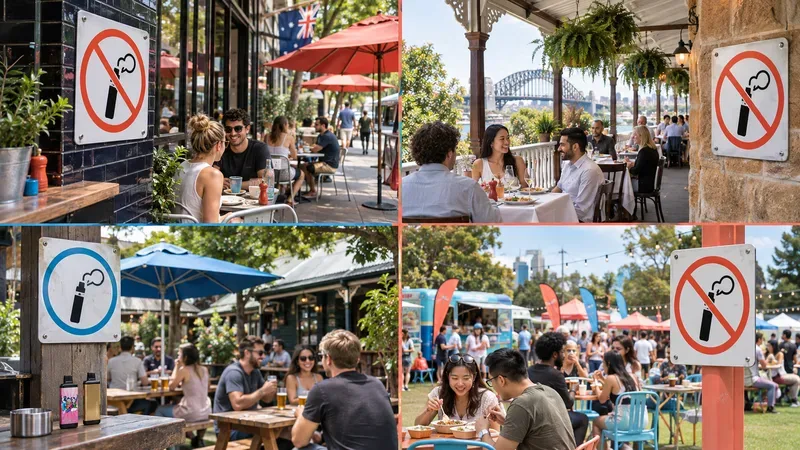
Food availability and consumption
Food often provides the clearest dividing line. If customers can buy, receive, or eat meals in an outdoor area, vaping will usually be prohibited. Additionally, some rules cover snacks, takeaway food, and food purchased from nearby vendors.
Consider a brewery courtyard with food trucks every Friday evening. The courtyard may become subject to food-related restrictions during trading hours. As a result, a location used for vaping on another day may become vape-free during the event.
However, removing menus from tables does not automatically change the area’s legal use. Authorities may consider where patrons actually eat and how staff manage the space. Therefore, operators need a genuine separation between dining and any permitted smoking or vaping zone.
Enclosure and airflow
An “outdoor” patio can still count as enclosed under local law. Roofs, walls, café blinds, windows, screens, and temporary coverings may contribute to the calculation. Notably, opening a sliding panel may not prevent an area from meeting an enclosure test.
For example, a terrace could have a roof and three sides covered by clear blinds. Customers may feel outdoor air entering through one open side. Nevertheless, the relevant formula could classify the terrace as an enclosed public place where vaping is prohibited.
Licensing, control, and proximity
A liquor licence can permit a venue to establish a designated area in some jurisdictions. However, it also brings strict conditions concerning food, service, size, signs, and separation. A restaurant licence may receive different treatment from a hotel or club licence.
Proximity creates another complication. A lawful area can become unsuitable because it sits near dining tables, entrances, air intakes, or another protected place. Furthermore, council rules may prohibit vaping across an entire footpath, plaza, beach, or event site.
Venue policy remains the final practical check. An operator can make its whole property vape-free even if legislation permits a designated zone. Therefore, customers must follow house rules alongside state, territory, and council requirements.
4. Distances, Barriers and Designated Vaping Areas
There is no universal Australian distance that makes vaping lawful near every outdoor dining area. Moving three, four, or five metres away may satisfy one rule but breach another. Moreover, the relevant measurement might begin at a table, boundary, entrance, stall, or service area.
How buffer distances work
New South Wales uses a four-metre restriction around certain seated dining areas and ten metres around food-fair stalls. Victoria restricts nearby outdoor drinking areas within four metres of outdoor dining. However, Victoria recognises a wall of at least 2.1 metres in the specified circumstances.
Western Australian designated zones must meet conditions that include distance from public entrances. Other jurisdictions apply separate buffers around buildings, playgrounds, transport stops, hospitals, or event facilities. Therefore, compliance requires checking every rule affecting the chosen spot.
Imagine stepping five metres from a café table toward a bus stop. You may leave one restricted boundary but enter another. As a result, distance alone cannot replace signs, official maps, or staff directions.
What counts as an effective barrier?
A decorative planter or rope usually does not create a legal barrier. Instead, legislation may require a wall with particular height, construction, or placement. Furthermore, temporary blinds can affect both barrier rules and whether the area counts as enclosed.
Operators should assess the complete layout, not one measurement. They should consider tables, service routes, doors, windows, roof coverage, ventilation, and neighbouring premises. Additionally, later furniture changes can undermine an arrangement that previously complied.
Designated areas are controlled exceptions
A designated smoking area may also allow vaping because local rules regulate both activities together. However, designation requires more than a handwritten sign. The venue may need a management plan, prescribed notices, food controls, structural separation, or limits on area size.
Staff may also face restrictions on serving or working inside the zone. Most importantly, patrons cannot create their own vaping area by moving a chair or standing beside an ashtray. Only the venue can identify and manage an approved area.
5. Signs, Enforcement, Fines and Venue Responsibilities
No-smoking signs commonly apply to vaping, even when the sign shows only a cigarette symbol. Some jurisdictions expressly promote the message that no smoking also means no vaping. Therefore, never treat the absence of a vape icon as permission.
Customers must stop vaping when an area falls within a legal prohibition. Meanwhile, staff and operators may need to display signs, remove ashtrays, explain the restriction, and respond to breaches. Event organisers and licensees can carry similar duties in areas they control.
What usually happens during enforcement?
Staff will often begin by informing the customer and asking them to stop. If the person refuses, staff may direct them to leave or move to an approved area. Additionally, authorised officers may inspect premises, investigate complaints, and issue formal penalties.
Fines may apply to the individual using the vape. Operators can also face consequences when they ignore prohibited conduct or fail to meet signage duties. However, penalty amounts and enforcement procedures can change, so current official guidance remains essential.
A single accidental puff does not give customers a right to continue. Therefore, the practical response is simple: stop immediately, apologise, and ask where vaping is allowed. Arguing with staff can turn a quick correction into removal from the premises.
For recurring problems, patrons can report concerns to the relevant health department, council, or licensing authority. Specifically, record the venue name, location, date, time, and affected area. Avoid confronting another customer when doing so could create a safety risk.
6. Practical Guidance and Outdoor Vaping FAQ
A quick decision process
- Look for food: Assume the space is vape-free when customers eat or receive food there.
- Read every sign: Treat no-smoking notices as covering vaping unless official guidance clearly says otherwise.
- Check nearby boundaries: Consider entrances, dining tables, food stalls, transport stops, and other protected places.
- Ask venue staff: Request directions to an approved area rather than choosing a quiet corner yourself.
- Confirm official rules: Operators should consult their state or territory regulator before establishing any designated zone.
Can I vape at an outdoor café table if nobody is eating?
Usually not. The area’s commercial purpose and setup may control its status, rather than one customer’s order. Therefore, an unused table inside an outdoor dining section generally remains vape-free.
Can I vape in a beer garden?
Only when that specific section lawfully permits it and the venue allows it. Many beer gardens include dining tables or food service. However, some licensed venues maintain clearly separated designated areas under local rules.
Does a nicotine-free vape avoid the ban?
Generally, no. Most jurisdictions regulate vaping devices or the act of vaping, not merely nicotine consumption. As a result, nicotine-free liquid usually receives no special location exemption.
Does permission from a staff member guarantee legality?
No. Staff advice helps identify venue arrangements, but it cannot override legislation or council restrictions. Therefore, operators should train employees, and patrons should follow official guidance when uncertainty remains.
Can a venue ban vaping where the law might allow it?
Yes. Businesses can adopt stricter smoke-free and vape-free policies across their property. Most importantly, customers must comply with those conditions or leave the premises.
Conclusion
Vaping is generally prohibited in Australian outdoor dining areas and commonly follows smoking restrictions. This usually includes nicotine-free devices. However, exact boundaries, drinking-area exceptions, designated zones, enforcement arrangements, and penalties depend on the jurisdiction.
Council rules and venue policies may impose further restrictions. Therefore, never assume a patio, terrace, or beer garden permits vaping because it sits outdoors. Before vaping, check the relevant health department’s current guidance, read every sign, and ask staff to direct you to an approved area.
