

You step onto a Melbourne footpath with a vape in hand, but can you legally use it there? Can You Vape in Melbourne’s Public Spaces? The answer depends on your exact location. Victorian laws, City of Melbourne rules, venue policies, event conditions, and signs can all restrict vaping.
In fact, moving several metres can change the legal position. A plain footpath might allow vaping, while a nearby café zone, tram platform, or playground does not. Therefore, checking boundaries matters as much as checking whether you are outdoors.
This guide explains the rules location by location. It covers Melbourne streets, parks, transport, hospitality areas, beaches, events, distance limits, enforcement, and practical ways to avoid a fine.
1. Can You Vape in Melbourne’s Public Spaces?
Vaping is not prohibited in every outdoor public space in Melbourne. However, Victorian law bans it in designated smoke-free and vape-free places. Melbourne also has locally prescribed smoke-free areas that include open streets, lanes, parks, tracks, and market spaces.

An ordinary outdoor street or open space may permit vaping when no restriction applies. Specifically, you must check state law, council rules, venue policies, event conditions, and displayed signs. Any one of these controls may make the location vape-free.
Outdoor does not automatically mean permitted
Consider someone walking along a wide CBD footpath. The footpath itself may not fall under a general statewide ban. However, it could pass through an outdoor dining area or a City of Melbourne smoke-free precinct.
Moreover, the same footpath might sit within four metres of a protected school entrance. It may also form part of a tram platform or an event site. Therefore, judging the location only by its open-air appearance can produce the wrong answer.
Victoria generally regulates vaping in the same smoke-free settings as tobacco smoking. This approach applies whether a vaping product contains nicotine or not. Consequently, a sign mentioning a smoke-free area should usually alert you that vaping is also prohibited.
Five layers can control one location
- Victorian law: Statewide restrictions cover transport, dining areas, schools, playgrounds, pools, and other protected places.
- City of Melbourne rules: The council prescribes additional streets, lanes, parks, tracks, and public areas as smoke-free.
- Property policies: Hospitals, universities, shopping centres, workplaces, and attractions may prohibit vaping across their entire grounds.
- Event conditions: Organisers may create temporary vape-free boundaries covering entrances, queues, seating areas, and event grounds.
- Displayed restrictions: Signs can identify a legal boundary or communicate an enforceable property condition.
Most importantly, permission is location-specific rather than citywide. If no ban, policy, event condition, or sign applies, outdoor vaping may be lawful. Nevertheless, moving away from crowds, doorways, children, and food service remains the safer practical choice.
2. Melbourne Vaping Rules by Location
The table below gives a quick classification of common Melbourne locations. However, temporary restrictions and property policies may create stricter rules. Always treat signs and staff directions as important location-specific information.
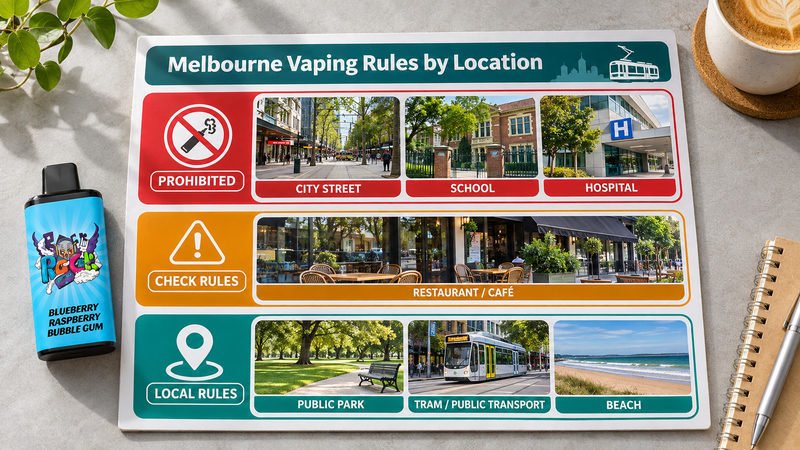
| Location | General position | Important boundary or condition |
|---|---|---|
| Ordinary outdoor street or footpath | Conditionally permitted | Allowed only when no state, council, venue, event, or posted restriction applies. |
| City of Melbourne prescribed smoke-free area | Prohibited | The signed and mapped boundary can include streets, lanes, parks, tracks, and market spaces. |
| Enclosed workplace | Prohibited | The ban includes enclosed shopping centres, restaurants, licensed premises, and substantially enclosed workplace car parks. |
| Commercial outdoor dining area | Prohibited | The entire dining area is vape-free, even when no customer is currently eating. |
| Outdoor drinking area | Conditional | Vaping is banned if any part lies within four metres of dining, unless a qualifying wall separates them. |
| Train, tram, or bus | Prohibited | The prohibition applies throughout the vehicle. |
| Train station | Prohibited | All station areas are covered, not merely enclosed waiting rooms. |
| Tram platform or transport shelter | Prohibited | Raised tram platforms and tram or bus shelters are covered. |
| School, kindergarten, preschool, or childcare grounds | Prohibited | The whole property and the area within four metres of an entrance are vape-free. |
| Public hospital or registered community health centre entrance | Prohibited | Keep at least four metres from the entrance; broader property policies may also apply. |
| Children’s playground equipment | Prohibited | The equipment and everything within ten metres are covered. |
| Outdoor public skate park | Prohibited | The skate park and a ten-metre surrounding zone are vape-free. |
| Under-age sporting event | Prohibited | The relevant sporting venue and the area within ten metres are covered during the event. |
| Public swimming pool complex | Prohibited | All outdoor areas inside the complex perimeter are vape-free. |
| Patrolled beach | Partly prohibited | The flagged area and a 50-metre radius around each lifesaving flag are covered during patrol. |
| Private motor vehicle | Conditional | Vaping is illegal when anyone under 18 is present in the vehicle. |
| Under-age music or dance event | Prohibited | The restriction applies throughout the event area. |
| Festival or organised outdoor event | Location-specific | Check event boundaries, dining zones, food vendors, family facilities, tickets, and signs. |
How to use the table in real life
Start with the immediate feature nearest you. For instance, notice any tables, food service, platform markings, playground equipment, flags, gates, or entrance doors. Then estimate the relevant distance from that feature.
Additionally, look beyond the obvious boundary. A hospital may prohibit vaping throughout its grounds, although state law highlights a four-metre entrance zone. Likewise, an event organiser may declare an entire fenced festival site vape-free.
Finally, check whether a local restriction covers the wider precinct. The City of Melbourne maintains prescribed smoke-free locations under its local law. These areas can include otherwise ordinary-looking open-air public spaces.
3. Vaping in Melbourne CBD, Streets, Parks, and Landmarks
Vaping is not subject to a blanket ban across every Melbourne CBD street. Therefore, an ordinary open footpath may permit it when no specific restriction applies. However, the CBD contains many overlapping transport, dining, workplace, council, and venue boundaries.
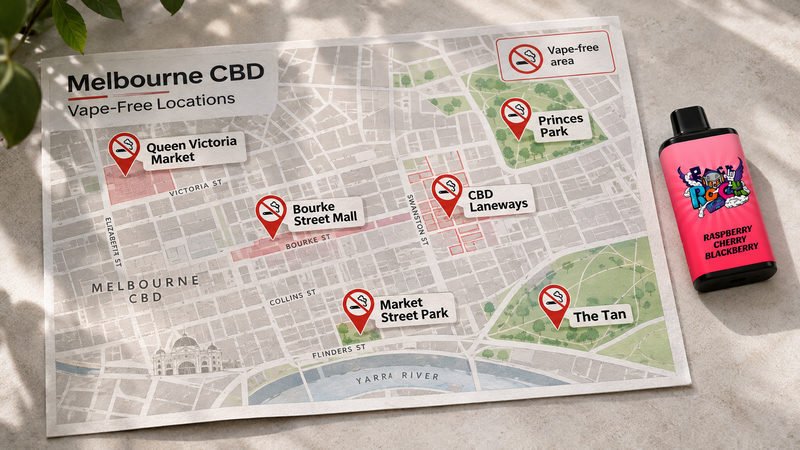
For example, a person may leave a shop and stand on the pavement. Yet that position could remain inside a commercial outdoor dining area. It could also fall within a locally prescribed smoke-free street or lane.
CBD streets and footpaths
The City of Melbourne has declared several public areas smoke-free, and vaping is included. These locations include selected streets, lanes, parks, running tracks, and Queen Victoria Market. Notably, Bourke Street has a prescribed section between Elizabeth Street and Russell Place, including the mall.
Other prescribed locations include The Causeway, Howey Place, Block Place, Equitable Place, Collins Way, and Fulham Place. McKillop Street and Goldsbrough Lane also appear among the council’s listed areas. Moreover, signs help identify the boundaries on the ground.
Do not assume that all of Bourke Street, every lane, or the entire CBD follows one rule. Specifically, local boundaries can start or finish at a particular intersection or property line. Check the current council map before relying on memory.
Parks, gardens, and running tracks
A public park is not automatically vape-free merely because the council owns it. However, protected facilities inside the park can create no-vaping zones. A playground, skate park, pool complex, organised junior sports venue, or outdoor dining area may trigger a ban.
For instance, vaping on an open lawn may appear permissible. Yet swings located eight metres away place that lawn inside the ten-metre playground zone. As a result, the equipment’s position matters more than the park’s general name.
Additionally, the City of Melbourne has prescribed certain recreational spaces as smoke-free. The Tan running track and Princes Park running track are prominent examples. Market Street Park also has a local smoke-free designation.
Landmarks, campuses, and attractions
Major landmarks often operate under their own conditions of entry. Museums, stadiums, galleries, universities, markets, gardens, and shopping precincts may prohibit vaping throughout their property. Therefore, an outdoor courtyard within a landmark can remain vape-free.
Moreover, a venue can set stricter rules than the minimum legislation. It may limit vaping to a marked area or prohibit it completely. Security staff can also direct visitors to leave a restricted area.
A useful test involves three questions. First, does Victorian law protect a feature nearby? Second, has the council prescribed the space as smoke-free? Finally, does the operator display a policy or sign?
- Check entrances, gates, tables, platforms, playgrounds, and event fencing.
- Read signs at both ends of a street or lane.
- Ask staff before vaping on a campus or attraction.
- Move well beyond the minimum distance when boundaries seem unclear.
4. Public Transport, Vehicles, Dining, and Drinking Areas
Melbourne commuters face some of the clearest vaping restrictions. You cannot vape on trains, trams, or buses. Furthermore, the ban covers train stations, raised tram platforms, and tram or bus shelters.
Stepping through a vehicle door does not always place you outside the prohibited area. For example, leaving a train onto a platform keeps you within a vape-free station. Likewise, standing beside a shelter can remain problematic if you are still inside its covered boundary.
Stops, stations, platforms, and queues
Wait until you have completely left the station or designated platform area. Then check for another nearby restriction, such as outdoor dining or a council smoke-free zone. In fact, busy CBD stops often sit beside cafés and building entrances.
At a basic roadside stop without a shelter, the statewide transport restriction may differ from a shelter or raised platform. However, signs, operator rules, or surrounding restrictions may still apply. Therefore, moving away from the stop and waiting crowd is sensible.
Cars, taxis, and other vehicles
Victoria prohibits vaping in a motor vehicle when a person under 18 is present. The rule applies whether the vehicle is moving or stationary. Consequently, opening a window does not remove the prohibition.
A taxi, rideshare vehicle, work vehicle, or rental car may also carry a complete operator ban. Additionally, an enclosed work vehicle may engage workplace rules. Check the owner’s policy instead of assuming a private vehicle creates an unrestricted space.
Outdoor dining and drinking
Vaping is prohibited in every commercial outdoor dining area in Victoria. The ban applies to footpath tables, courtyards, rooftops, balconies, and similar dining spaces. Importantly, an area can remain classified for dining even when no meal sits on a table.
Outdoor drinking areas require closer attention. Vaping is prohibited when any part of the drinking area lies within four metres of an outdoor dining area. However, a wall at least 2.1 metres high may provide the required separation.
Furthermore, a roof and substantial walls can make a drinking space legally enclosed. If actual wall surfaces exceed 75% of the notional wall area, vaping is prohibited there. Thus, a covered beer garden may not qualify as truly open.
- Do not vape at a table where food may be served.
- Do not rely on the absence of plates or customers.
- Check whether one venue combines dining and drinking sections.
- Ask staff where the approved smoking or vaping area begins.
- Respect a complete venue ban even when legislation might permit a separate area.
5. Four-Metre and Ten-Metre Vape-Free Zones
Melbourne’s distance rules become easier when you remember two numbers: four metres and ten metres. However, these measurements do not cover every restriction. Whole-property bans can apply before you even consider a buffer.
Remember the four-metre rule for entrances and dining
Four-metre restrictions commonly protect entrances used by children, patients, and the public. They apply outside childcare centres, kindergartens, preschools, and primary or secondary schools. Moreover, vaping is banned throughout the grounds of these learning environments.
The entrance buffer also applies to children’s indoor play centres. Public hospitals and registered community health centres receive similar protection. Certain Victorian Government buildings, including courts, Parliament, and police stations, also have protected entrances.
Additionally, four metres matters between outdoor drinking and dining areas. If any part of a drinking area falls within that distance, the drinking area becomes vape-free. A qualifying wall of at least 2.1 metres can create an exception.
- School and childcare grounds, plus four metres from entrances
- Entrances to children’s indoor play centres
- Entrances to public hospitals and registered community health centres
- Entrances to certain Victorian Government buildings
- Outdoor drinking areas positioned within four metres of outdoor dining
Measure from the relevant entrance or area boundary, not from another person. In practice, four metres roughly equals the length of a small car. However, stepping farther away reduces disputes over uncertain measurements.
Remember the ten-metre rule for recreation and food vendors
Ten-metre restrictions focus mainly on children’s recreational spaces. Vaping is banned at and within ten metres of outdoor public playground equipment. The rule starts at the equipment, including swings, slides, climbing frames, and grouped play structures.
Likewise, outdoor public skate parks carry a ten-metre vape-free zone. Sporting venues receive the same buffer during organised under-age sporting events. Specifically, the protected venue can include playing surfaces and associated spectator seating.
At organised outdoor events, vaping is also prohibited within ten metres of a food stall or food vendor. An exception may apply to a food fair under the relevant dining framework. Nevertheless, organisers may impose a broader event-wide ban.
- Outdoor public playground equipment
- Outdoor public skate parks
- Sporting venues during organised under-age events
- Food stalls or vendors at organised outdoor events
Property-wide bans override simple distance calculations
A four-metre entrance buffer does not promise permission elsewhere on the property. Hospitals, schools, workplaces, stadiums, and universities may prohibit vaping across their grounds. Furthermore, public swimming pool restrictions cover all outdoor areas inside the complex perimeter.
Therefore, do not stand five metres from a door and assume compliance. First, check whether the entire site has a no-vaping policy. Then confirm that no ten-metre zone or separate restriction overlaps your position.
6. Can You Vape at Melbourne Beaches and Outdoor Events?
Melbourne beaches can contain both permitted and prohibited sections. At a patrolled beach, vaping is banned between the red-and-yellow lifesaving flags. The prohibited area also extends within a 50-metre radius of each flag.
The beach rule applies during patrolled periods when the flags are in place. Moreover, the statutory zone does not extend beyond the landward edge of the sanded area. However, council rules or signs may restrict adjoining paths, lawns, reserves, or facilities.
Assessing a beach location
First, find the lifesaving flags and identify the swimming zone. Then allow 50 metres around each flag while remaining aware of the sand’s landward edge. Finally, check nearby signs, playgrounds, dining terraces, and lifesaving club policies.
For example, an unflagged stretch of sand may sit outside the statewide beach zone. Yet a playground ten metres away could still prohibit vaping there. Additionally, a council may establish a broader smoke-free beach or reserve area.
Festivals, markets, concerts, and sporting events
Outdoor events often create several overlapping zones. Food vendors generate ten-metre restrictions, while commercial dining areas remain completely vape-free. Under-age music or dance events also prohibit vaping throughout the event.
Meanwhile, a festival organiser can make the whole fenced site vape-free. Ticket conditions may limit vaping to designated sections or ban it entirely. Therefore, leaving a performance crowd does not necessarily place you beyond the event boundary.
Sporting events require special care when participants are under 18. Vaping is prohibited at the outdoor venue and within ten metres during an organised under-age event. On the other hand, an adult event may follow different statutory rules, although venue policies still apply.
- Look for red-and-yellow flags and beach patrol signs.
- Identify playgrounds, pools, food vendors, and dining areas.
- Check fences, wristband zones, ticket terms, and entry notices.
- Follow temporary signs and announcements from event organisers.
- Ask security or event staff where vaping is permitted.
7. Fines, Enforcement, Reporting, and Legal Vaping Tips
Authorised inspectors, council officers, transport officers, venue staff, and police may have different enforcement roles. Education or a request to stop may come first in some settings. However, authorities can issue infringement notices or pursue court penalties where legislation allows.
For many Tobacco Act location offences, an individual may face an infringement of one penalty unit. A maximum court penalty of five penalty units may apply to several common offences. Since Victoria indexes penalty-unit values, the dollar amount can change each financial year.
Transport offences use a separate enforcement process and fine schedule. Authorised Officers may report an alleged offence for review rather than issue a fine immediately. Moreover, venue operators can require someone to stop or leave under property conditions.
A practical compliance checklist
- Check the immediate area for no-smoking or no-vaping signs.
- Look for dining tables, food stalls, platforms, shelters, flags, and playground equipment.
- Keep more than four metres from protected entrances.
- Keep more than ten metres from playgrounds, skate parks, junior sport, and event food vendors.
- Confirm whether the entire property or event prohibits vaping.
- Ask the responsible operator when the boundary remains unclear.
- Stop immediately if an authorised person identifies a restriction.
Concerns about vaping in most protected public areas can be reported to the relevant local council. Public transport complaints should go to the transport operator or Transport Victoria. Suspected illegal vape supply can be reported through the appropriate government reporting channel.
Public-use rules and product-supply rules are separate
A lawful place to vape does not prove that a product was lawfully supplied. Australian rules generally restrict vape sales to participating pharmacies for therapeutic purposes. Non-pharmacy retailers, including convenience stores and vape shops, cannot lawfully supply vaping goods.
In Victoria, pharmacies cannot supply vaping products to anyone under 18. Adults may access eligible lower-nicotine therapeutic products without a prescription when a participating pharmacist considers supply appropriate. Other products and circumstances can require a prescription.
For current public-use restrictions, consult the Victorian Government smoke-free and vape-free guidance. Additionally, verify pharmacy supply requirements through official therapeutic vaping information. These rules can change independently of location bans.
Conclusion
Vaping is not banned in every Melbourne outdoor space. However, Victorian law prohibits it around protected entrances, transport facilities, dining areas, children’s recreation, patrolled beach zones, and several other locations. City rules, venue policies, event conditions, and signs can create additional vape-free areas.
Therefore, open air alone never confirms that vaping is legal. Keep clear of protected entrances and facilities, inspect the surrounding boundary, and follow every displayed restriction. When uncertainty remains, ask the council, venue, transport operator, or event organiser.
Before vaping, check the latest Victorian Government smoke-free guidance and the City of Melbourne’s current smoke-free area map. A quick check can prevent an avoidable fine. More importantly, it helps protect nearby families, workers, commuters, and visitors.
