

You are vaping on your rental balcony when vapour drifts toward a neighbour’s open window. Could one cloud trigger a complaint, breach notice, or bond claim? Can You Vape in a Rental Property in Australia? The answer depends on more than whether vaping products are lawful.
Australia has no single nationwide tenancy rule covering every rental vaping situation. Instead, your lease, local laws, building rules, chosen location, and effects on neighbours all matter. Therefore, conduct allowed in one rental may cause serious problems in another.
This guide covers houses, apartments, balconies, courtyards, and common areas. Moreover, it explains restrictions, damage, complaints, inspections, breach procedures, and reliable sources of local advice.
1. Can You Vape in a Rental Property in Australia?
The concise answer is sometimes, but never automatically. A private rental home does not fall under one universal Australian tenancy rule about vaping. Instead, permission depends on the agreement, state or territory legislation, applicable building rules, and the consequences of vaping.

Private homes also differ from public and shared places. Enclosed public areas, workplaces, and many communal facilities face stronger smoke-free controls. Furthermore, some laws apply equally to smoking and vaping, while other documents use narrower wording.
Product legality and rental permission are separate
Australia regulates how people obtain vaping products. However, lawful access or possession does not create a right to use a vape anywhere. Rental agreements, strata rules, public-health laws, and general tenant obligations operate separately.
Likewise, a therapeutic product does not remove restrictions on its use. For instance, a renter may lawfully possess a vape yet breach an express indoor vaping condition. Therefore, tenants must examine both product rules and property rules.
Four situations can produce different answers
- Detached house: The lease and obligations concerning damage, nuisance, and safety usually carry the greatest importance.
- Apartment interior: The lease applies, while vapour movement and strata rules may create additional concerns.
- Private balcony: The answer depends on lease boundaries, by-laws, nearby openings, and vapour drift.
- Shared corridor: Smoke-free rules, building policies, or common-property by-laws may prohibit vaping entirely.
Notably, legislation and agreements do not always treat smoking and vaping identically. Some documents expressly mention e-cigarettes, vapour, or vaping devices. Others mention only smoking, making the definition and local interpretation important.
2. Rental Agreements, No-Smoking Clauses and Landlord Rules
Start with the written rental agreement. An express no-vaping term may prohibit vaping indoors, outdoors, or across the entire property. Specifically, check whether the condition covers the premises, grounds, balconies, visitors, or only enclosed rooms.
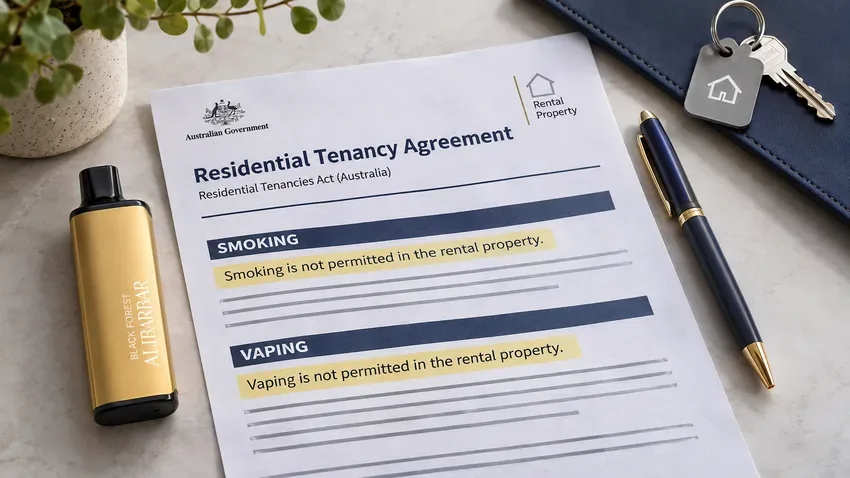
A clause may also prohibit smoking without mentioning vaping. However, tenants should not assume that “no smoking” definitely includes or excludes e-cigarettes. The agreement’s definitions, surrounding wording, and relevant local law may determine its effect.
Additional terms must comply with tenancy law
A landlord can propose special conditions concerning smoking or vaping. Nevertheless, state and territory legislation may regulate additional terms and restrict inconsistent, unlawful, or unfair conditions. A signed clause does not necessarily become enforceable merely because it appears in an agreement.
Therefore, tenants who question a condition should obtain local tenancy advice. They should not simply ignore it. A tribunal may need to decide whether a disputed term applies or can be enforced.
A silent lease is not automatic permission
An agreement without a vaping clause leaves other responsibilities intact. Renters must still avoid property damage, unreasonable disturbance, safety hazards, and interference with neighbouring residents. Additionally, strata by-laws can apply even when the lease says nothing about vaping.
Imagine a renter vaping daily beside a shared ventilation intake. The agreement contains no vaping condition, yet vapour repeatedly enters the next apartment. In fact, that conduct could still prompt nuisance allegations or action under building rules.
The safest approach involves asking the landlord or property manager for written clarification. Specifically, identify the proposed location and ask whether any lease or building rule prohibits its use. Keep the response with your agreement, condition report, and other tenancy records.
Before signing, inspect every relevant document. Review special conditions, property rules, strata by-laws, and written representations from the inspection. Most importantly, request clarification before paying the bond when vaping access could affect your decision.
3. Where Vaping May Be Restricted: Rooms, Balconies and Common Areas
Inside a detached rental house, the lease may provide the main restriction. However, ordinary duties concerning care, nuisance, and safety still apply. A tenant should never treat privacy inside the house as permission to cause damage or hazards.

Apartments add another layer. Vapour may enter neighbouring homes through windows, doors, vents, or gaps around shared services. Moreover, tenants in strata properties generally must follow by-laws applying to residents, occupants, and visitors.
Balconies, patios, and private courtyards
An outdoor area does not automatically permit vaping. First, check whether the balcony, patio, or courtyard forms part of the rented lot or common property. Then examine the lease, by-laws, proximity to openings, and potential for vapour drift.
Owners corporations, bodies corporate, and comparable strata organisations may regulate conduct across a development. Depending on local law, rules may address private lots, balconies, gardens, and shared spaces. However, the validity and reach of those rules vary between jurisdictions.
Common areas often carry stronger restrictions
Corridors, lifts, stairwells, foyers, car parks, and shared laundries may fall under common-property rules. Communal gyms, pools, rooftop areas, and barbecue spaces can also carry separate restrictions. Additionally, public-health laws or building policies may prohibit vaping in certain enclosed or shared areas.
Consider two renters using identical devices. One vapes occasionally in the open backyard of a detached house without causing drift. Meanwhile, the other vapes in an apartment hallway beside several doors.
The first renter may face only the lease and general tenant obligations. In contrast, the second renter could breach common-property rules or applicable smoke-free requirements. Therefore, the location can change the legal position completely.
Use only areas that written rules clearly permit. Furthermore, remain well away from doors, windows, vents, and air-conditioning intakes. Stop or relocate if vapour enters another home, even when you remain inside your rental boundary.
4. Vapour Drift, Neighbour Complaints and Quiet Enjoyment
Vapour does not always remain around the person using the device. It can pass through open windows, balcony doors, ventilation systems, and shared spaces. Consequently, vaping inside one apartment may affect someone several metres away.
Persistent or substantial drift can generate nuisance complaints. Relevant factors may include frequency, duration, intensity, time of day, and effects on residents. However, one brief and isolated incident will not necessarily establish a legal breach.
Quiet enjoyment works in both directions
Renters generally have rights concerning peaceful use and privacy within their homes. Neighbours also expect to use their residences without repeated outside interference. Therefore, ongoing vapour intrusion may support an allegation that someone’s reasonable enjoyment has been disrupted.
For example, suppose vapour enters a child’s bedroom every evening through an open window. The affected household complains several times, but the vaping continues beside that window. Notably, this pattern appears more serious than one accidental drift event.
Complaints and useful evidence
An affected resident may contact the landlord, property manager, strata committee, owners corporation, or body corporate. In some situations, the person may also contact a tenancy authority, health authority, council, or tribunal. The correct pathway depends on the location and applicable rule.
Evidence may include:
- Contemporaneous logs recording dates, times, duration, and affected rooms.
- Photographs or video gathered lawfully and without invading another person’s privacy.
- Witness accounts from residents, visitors, or building staff.
- Emails, letters, complaint notices, and responses from the parties.
- Inspection records, ventilation reports, or professional assessments where necessary.
Early discussion often prevents a larger dispute. For instance, the renter might change balconies, adjust timing, or use a clearly permitted location away from openings. Additionally, everyone should record any agreed arrangement in writing.
Keep communication factual and respectful. Avoid accusations about health conditions or product legality unless reliable evidence supports them. Most importantly, focus on the observed drift, its effect, and practical ways to prevent repetition.
5. Property Damage, Cleaning Costs and the Rental Bond
Vaping may affect a property, although results vary considerably. Product composition, frequency, ventilation, surface materials, and tenancy length can influence residue or scent. Over time, walls, ceilings, windows, and fixtures may require additional cleaning.
However, a landlord should not assume that every vaping tenant caused visible damage. Some properties show no identifiable effects, while frequent indoor use may leave residue or discolouration. Therefore, actual condition evidence matters more than speculation.
Damage can extend beyond airborne residue
E-liquid can spill onto carpets, timber, paint, and furniture supplied with the property. Devices may also cause impact damage, burns, or heat marks. Furthermore, damaged or incorrectly charged batteries can create serious fire and safety risks.
Store devices upright and protect liquid containers from children, pets, and direct heat. Additionally, use suitable charging equipment and follow the manufacturer’s safety directions. Clean spills promptly without applying products that could damage the surface further.
Fair wear and tear versus tenant-caused damage
Fair wear and tear covers ordinary deterioration arising from normal residential use. In contrast, unusual staining, burns, spills, or excessive cleaning needs may amount to tenant-caused damage. The distinction depends on the evidence and the applicable tenancy law.
A landlord seeking bond money generally needs to connect the claimed expense with the tenancy. Moreover, the amount should reflect reasonable cleaning or repair costs. An unsupported statement that “the tenant vaped” may not prove either damage or financial loss.
Useful evidence can include:
- Detailed entry and exit condition reports.
- Dated photographs showing the same surfaces before and after the tenancy.
- Routine inspection notes and relevant correspondence.
- Itemised cleaning invoices or repair quotations.
- Professional assessments where the cause or treatment remains disputed.
Tenants should complete the entry report carefully and photograph every room. Specifically, record existing marks, odours, discolouration, damaged flooring, and dirty windows. At departure, take comparable photographs after cleaning and retain the original files.
Ventilation may reduce accumulation, but only use it where vaping itself remains permitted. Opening a window can also direct vapour into another residence. Therefore, ventilation does not excuse a lease breach or nuisance.
6. Breach Notices, Inspections and Possible Eviction
Vaping may become an alleged tenancy breach through several routes. These include violating an express term, using a prohibited common area, damaging property, creating safety risks, or disturbing neighbours. Repeated conduct after warnings can make the allegation more serious.
A typical process starts with a complaint or observation. The landlord, agent, or building manager may then gather statements, photographs, inspection records, or correspondence. Where local law allows, the next step may involve a formal notice requiring the tenant to remedy the breach.
Eviction is not usually immediate or automatic
A vaping allegation does not automatically end a tenancy. Valid grounds, notice forms, response periods, and decision-making procedures vary across Australia. Furthermore, a tribunal or court may need to consider disputed facts before possession can change.
Some problems may be remedied by stopping the conduct or following an enforceable direction. A tenant might also repair damage or pay an agreed, properly supported expense. However, serious damage or repeated unresolved breaches may produce stronger consequences.
Inspections must still follow lawful procedures
Suspicion of indoor vaping does not cancel a renter’s privacy rights. Landlords and agents must use lawful reasons for entry and provide the required notice. Additionally, they must follow local limits concerning timing, frequency, and inspection conduct.
A neighbour’s complaint may justify communication or further investigation. Nevertheless, it does not generally authorise an agent to enter without proper notice. Emergencies can follow different rules, especially where fire or immediate safety risks exist.
Responding to an allegation
Never ignore a breach notice or building notice. Read every allegation, identify the rule cited, and check the response deadline. Then answer in writing and keep proof that you sent the response.
Preserve the agreement, by-laws, photographs, inspection reports, messages, and witness details. Moreover, explain any factual disagreement clearly without making unsupported admissions. Obtain tenancy advice promptly if the notice threatens termination or claims substantial damage.
Continue meeting unrelated obligations, including rent payments. In fact, withholding rent can create a separate problem even when the vaping allegation seems unfair. Follow any enforceable direction while seeking advice about review or dispute options.
7. State Rules, Therapeutic Vapes and Practical Next Steps
Residential tenancy rules differ across every Australian jurisdiction. New South Wales, Victoria, Queensland, Western Australia, South Australia, Tasmania, the Australian Capital Territory, and the Northern Territory use different legislation and procedures. Their terminology, notices, smoke-free requirements, and strata frameworks also vary.
Therefore, avoid relying entirely on advice written for another state. Check your state or territory tenancy authority, consumer affairs agency, tenants’ service, strata regulator, or tribunal. For complex disputes, consult a qualified legal adviser who practises in your jurisdiction.
Vaping product laws answer a different question
Australia’s rules governing access to vaping products operate separately from rental law. Current federal arrangements generally channel lawful vape sales through participating pharmacies for therapeutic purposes, subject to applicable conditions. Official Australian health guidance should be checked because product requirements can change.
However, lawful therapeutic use generally does not override a rental restriction or smoke-free law. It also does not automatically defeat an applicable strata by-law or another resident’s rights. A renter can still discuss workable arrangements with the landlord or manager.
Checklist for tenants
- Read the entire rental agreement, including definitions and special conditions.
- Obtain the current strata, owners corporation, or body corporate by-laws.
- Ask for written clarification when smoking language appears ambiguous.
- Request permission before vaping where the agreement requires consent.
- Use only clearly permitted locations and prevent vapour drift.
- Protect surfaces, store liquids carefully, and charge devices safely.
- Retain correspondence, condition reports, photographs, and inspection records.
Checklist for landlords and property managers
- Use precise wording that distinguishes smoking, vaping, devices, and locations.
- Disclose relevant building rules before the tenant signs the agreement.
- Document the property’s condition with detailed reports and dated photographs.
- Base cleaning or repair claims on actual evidence and reasonable costs.
- Follow lawful entry, notice, breach, and termination procedures.
- Avoid assuming that vaping occurred merely because a device was present.
This guide provides general information only. It does not replace legal advice based on your jurisdiction, agreement, building rules, and individual circumstances. Specifically, seek prompt advice when responding to a formal notice or disputed bond claim.
Conclusion
Whether a renter can vape at a property depends on several connected rules. The lease, local tenancy law, smoke-free requirements, strata by-laws, chosen location, damage, and disturbance all matter. Therefore, no single answer applies to every Australian rental.
A silent agreement does not remove responsibilities concerning care, safety, nuisance, and neighbours’ quiet enjoyment. However, an alleged breach does not automatically mean immediate eviction. Proper grounds, evidence, notices, and local procedures remain important.
Check your agreement and all applicable by-laws before vaping at the property. Ask the landlord or property manager to confirm permitted locations in writing. Most importantly, contact your state or territory tenancy service before vaping or responding to a breach notice.
