
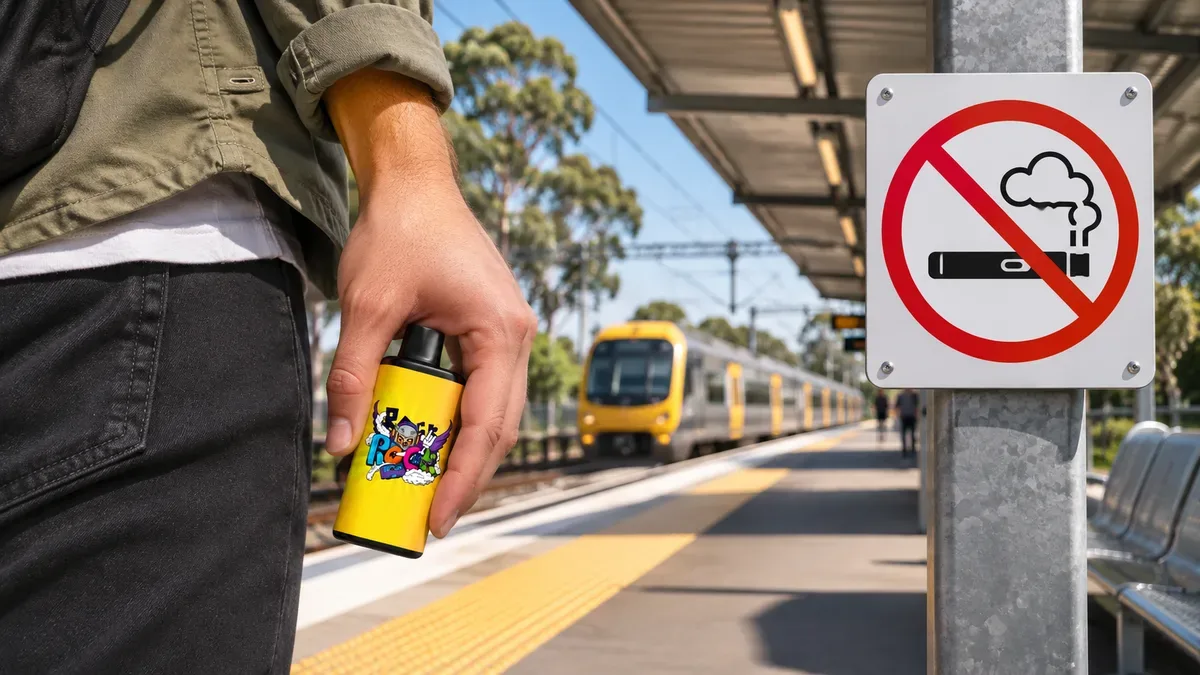
You step onto a quiet outdoor platform with a vape in your pocket. Can You Vape at Australian Train Stations? Usually, the safe answer is no. Open air does not automatically make a platform a lawful vaping area.
Australia has no single station rule covering every boundary nationwide. However, trains are smoke-free, while states and territories regulate platforms, shelters, entrances, and surrounding land differently. Transport operators may also impose broader conditions than public health laws.
Therefore, passengers must check both local law and operator directions. This guide explains the common rules, jurisdictional differences, possible penalties, and practical ways to identify station boundaries.
1. Can You Vape at Australian Train Stations?
Vaping is generally prohibited wherever smoking is banned. That commonly includes trains, platforms, station buildings, shelters, waiting areas, and public transport interchanges. In several jurisdictions, the restriction covers an entire station rather than selected enclosed spaces.
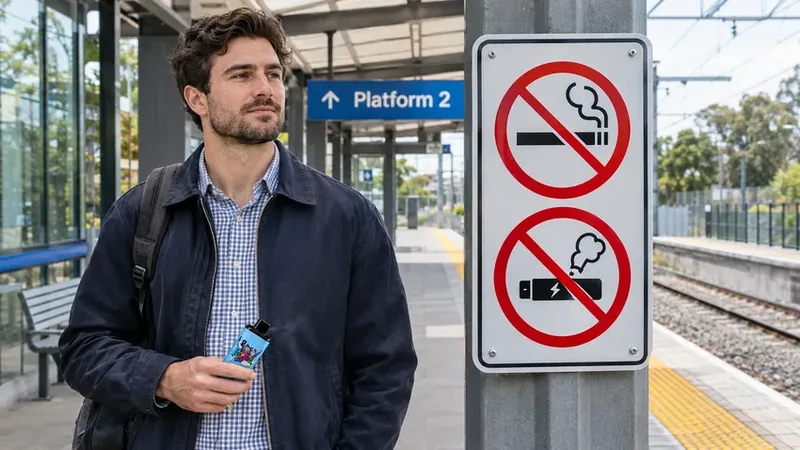
However, using a vape differs from simply carrying one. A passenger can generally carry a lawfully possessed device inside a pocket or bag. The offence usually concerns activating or using it within a prohibited area.
Treat every passenger train as vape-free
Never vape inside a passenger train, even when the carriage seems empty. The restriction also covers toilets, vestibules, door areas, and spaces between carriages. Moreover, opening a window or standing near a doorway does not create an exception.
Passengers should treat replacement buses and rail buses the same way. Likewise, light rail vehicles, station shuttles, and other connecting services commonly prohibit smoking and vaping. Operator conduct rules may support removal when a passenger refuses to stop.
Outdoor does not mean permitted
An uncovered platform may feel different from an enclosed concourse. Nevertheless, many laws explicitly cover outdoor platforms, including uncovered areas. Station-wide policies can also include paths, footbridges, car parks, and interchange areas.
Restrictions commonly cover e-cigarettes and similar devices regardless of their contents. Therefore, disposable, refillable, nicotine-free, and therapeutic products may receive identical treatment. Marketing terms such as “personal vaporiser” usually make no practical difference.
Most importantly, do not guess when signs or boundaries seem unclear. Leave the controlled station area and move beyond entrances, waiting areas, and any prescribed buffer. Ask staff before vaping if you still cannot identify the boundary.
2. Where the Vape-Free Rules Apply Within a Station
Indoor and enclosed areas
Station interiors almost always fall within smoke-free rules. These areas include concourses, ticket halls, customer-service counters, waiting rooms, toilets, lifts, and stairways. Underground platforms and pedestrian tunnels also qualify as enclosed or controlled transport spaces.
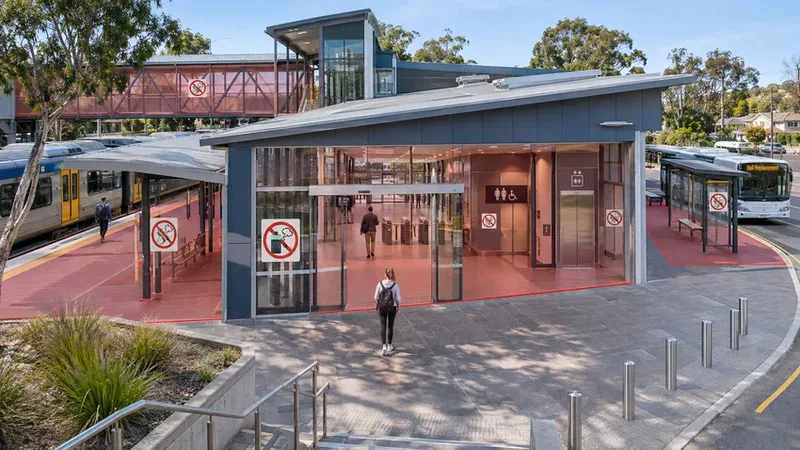
Furthermore, airflow does not determine whether a legal ban applies. Large doors, open sides, or strong ventilation may not change the area’s legal status. A partly enclosed shelter can also fall within specific public transport restrictions.
Platforms and outdoor facilities
Outdoor coverage varies, although platforms are frequently vape-free. Restrictions may include covered platforms, open platforms, shelters, benches, footbridges, and pedestrian access routes. Additionally, an operator may prohibit vaping across all railway land under its control.
Station car parks require particular care. A car park might sit inside the regulated station boundary, outside it, or under separate operator conditions. Similarly, a path beside a station may form part of a passenger gathering area.
Entrances, stops, and connecting services
Some laws create buffers around entrances, exits, transport stops, or other defined points. For instance, the ACT covers public transport interchanges and areas within five metres of public transport stops. Other jurisdictions use different distances or regulate queues beyond a measured boundary.
Connecting services remain important during disruptions. Replacement buses, rail buses, shuttle vehicles, and light rail services generally remain vape-free. Moreover, bus interchanges and queues may have their own smoke-free boundaries.
A queue can extend past a shelter or stop marker. Therefore, walking several metres from a sign may not place someone outside the regulated waiting area. Passengers should avoid vaping near people waiting for transport.
How to check the boundary
One jurisdiction may regulate the whole station. On the other hand, another may focus on platforms, enclosed areas, shelters, transport stops, or signed zones. Councils and property managers can sometimes establish additional restrictions.
Some large facilities may provide a designated smoking area outside the controlled station boundary. However, passengers should never assume one exists. A bin, bench, or collection of cigarette butts does not establish lawful permission.
- Read signs at station entrances, platforms, shelters, and interchange exits.
- Follow pavement markings, announcements, operator maps, and staff directions.
- Check whether queues or entrance buffers extend beyond the visible station structure.
- Follow the stricter local rule when station and surrounding property rules overlap.
3. Vaping at Train Stations: State and Territory Rules
New South Wales
NSW bans smoking and vaping at all public transport stops and stations. The rule includes passenger railway platforms, light rail platforms, bus stops, taxi ranks, and ferry wharves. Notably, it applies whether an area is covered or uncovered.
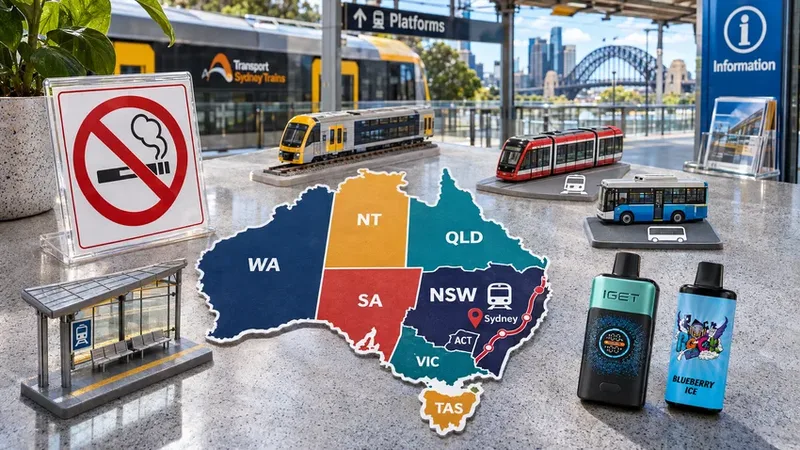
The prohibition also covers places where passengers queue or gather. Trains, buses, ferries, and light rail vehicles are vape-free under transport rules. NSW Health explains the boundaries on its public transport smoking and vaping page.
Victoria
Victoria prohibits smoking and vaping throughout its public transport network. This includes trains, trams, buses, train stations, raised-platform tram stops, and bus or tram shelters. Therefore, passengers should not search for an uncovered section of a platform.
The Victorian restriction applies to all areas of train stations, not merely enclosed waiting rooms. Moreover, operators and station signs may clarify the practical property boundary. Travellers can confirm current requirements through Victorian health guidance and Public Transport Victoria information.
Queensland
Queensland treats vapes as smoking products for public-place restrictions, whether they contain nicotine or not. Trains and railway stations are smoke-free and vape-free. Public transport waiting points also receive specific protection.
Additionally, the restriction generally extends five metres beyond a public transport waiting point. It can cover bus stops, shelters, stations, lay-bys, ferry terminals, and taxi ranks. A queue remains protected even when it stretches beyond the ordinary five-metre area.
Queensland Health authorised officers enforce statewide public smoking and vaping laws. Meanwhile, passengers can report incidents on trains or at stations through Translink. Current definitions and penalties appear on Queensland Health’s smoking-law pages.
Western Australia
Transperth prohibits smoking, including e-cigarette use, on buses, trains, and at stations. Therefore, passengers should treat the complete station premises as vape-free. Signs and authorised-officer directions help identify less obvious boundaries.
Western Australian health law also prohibits vaping wherever smoking is prohibited. Notably, Transperth publishes transport-specific infringement information for smoking on vehicles or at stations. Operator conditions can apply alongside broader public health requirements.
South Australia
South Australian rules cover smoking and vaping in enclosed public places and prescribed public transport areas. Adelaide passengers should treat trains, station facilities, platforms, shelters, and transport waiting areas as vape-free. Adelaide Metro conduct requirements and displayed signs may provide additional direction.
Furthermore, South Australia restricts smoking and vaping at many non-residential building entrances. This can matter where a station connects with a shopping centre or commercial building. Passengers should check SA Health guidance and Adelaide Metro information before relying on an outdoor location.
Tasmania
Hobart does not currently have a metropolitan passenger railway network. Consequently, ordinary commuting questions mainly involve buses, interchanges, shelters, and terminals. Tourism and heritage rail facilities may apply their own smoke-free conditions.
Tasmanian smoke-free areas also prohibit electronic cigarettes and personal vaporisers. Enclosed public places, declared pedestrian or bus malls, and other designated spaces may fall within those rules. Therefore, visitors should follow facility signs rather than assuming tourism rail platforms permit vaping.
Australian Capital Territory
Canberra uses light rail rather than a conventional metropolitan heavy-rail network. Smoking and vaping are banned inside public transport vehicles and across public transport interchanges. Platforms and light rail stops are also covered.
Specifically, ACT rules prohibit smoking and vaping within five metres of public bus, train, light rail, and taxi stops. The buffer does not generally extend onto private property within that distance. The ACT Government boundary guide provides current details.
Northern Territory
Darwin has no urban passenger train network. However, bus interchanges, shelters, terminals, and other public facilities may fall under smoke-free laws or property rules. Long-distance tourism rail terminals can also impose station-wide restrictions.
Northern Territory law regulates e-cigarettes in a similar manner to tobacco products. Therefore, the same consumption restrictions generally apply to both. Passengers using a tourism train should check terminal signs and the operator’s conditions before arrival.
Quick jurisdiction comparison
- New South Wales: Vehicles and platforms are vape-free, including uncovered platforms and passenger gathering areas. Check NSW Health and Transport for NSW.
- Victoria: Vehicles and all train-station areas are vape-free. Check Victorian health guidance and Public Transport Victoria.
- Queensland: Trains, stations, and waiting points are vape-free, with a general five-metre waiting-point buffer. Check Queensland Health and Translink.
- Western Australia: Transperth vehicles and stations are vape-free. Check WA Health, Transperth signs, and authorised-officer directions.
- South Australia: Vehicles and prescribed transport areas are vape-free. Check SA Health and Adelaide Metro.
- Tasmania: There is no Hobart metropolitan rail system. Check Tasmanian Health guidance and individual transport facility rules.
- Australian Capital Territory: Vehicles, interchanges, platforms, stops, and five-metre buffers are vape-free. Check ACT Health and Transport Canberra.
- Northern Territory: Darwin has no urban rail network. Check NT Health and the relevant bus, terminal, or tourism rail operator.
Despite a consistent smoke-free expectation, the legal details differ. Definitions, exclusion distances, designated areas, offences, and fine amounts can change across state borders. Therefore, never carry one city’s assumptions into another jurisdiction.
4. Fines, Removal, and Enforcement on Public Transport
Vaping in a prohibited transport area can produce several consequences. A staff member may first direct the passenger to stop. However, an authorised officer may issue an infringement or require the passenger to leave.
Possible outcomes include a warning, fine, station removal, or referral to police. Refusing a lawful direction can create a separate problem. Likewise, aggressive or threatening conduct may trigger additional transport or criminal consequences.
There is no single national fine
Fine amounts vary by jurisdiction, offence, and enforcement process. They may also change when penalty units receive routine adjustments. Therefore, a nationwide figure would quickly become misleading.
For example, Transperth publishes an infringement amount and a higher maximum court penalty for smoking at stations. Other jurisdictions use different schedules. Most importantly, travellers should consult the current health department or transport authority penalty page.
Who can enforce the rules?
Enforcement arrangements differ across transport networks. Relevant personnel may include authorised transport officers, transit officers, police, security teams, health inspectors, and local enforcement officers. Station employees can also issue operational directions or request assistance.
A missing sign does not necessarily cancel a statutory prohibition. Laws often define a station, platform, waiting point, or public place independently of signage. Nevertheless, signs and announcements help passengers understand the practical boundary.
If a sign seems unclear, ask a staff member. Alternatively, move entirely outside the station and away from its entrances. Relying on an open roof or faded pavement marking creates unnecessary risk.
5. Nicotine-Free, Therapeutic, and Other Vapes
Nicotine content rarely changes the location rule
A nicotine-free label does not normally permit vaping at a station. Public-place rules commonly focus on activating an e-cigarette or similar device. Consequently, the liquid’s ingredients may not affect whether the location ban applies.
The same principle usually covers disposable and refillable devices. Flavour, design, nicotine strength, and marketing terminology do not override a transport restriction. Even a device sold as a wellness product may meet the relevant legal definition.
Therapeutic use is not a station exemption
Lawful access to a therapeutic vape does not normally create permission to use it anywhere. A prescription or pharmacy supply relates to lawful access and possession. However, smoke-free public transport rules still control where someone may vape.
People managing nicotine dependence should plan before travelling. For instance, they can discuss approved alternatives with a prescriber or pharmacist. Nicotine gum, lozenges, or patches may suit longer journeys when clinically appropriate.
Cannabis products involve additional legal questions. Separate laws govern possession, prescriptions, impairment, driving, and public consumption. Therefore, medicinal status should never be interpreted as permission to vape cannabis at a station.
Carrying a vape safely
Passengers can usually transport a lawfully possessed vape without activating it. Nevertheless, product possession and supply laws have changed substantially across Australia. Travellers should confirm that their particular device and product are lawful.
- Switch off the device and lock its activation control.
- Prevent buttons from pressing against objects inside a bag.
- Protect spare batteries from coins, keys, and other metal items.
- Use a suitable battery case and inspect cells for visible damage.
- Avoid charging or using the device aboard a train.
- Follow any operator directions concerning batteries and dangerous goods.
Lithium batteries can overheat after damage, short-circuiting, or improper charging. As a result, safe storage protects passengers as well as the device. Report smoke, unusual heat, swelling, or a battery fire to transport staff immediately.
6. Finding a Lawful Place and Reporting Vaping Safely
Finding somewhere lawful
First, leave the train and the controlled station area completely. Then move beyond any signed or legally prescribed buffer. Avoid doorways, platforms, queues, air intakes, and interchange shelters.
However, leaving railway property may not be enough. A nearby council area, shopping centre entrance, dining zone, or workplace could have separate restrictions. Therefore, confirm that local rules allow vaping before using the device.
Choose a place where aerosol will not drift toward passengers or ventilation systems. Additionally, stay away from children, crowds, and people with respiratory sensitivities. Lawful use can still cause discomfort to others.
Why transport networks restrict vaping
- Vape aerosol can expose nearby passengers to nicotine and other substances.
- Consistent rules make smoking and vaping restrictions easier to understand and enforce.
- Visible vapour can concern passengers or reduce visibility in enclosed areas.
- Aerosol may activate sensitive alarms or create confusion during an incident.
- Damaged lithium batteries can create heat, smoke, and fire risks.
Reporting an incident
For routine incidents, notify station staff, a conductor, or an authorised officer. Passengers may also use a platform help point or the operator’s official support channel. Some networks accept reports through applications, websites, text services, or online forms.
Avoid confronting someone inside a confined carriage. Instead, note the service, carriage number, station, time, and direction of travel. Provide a brief factual description without exaggeration.
If behaviour becomes threatening, move away and contact transport security or police. Use emergency channels only when an immediate safety risk exists. Moreover, follow staff instructions during any evacuation or security response.
Before travelling, check federal vaping information and the relevant state or territory health department. Also review operator conditions and current station signs. These sources provide better guidance than old forum posts or assumptions from another city.
Conclusion
Treat vaping like smoking throughout Australian public transport. Never vape aboard a train, replacement bus, or light rail vehicle. Moreover, assume platforms and station facilities are vape-free unless authoritative directions clearly state otherwise.
Carrying a lawful vape differs from using one. However, nicotine-free, therapeutic, disposable, and prescription status generally does not override location restrictions. Outdoor platforms can remain prohibited even without walls or a roof.
Before your journey, check the relevant health department and transport operator website. Then follow current signs, boundaries, announcements, and staff directions. When doubt remains, wait until you have left the station and every applicable exclusion zone.
