

A forgotten vape poster can create a very current legal problem. So, can Australian businesses be fined for displaying vape advertisements? Yes, unauthorised promotion can attract substantial penalties and wider regulatory action. Moreover, the rules can reach shop windows, websites, social media accounts, and third-party campaigns.
Business owners face overlapping Commonwealth, state, and territory requirements. In fact, Australian law defines advertising broadly and allows public promotion only in narrow circumstances. Therefore, businesses must examine both obvious advertisements and quieter forms of commercial communication.
This guide explains unlawful advertising, potential responsibility, enforcement measures, and limited authorisations. Additionally, it provides practical steps for reducing compliance risk. However, every situation depends on its facts and the legislation applying at that time.
1. Can Australian Businesses Be Fined for Displaying Vape Advertisements?
Australian businesses and individuals can face penalties for displaying, publishing, or facilitating unauthorised vape advertisements. Depending on the provision, consequences may include civil proceedings, criminal prosecution, and administrative action. Moreover, regulators can investigate related supply, possession, or importation activities. A seemingly simple poster may therefore expose a broader compliance problem.
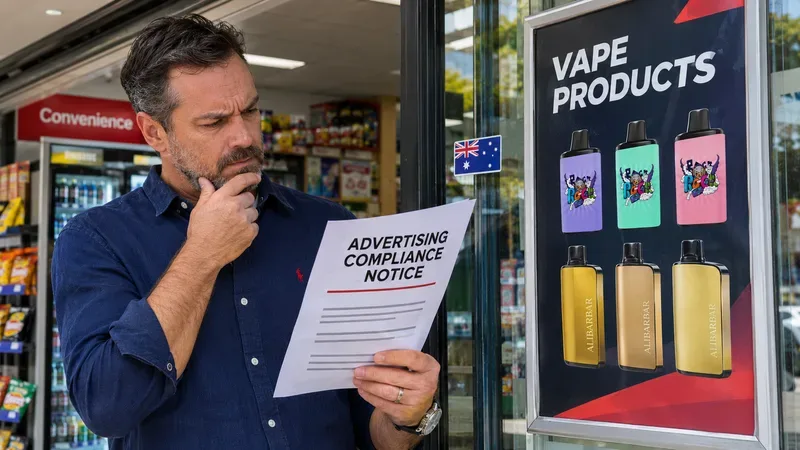
Responsibility does not necessarily stop with the advertisement’s designer. For instance, a retailer may approve a window sign created by an external agency. The retailer, agency, publisher, and relevant individuals may each require legal assessment. Additionally, a person who causes unlawful advertising can face exposure under applicable provisions.
Who may face responsibility?
The parties involved can vary across physical and digital campaigns. Specifically, potential responsibility may extend beyond the business whose product appears. Relevant parties can include:
- Retailers displaying posters, menus, cabinets, or promotional material.
- Website operators and marketplace sellers publishing product listings.
- Publishers, advertising agencies, and social media managers.
- Directors, employees, and contractors involved in approval or publication.
- Influencers, affiliates, and reviewers receiving commercial benefits.
- Landlords or venue operators knowingly facilitating promotional displays.
Actual liability depends on the relevant law, evidence, and each party’s conduct. However, outsourcing publication does not automatically transfer every legal risk. Businesses should control what agencies, affiliates, and venue partners publish on their behalf.
A broad prohibition with narrow exceptions
Australia generally prohibits advertising and promoting vaping goods to the public. Notably, the restriction covers far more than traditional paid advertising. It may capture indirect promotion, sponsorship, branding, and conduct encouraging vaping. Narrow statutory exceptions and authorisations apply, but businesses must satisfy every relevant condition.
A maximum statutory penalty is not an automatic fine. Instead, it marks the highest available penalty under a particular provision. The ultimate outcome depends on evidence, seriousness, culpability, repetition, and the enforcement path. Furthermore, courts consider the relevant legal tests before imposing civil or criminal penalties.
Australian penalty-unit values change through indexation. Therefore, businesses should not rely on an old dollar conversion found in a previous article. They should check current legislation and official regulator guidance. Most importantly, maximum penalties may differ for corporations, individuals, offences, and civil contraventions.
2. How Australia’s Vape Advertising Laws Work
Two major Commonwealth statutes shape the national framework. These are the Therapeutic Goods Act 1989 and the Public Health (Tobacco and Other Products) Act 2023. However, they operate alongside other Commonwealth, state, and territory laws. Businesses must therefore avoid treating either statute as the complete rulebook.

The Therapeutic Goods Act framework
The Therapeutic Goods Act 1989 regulates therapeutic goods and Australia’s lawful vaping supply pathway. Specifically, it controls matters including importation, manufacture, supply, commercial possession, and advertising. It also supports the limited pharmacy-based supply of compliant therapeutic vaping goods. Consequently, advertising compliance often connects directly with product and supply compliance.
Under this framework, advertising vaping goods is prohibited unless a valid authorisation covers the communication. Furthermore, authorised material must meet all applicable conditions. A communication can fall outside an authorisation because of its wording, audience, format, placement, or purpose. Therefore, using factual statements alone does not guarantee compliance.
Public-health advertising and sponsorship controls
The Public Health (Tobacco and Other Products) Act 2023 creates additional national controls. In particular, it addresses advertising, promotion, sponsorship, branding, and related conduct concerning e-cigarettes. The law can cover communications or activities that directly or indirectly encourage vaping. As a result, businesses must consider the complete impression created by a campaign.
For example, an event banner might show only a familiar brand symbol. However, its colours, audience, commercial relationship, and associated online material may connect it with vaping goods. That connection can create risk without showing a device or naming a flavour. Similarly, a sponsorship arrangement may promote vaping through lifestyle associations rather than express sales language.
State and territory requirements
State and territory laws can apply at the same time. These laws may regulate tobacco products, vaping goods, medicines, retail displays, public health, and local enforcement. Additionally, the Australian Consumer Law may affect misleading claims or commercial conduct. Compliance with one Commonwealth permission does not necessarily satisfy every other requirement.
The Therapeutic Goods Administration administers important parts of the therapeutic goods framework. Meanwhile, the Australian Government Department of Health, Disability and Ageing oversees relevant national public-health requirements. State and territory health departments, medicines regulators, and enforcement bodies may also investigate conduct. Businesses operating nationally should therefore review every jurisdiction where customers can see their material.
Online publication makes that task especially important. For instance, a promotion created in Melbourne may reach customers throughout Australia within minutes. Geographical targeting can reduce reach, but it may not resolve every legal issue. Furthermore, overseas hosting does not necessarily prevent Australian law from applying to Australian-facing conduct.
3. What Counts as a Vape Advertisement?
A vape advertisement can include communication or conduct that directly or indirectly promotes vaping goods. It may also promote their use, a related brand, or a supplier. Notably, the assessment considers substance and context, not merely the label given to material. Calling a post “education” does not protect content that encourages purchases.
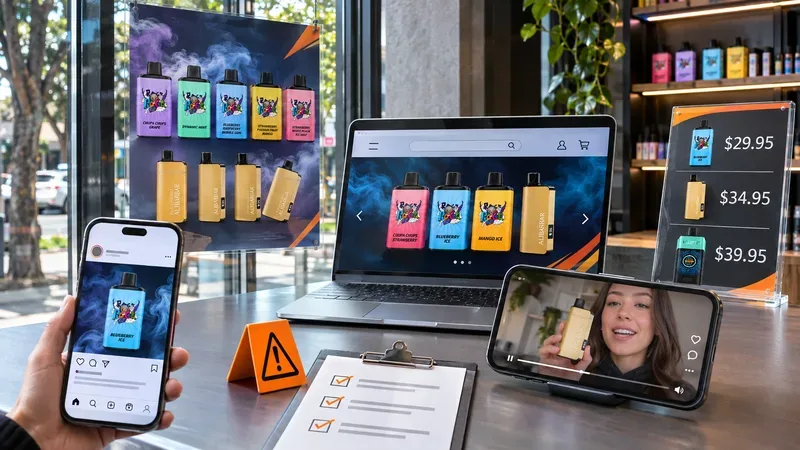
Regulators may examine the design, wording, audience, timing, links, and commercial purpose. Additionally, they may consider whether the publisher receives money, products, discounts, or another benefit. No single factor necessarily decides the issue. Instead, the overall impression and practical effect often matter.
Physical retail and point-of-sale material
Traditional retail displays create clear risks. For example, a bright window poster may show a device beside a price and flavour description. However, less obvious material can also encourage demand. Relevant physical material may include:
- Storefront signs, posters, banners, and pavement boards.
- Menus, catalogues, price boards, and printed order forms.
- Illuminated cabinets and visible product displays.
- Packaging arranged to attract customer attention.
- Counter cards and other point-of-sale material.
- Discounts, giveaways, loyalty rewards, and bundled offers.
- Branded clothing, stickers, bags, or customer merchandise.
A plain price list may still create risk when customers can see it. Specifically, product names, branding, decorative images, or prominent discounts may make it promotional. The placement also matters. A list facing the street creates a different impression from restricted operational information within a lawful supply chain.
Digital and social media advertising
Digital communications receive the same serious attention as physical displays. Furthermore, old content can remain searchable long after a campaign ends. Businesses should examine:
- Websites, online stores, and marketplace listings.
- Paid search advertisements and sponsored search results.
- Email promotions, newsletters, and text messages.
- Social media posts, stories, reels, and saved highlights.
- Videos, podcasts, livestreams, and digital events.
- Influencer posts, affiliate links, and discount codes.
- Sponsored reviews, testimonials, and comparison pages.
For instance, an influencer might hold an unmarked device during a lifestyle video. A discount code and purchase link may reveal the commercial connection. Therefore, omitting the word “vape” does not necessarily remove the promotional effect. Likewise, deleting payment records does not change the campaign’s original purpose.
Businesses must also consider material published by other parties. Specifically, an affiliate may reuse an expired banner or reactivate a product page. A marketing agency might retain scheduled posts after a contract ends. Consequently, contracts should require removal, access control, and confirmation when campaigns stop.
Indirect promotion, branding, and sponsorship
Indirect promotion can create substantial risk. Sponsorships may connect vaping brands with music, gaming, nightlife, or sporting communities. Moreover, brand extensions can place familiar names or symbols on unrelated merchandise. These strategies may build recognition even when no vaping product appears.
Testimonials and endorsements can also promote use. For instance, a creator might describe feeling calmer, more social, or more confident after switching products. Such claims connect vaping with desirable outcomes. Additionally, favourable reviews may encourage purchases without containing a direct instruction to buy.
A brand name alone may function as advertising. The surrounding context will influence that assessment. Specifically, design, audience, product links, pricing, commercial arrangements, and publication history may connect the name with vaping goods. A neutral corporate reference and a colourful consumer-facing banner create very different impressions.
Which products can the rules cover?
Relevant provisions can extend beyond nicotine liquids. Depending on the applicable definition, they may cover nicotine and nicotine-free products, devices, and related components. Accessories and connected goods may also attract scrutiny in particular circumstances. Therefore, businesses should check the exact statutory definition rather than relying on informal product categories.
A shop should not assume that “nicotine-free” means advertising is permitted. In fact, national vaping reforms cover broader categories of vaping goods. Product construction, intended use, presentation, and relevant legislative definitions all matter. Legal advice may be necessary when a component has several possible uses.
Information versus promotion
Neutral public-health information does not automatically become an advertisement. For example, a factual notice may explain that general retailers cannot lawfully sell vaping goods. However, commercial details can alter its character. Product names, prices, purchase links, favourable claims, discounts, or calls to action may turn information into promotion.
Context remains essential. A public-health warning surrounded by brand logos and an order button may still encourage sales. Conversely, a genuinely neutral warning can discourage use without promoting a supplier. Most importantly, businesses should assess the entire communication rather than isolating one careful sentence.
4. When Is Advertising of Vaping Goods Authorised?
The Therapeutic Goods (Vaping Goods—Advertising) Authorisation 2024 permits specified communications under strict conditions. It does not provide a general marketing licence. Instead, it supports limited communications within legitimate therapeutic and supply settings. Businesses can review the instrument through the Federal Register of Legislation.
An authorisation applies only when the communication, goods, audience, and content meet its requirements. Additionally, other legislation may still restrict the conduct. Businesses should document every condition they rely upon. A partially compliant advertisement can remain unauthorised.
Labels, packaging, and inserts
Specified material may appear on compliant labels, packaging, and package inserts. However, those materials must satisfy relevant product standards and advertising conditions. They cannot simply become colourful promotional surfaces. Furthermore, prohibited or restricted representations may create separate problems.
The authorisation concerns notified or otherwise specified vaping goods within its terms. Therefore, lawful packaging for one product does not authorise promotion of another. Businesses should match the product, notification details, content, and applicable technical requirements. They should also retain the supporting product and approval records.
Supply-chain communications
Limited communications may occur within a legitimate wholesale and pharmacy supply chain. Specifically, qualifying communications can involve authorised participants engaged in wholesale or pharmacy supply. Permitted information may concern availability, price, safe use, ingredients, composition, design, presentation, or intended purpose. However, every communication must remain within the authorisation’s boundaries.
The phrase “directed exclusively” matters greatly. A trade communication visible to ordinary consumers may fall outside its intended restriction. For instance, an unrestricted webpage cannot become supply-chain material merely because pharmacists might read it. Therefore, businesses may need verified access controls and carefully managed distribution lists.
Authorised supply-chain advertising also has important exclusions. Depending on the applicable conditions, businesses cannot rely on event displays, promotional stalls, banners, consumer pamphlets, or samples. Additionally, testimonials, endorsements, gifts, personal payments, incentives, and certain discounts can create problems. The precise conditions require current review before publication.
Health professionals and patient treatment
Specified communications may be directed exclusively to certain health professionals. These can include medical practitioners, nurse practitioners, pharmacists, and specified practice personnel. Again, the content and audience must comply with the authorisation. A public social media post does not become professional communication because several doctors follow the account.
Medical practitioners, nurse practitioners, and pharmacists may provide relevant information directly during eligible patient treatment. Specifically, this can occur when addressing smoking cessation or nicotine dependence. The communication should support clinical care rather than public product promotion. Health practitioners must also observe their professional and regulatory duties.
For example, a pharmacist may discuss product suitability during a patient consultation. However, a public post praising a particular product reaches a different audience and serves another purpose. Treatment-related advice does not create unlimited permission for lifestyle marketing. Nor does it authorise unrestricted testimonials, discounts, or mass consumer advertising.
Why pharmacies occupy a special position
Participating pharmacies provide the lawful consumer supply pathway for therapeutic vaping goods when clinically appropriate. In contrast, general retailers cannot lawfully sell vaping goods. This includes tobacconists, convenience stores, service stations, and most other non-pharmacy businesses. Therefore, those retailers generally cannot lawfully advertise products they cannot supply.
Pharmacy status does not create unrestricted promotional freedom. Pharmacies must still comply with the authorisation, therapeutic goods requirements, and other applicable laws. Moreover, a pharmacy’s communications may need careful separation between patient information and public advertising. Professional advice should address ambiguous campaigns before publication.
5. Penalties, Enforcement, and Reporting Illegal Vape Advertising
Regulators can use several enforcement tools in response to suspected unlawful conduct. The selected response depends on the facts, evidence, risks, and relevant legislation. Possible measures include:
- Educational contact, formal warnings, and removal requests.
- Advertising directions or other compliance directions.
- Infringement notices for alleged contraventions.
- Product seizure, including seizure under warrant where authorised.
- Injunctions and other court orders.
- Civil penalty proceedings.
- Criminal investigation and prosecution.
Authorities may examine more than the published advertisement. For example, investigators might review invoices, stock records, messages, contracts, and website data. Additionally, advertising evidence may prompt scrutiny of supply and commercial possession. Businesses should expect connected conduct to form part of the investigation.
Corporate and individual exposure
A corporation and the individuals involved may face separate legal questions. Specifically, investigators may consider who approved, directed, published, or caused the advertisement. Directors, employees, contractors, influencers, and agencies can have different exposure. The corporate structure does not automatically shield every participant.
Maximum criminal penalties can include imprisonment and substantial penalty units under relevant provisions. Meanwhile, maximum civil penalties can differ for individuals and corporations. Penalty units undergo indexation, so their dollar value changes. Therefore, businesses must verify current amounts through official legislation and current TGA guidance.
A stated maximum does not predict the actual outcome. Courts and regulators consider the available provision and evidence. Furthermore, an infringement notice amount differs from a court-imposed maximum penalty. Paying an infringement notice may also have different legal consequences from defending proceedings.
Factors influencing enforcement
Regulators can consider the advertiser’s role and the communication’s commercial purpose. They may also examine the audience, medium, reach, duration, and repetition. Additionally, financial benefit and previous compliance history can affect the response. Conduct targeting young people may create particularly serious public-health concerns.
A quick and responsible response can also matter. For instance, a business may remove content, preserve records, and prevent republication. However, deleting evidence or providing inaccurate explanations can worsen the situation. Businesses should obtain legal advice before responding to significant regulator correspondence.
Reporting suspected advertising
People can report suspected unlawful vape advertising through the TGA’s online reporting channels. Reports can cover physical advertising, online material, and related questionable practices. Additionally, relevant state or territory health authorities may accept complaints under local laws. Screenshots, dates, locations, account names, and website addresses can support a useful report.
Enforcement creates consequences beyond formal penalties. Businesses may face legal costs, product loss, operational disruption, and urgent content removal. Moreover, public action can damage commercial relationships and reputation. An advertising investigation may also reveal unlawful supply arrangements or deficient records.
6. Vape Marketing Compliance Checklist for Businesses
A practical audit should cover every place where customers may encounter the business. Do not limit the review to current paid campaigns. In fact, archived webpages and forgotten social highlights can remain visible. Use the following checklist as a starting point.
Inspect physical premises
- Check windows, doors, external signs, and pavement boards.
- Review counters, posters, cabinets, and product displays.
- Inspect menus, catalogues, price boards, and order forms.
- Examine customer receipts, bags, flyers, and loyalty cards.
- Review branded merchandise and material supplied by third parties.
Photograph each area and record the audit date. Additionally, check storerooms for material that staff might display again. Ask employees whether suppliers previously provided posters or counter cards. Therefore, the audit should examine both visible content and dormant campaign assets.
Review every digital channel
- Search the website, online store, and archived landing pages.
- Check marketplace listings and third-party seller profiles.
- Review paid search campaigns and advertising dashboards.
- Inspect email templates, mailing lists, and automated messages.
- Examine social posts, stories, highlights, videos, and livestream recordings.
- Search page titles, image descriptions, tags, and other metadata.
- Check historic accounts that employees or agencies previously managed.
Use brand names, product terms, and former campaign slogans during the search. Moreover, test how pages appear to ordinary visitors without an account. Scheduled posts and automated emails deserve separate attention. A disabled product page may still appear through search results or cached previews.
Examine commercial relationships
- Review influencer agreements and supplied campaign instructions.
- Inspect affiliate programs, referral links, and discount codes.
- Check agency, publisher, and marketplace contracts.
- Assess sponsorships, events, competitions, and branded merchandise.
- Review discounts, loyalty schemes, giveaways, and bundled offers.
- Identify customer content that the business reposted or reused.
User-generated content can become business promotion after reuse. For instance, reposting a favourable customer video may give it a new commercial purpose. Additionally, tagging products or adding purchase details increases risk. Businesses should create approval rules for reposts, comments, and collaborative content.
Respond carefully to questionable material
Remove or disable suspected non-compliant material promptly when appropriate. However, preserve copies before removal, including screenshots, links, and publication dates. Retain approvals, invoices, contracts, campaign briefs, and relevant communications. Furthermore, record when and how the business disabled each item.
Preservation supports legal advice and a reliable response to regulators. It also helps the business determine who authorised publication. Therefore, staff should not destroy files or alter records during an investigation. Legal advisers can guide preservation duties in more serious cases.
Check whether third parties can republish old assets. Specifically, revoke unnecessary account access and cancel scheduled campaigns. Ask agencies, influencers, and affiliates to confirm removal in writing. Additionally, monitor major platforms for reactivated or copied promotions.
Build continuing approval controls
Document the legal basis for every communication treated as authorised. The record should identify the relevant product, audience, authorisation, and conditions. Moreover, businesses should keep supporting evidence for access restrictions and professional distribution. A vague note stating “approved” offers little practical protection.
Create a written approval process with named decision-makers. Additionally, train sales, marketing, pharmacy, and customer-service staff on their responsibilities. Establish an escalation path for uncertain content. Periodic audits can then detect outdated material, uncontrolled accounts, and third-party promotion.
Seek qualified legal advice when content presents unusual risks. Examples include ambiguous branding, cross-border publication, sponsorship, pharmacy campaigns, and health-professional communications. Furthermore, obtain advice about regulator correspondence or possible historic breaches. Early advice can help preserve evidence and prevent inconsistent responses.
Conclusion
Australian businesses can face significant penalties and other action for unauthorised vape advertising. The rules reach physical displays, websites, social media, influencers, sponsorships, and indirect promotion. Moreover, responsibility can extend across several organisations and individuals. Narrow legal authorisations do not create general permission for consumer marketing.
Businesses must also consider state and territory requirements. Most importantly, they should distinguish neutral information from content promoting a product, brand, supplier, or use. Prices, purchase links, favourable claims, branding, and discounts can change that assessment. Context and commercial purpose remain central.
Remove or disable questionable material and preserve all relevant records. Additionally, audit every physical and digital channel, including historic and third-party content. Check current TGA guidance and the Federal Register of Legislation before relying on any authorisation. Where uncertainty remains, obtain advice from an appropriately qualified Australian lawyer.
This content provides general legal information only. It does not constitute legal advice and does not address every business, jurisdiction, or factual situation.
