
What truly separates one high-capacity vape from dozens of nearly identical devices on a retailer’s shelf? BIMO Vape: Brand Background and Device Technology requires careful verification because published specifications often conflict. Puff counts, battery sizes, company details, and certification claims may vary between websites. Therefore, buyers should evaluate each model separately instead of trusting a single headline number.
BIMO listings describe a broad range of prefilled devices, including rechargeable disposable formats with screens, mesh coils, and adjustable airflow. However, those features do not appear consistently across every model. Retailers also publish conflicting values for certain batteries and liquid capacities. This guide separates documented specifications from details that still require confirmation.
The discussion covers brand history, product formats, internal engineering, performance, safety, authenticity, health, and legal requirements. Moreover, it treats advertised puff counts as test-based estimates rather than guaranteed personal totals. Adult users and trade buyers can then compare products using measurable evidence. Nicotine products remain addictive and unsuitable for minors or non-users.
1. BIMO Vape: Brand Background and Device Technology Overview
BIMO Vape presents itself as a manufacturer and supplier of disposable vapes, e-liquids, and related nicotine products. Its published product range centers on prefilled devices designed for replacement after their liquid becomes exhausted. Additionally, many models contain rechargeable batteries, although sellers still commonly call them disposable vapes. That description refers to the complete device, not necessarily its battery behavior.

Public-facing company materials state that BIMO began operating in 2015. They also connect its production and wholesale operations with Shenzhen, China. However, some retailers describe the brand or particular products as originating from Dubai. These statements may refer to distribution, branding, export arrangements, or regional inventory rather than manufacturing origin.
How the brand fits into the market
The range occupies both standard disposable and rechargeable-disposable segments. Basic products emphasize simple draw activation and fixed airflow. Meanwhile, higher-capacity models add charging ports, liquid indicators, displays, adjustable airflow, and multiple flavor chambers. These additions make the devices more complex without turning most models into refillable systems.
Published catalogs list models with advertised ratings from roughly 6,000 to 100,000 puffs. Notably, an extremely large rating may involve several chambers, selectable flavors, or special testing conditions. It does not mean one small reservoir delivers that figure under every usage pattern. Buyers should examine liquid volume, operating modes, and testing methods alongside the advertised number.
Ownership and manufacturing require verification
A brand website can provide useful information, but it does not replace independent corporate or regulatory records. Specifically, buyers should compare the legal company name, factory address, importer, and responsible market entity. Packaging should identify the manufacturer or importer according to local requirements. An authorized distributor should also provide matching invoices and batch information.
Moreover, ownership claims deserve the same scrutiny as technical specifications. A domain name, social profile, or wholesale page does not automatically prove brand ownership. Retailers should request company registration records, trademark documents, and model-specific compliance files. For regulated markets, buyers should also search the relevant government product database.
- Match the legal company name across packaging, invoices, and corporate records.
- Confirm the manufacturing address instead of relying on a retailer’s country-of-origin label.
- Check whether the importer holds required registrations within the destination market.
- Verify each model because one compliant product does not validate the entire range.
2. BIMO Vape Product Range, Formats, and Specifications
BIMO’s documented catalog includes compact disposables, rechargeable-disposable models, multi-flavor devices, and direct-to-lung formats. However, availability differs considerably between countries and distributors. A product visible in a wholesale catalog may not qualify for lawful consumer sale locally. Therefore, catalog presence should never serve as proof of authorization.

Common device formats
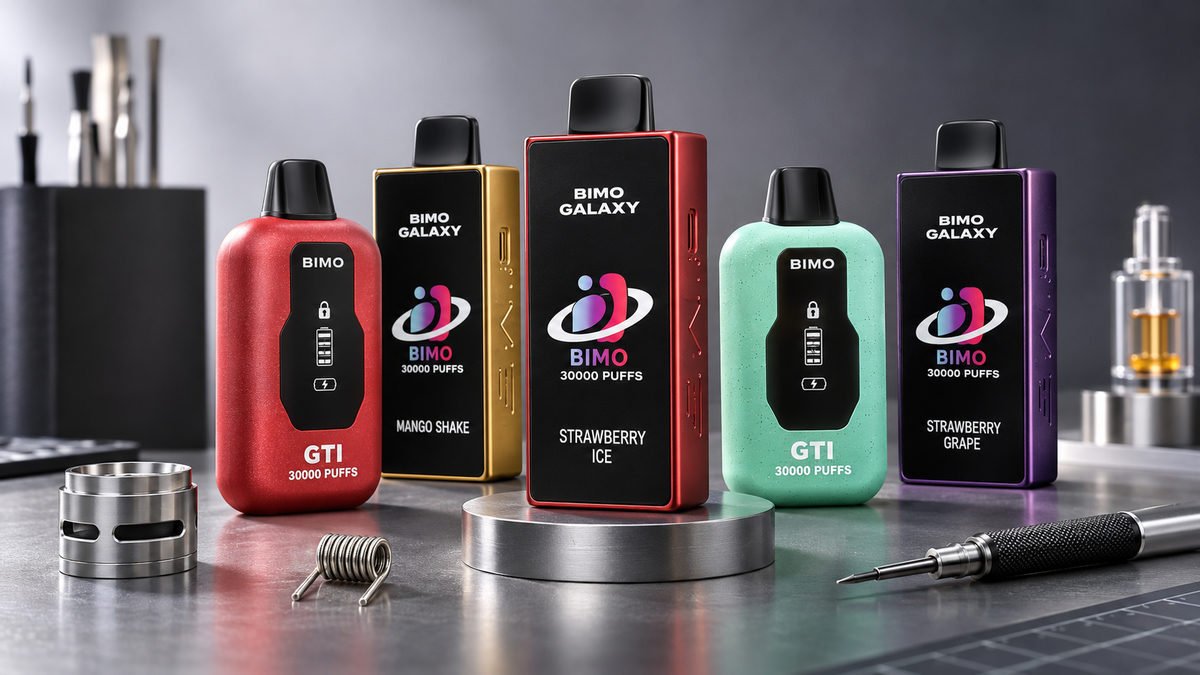
Models such as the Platinum 6000 and Ultra 7500 represent lower advertised capacities within the wider range. The One 9000 and Crystal 12000 occupy the middle of older catalog listings. Meanwhile, Turbo 20000, Galaxy 30000, GTI 40000, and Felxy 40000 target higher-capacity buyers. Newer multi-chamber products advertise even larger totals through selectable reservoirs or operating configurations.
Most documented high-capacity models use rechargeable batteries and USB Type-C connections. In contrast, lower-capacity products may use non-rechargeable batteries, depending on their revision. Additionally, screens can show battery and estimated liquid status on selected devices. Buyers should not assume that every model includes those features.
The following table summarizes published claims from brand-associated pages and distributor listings. It does not represent independent laboratory confirmation. Moreover, conflicting or unavailable information appears clearly instead of being estimated. Packaging from the exact batch should take priority over a generic listing.
| Model | Dimensions | Battery | E-liquid | Charging | Coil | Nicotine | Advertised puffs |
|---|---|---|---|---|---|---|---|
| BIMO Platinum | Not consistently published | Verify by batch | Verify by market | Verify exact version | Not consistently published | Varies by market | Up to 6,000 |
| BIMO One | Not consistently published | Verify by batch | Verify by market | Model-dependent | Verify exact version | Varies by market | Up to 9,000 |
| BIMO Crystal | Not consistently published | 500 or 550mAh claimed | 20ml claimed | USB Type-C | 1.2-ohm mesh claimed | 2% or 5% claimed | Up to 12,000 |
| BIMO Turbo | Not consistently published | 600 or 850mAh claimed | 18ml claimed | USB Type-C | Dual mesh claimed | 0%, 2%, or 5% claimed | Up to 20,000 |
| BIMO GTI | 49 × 27 × 100mm claimed | 850mAh claimed | 30ml claimed | USB Type-C claimed | 0.55-ohm dual mesh claimed | 2% or 5% claimed | Up to 40,000 |
| BIMO 4-in-1 | Verify exact revision | Verify by batch | Multiple chambers claimed | USB Type-C claimed | Multiple coils claimed | 2% or 5% claimed | Up to 100,000 |
The Crystal listings illustrate why batch verification matters. One published page has presented both 500mAh and 550mAh values for the same model. Likewise, Turbo listings disagree between 600mAh and 850mAh. Those differences may reflect revisions, regional versions, or ordinary listing errors.
Furthermore, nicotine labels need careful interpretation. A 2% formulation commonly corresponds to about 20mg/ml, while 5% commonly means about 50mg/ml. However, labeling conventions and permitted concentrations differ between jurisdictions. The sealed package should state the actual concentration and liquid volume.
3. Inside BIMO Vape Devices: Coils, Airflow, and Power
A vape device coordinates five core elements during every draw. The battery supplies electricity, while a control circuit manages power delivery. The coil converts electrical energy into heat. Meanwhile, a wick draws liquid from the reservoir toward the heated surface.
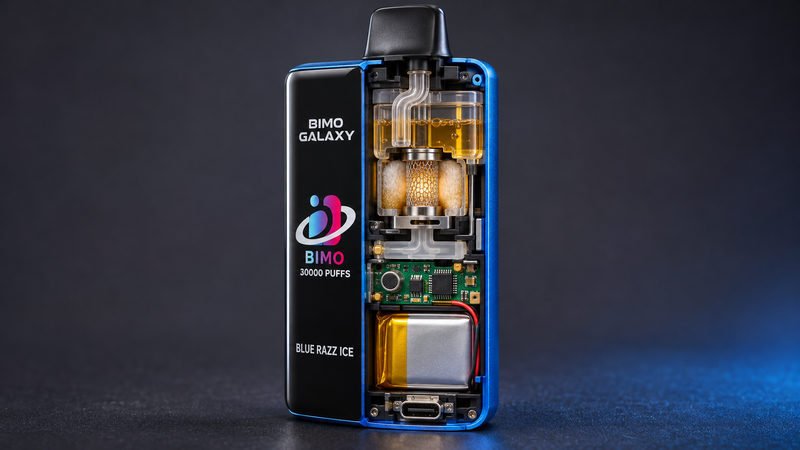
Air enters through an inlet and travels around the coil assembly. The heated liquid forms an aerosol, which moves through the central airway toward the mouthpiece. Therefore, airflow resistance affects coil temperature, aerosol volume, and liquid consumption. A blocked inlet can weaken output or produce inconsistent activation.
Mesh coils and liquid delivery
A traditional coil uses wound resistance wire, while a mesh coil uses a broader patterned heating surface. In principle, that larger surface can heat more wick material evenly. Additionally, mesh may support consistent aerosol production at suitable power levels. Actual performance still depends on mesh quality, wick contact, liquid composition, and circuit tuning.
The Crystal 12000 is commonly listed with a 1.2-ohm mesh coil. Turbo and GTI listings instead describe dual-mesh arrangements. However, “dual mesh” can refer to two active elements or selectable operating modes. Buyers should seek a diagram or technical sheet before assuming both coils operate simultaneously.
A cotton-based wick usually transfers e-liquid through capillary action. Specifically, the wick must remain wet enough to prevent excessive heating. Repeated long draws can consume liquid faster than the wick replenishes it. As a result, flavor may become harsh even when some liquid remains elsewhere in the reservoir.
Battery, control board, and activation
Most modern disposable-style devices activate through an airflow sensor. When the user draws, pressure changes trigger the control board. The circuit then sends power to the coil for a limited period. Furthermore, a cutoff may stop unusually long activation to reduce overheating.
Rechargeable models separate battery endurance from total liquid capacity. For example, a 550mAh battery cannot usually power thousands of draws without recharging. Instead, repeated charging allows the battery to support the reservoir over its usable life. Therefore, a charging port does not mean the liquid reservoir accepts refilling.
Power output influences heat, aerosol volume, and energy consumption. Some devices regulate output to keep performance steadier as the battery voltage falls. Others may feel weaker near a low charge. Without a published power curve, users should not assume constant wattage throughout the device’s life.
Airflow and operating modes
Fixed-airflow models prioritize simplicity because the user cannot adjust the inlet. Adjustable systems let users open or restrict the incoming air. In general, more airflow can cool the coil and create a looser draw. However, circuit power and coil design determine the final result.
Some high-capacity BIMO listings promote adjustable airflow, direct-to-lung operation, or boosted modes. These claims apply only to identified models. They should not be extended to the Crystal, One, Platinum, or every product carrying the BIMO name. Model revisions can also change controls without changing the headline product family.
Displays provide information rather than direct measurement in every case. A battery percentage can reflect calculated voltage ranges. Similarly, a liquid indicator may estimate consumption through puff activity instead of sensing the remaining volume directly. Consequently, a screen reading should not override leakage, burnt flavor, or abnormal heat.
Features that require model-specific evidence
- Coil resistance and the number of heating elements
- Automatic or adjustable power settings
- Fixed, adjustable, or direct-to-lung airflow
- Battery and liquid monitoring methods
- Overcharge, short-circuit, and activation protections
- Refillability, which should never be assumed from rechargeability
Most importantly, buyers should distinguish functional descriptions from broad marketing terms. Words such as “smart,” “premium,” or “turbo” do not identify a test standard. A useful specification states a measurable value and explains its conditions. Independent electrical, emissions, and durability testing would provide stronger evidence.
4. BIMO Vape Performance and Advertised Puff Counts
Puff count offers a convenient comparison, but it rarely predicts one user’s exact result. BIMO states that its laboratory counting can use one-second puffs. However, many users draw for two or three seconds. A longer draw consumes more liquid and battery energy, so the final count can fall substantially.
For instance, consider two adults using the same 20ml device. One takes short, gentle draws, while the other takes longer draws through open airflow. The second user may consume several times more liquid during each activation. Therefore, identical devices can reach very different totals without either device being defective.
Variables that change real-world performance
- Draw duration: Longer activation usually consumes more liquid and battery power.
- Draw strength: Stronger airflow may alter sensor behavior and aerosol production.
- Power mode: Boosted output generally increases vapor volume and liquid consumption.
- Airflow setting: An open or restricted inlet changes cooling and draw characteristics.
- Temperature: Cold conditions can affect battery output and liquid movement.
- Storage: Heat, sunlight, and long storage periods can degrade liquid and battery condition.
- Manufacturing variation: Wick placement, seals, and battery capacity may vary between units.
Liquid volume provides a more concrete starting point than a large puff number. Even then, usable volume may differ from the stated fill because some liquid can remain trapped. Moreover, leakage or poor wicking can reduce usable output. A laboratory should weigh devices before and after controlled puff testing for stronger comparisons.
Battery testing should also record recharge cycles, charging energy, voltage behavior, and temperature. Specifically, a screen percentage alone cannot establish actual battery capacity. A measured 850mAh cell should deliver more stored charge than a 550mAh cell under comparable conditions. Circuit efficiency and output settings still influence usable runtime.
How to compare performance fairly
A neutral test uses identical puff duration, interval, airflow, temperature, and operating mode. It also defines an endpoint, such as depleted liquid or unacceptable aerosol output. Furthermore, testers should report failed activations, leakage, and charging interruptions. A single impressive total without those details provides limited evidence.
Flavor intensity and cloud size remain subjective unless researchers use chemical or aerosol measurements. However, consistency can still be observed across controlled sessions. Sudden weakening may indicate low charge, poor liquid delivery, or a restricted airflow path. A burnt taste signals that use should stop rather than continue toward the advertised total.
Consequently, treat “up to” ratings as maximum promotional estimates under specified conditions. Do not divide the number by daily usage and expect an exact lifespan. Instead, compare reservoir size, battery rating, coil design, and independent test conditions. Those factors explain performance more effectively than the largest printed number.
5. Safety Features, Quality Claims, and Authenticity Checks
Brand materials and sellers mention protections such as overcharge, short-circuit, low-voltage, and activation cutoffs. However, a feature list does not prove successful testing. Buyers should request model-specific safety documentation from a recognized laboratory. The report should identify the exact product, revision, battery, applicant, and tested standard.
Some BIMO pages also reference ISO 9001, CE, and RoHS. ISO 9001 concerns a quality management system, not the safety of every finished device. Meanwhile, CE and RoHS declarations apply within particular legal and technical contexts. A logo printed on packaging does not replace a valid declaration or supporting report.
Evidence that deserves closer inspection
- A complete test report matching the exact model and hardware revision
- A declaration naming the manufacturer and responsible market entity
- Traceable batch, production, and importer information
- Battery transport documentation for the installed lithium cell
- Ingredient and emissions evidence required by the destination market
Authenticity checks begin with the package rather than the device’s appearance. Specifically, inspect spelling, print quality, tamper seals, nicotine warnings, and batch codes. Compare any verification code only through a confirmed official domain. A copied security label can still lead to a convincing counterfeit page.
Moreover, suspicious pricing deserves attention when it falls far below normal wholesale costs. Mixed model names, missing importer details, and conflicting capacities also indicate risk. Retailers should preserve invoices and supplier correspondence for traceability. Adult consumers should choose established, authorized sellers that accept defective-product reports.
Never use a device with leakage, swelling, cracking, scorching, or unusual heat. Additionally, stop charging if the unit smells abnormal or becomes excessively hot. Keep it away from water, direct sunlight, vehicles, and combustible materials. Certification claims cannot make damaged lithium-powered equipment safe.
6. Troubleshooting, Responsible Use, Health, and Legal Rules
Simple troubleshooting should remain external and safety-focused. If a rechargeable device stops producing aerosol, check its display or indicator first. Next, inspect the mouthpiece and airflow openings for removable packaging or visible debris. Do not insert metal objects into the airway or charging port.
Common symptoms and safe responses
- No activation: Confirm charge status and ensure the airflow openings remain uncovered.
- Weak output: Recharge according to the supplied instructions and allow the wick time between draws.
- Gurgling: Keep the device upright and wipe only accessible condensation from the mouthpiece.
- Burnt flavor: Stop using the device because the wick may lack sufficient liquid.
- Leakage: Avoid skin contact, isolate the unit, and follow local disposal guidance.
- Abnormal heat: Disconnect charging when safe and move away from combustible materials.
Do not open, puncture, refill, or replace the cell inside a sealed device. Furthermore, never bypass its sensor or protection circuit. Internal lithium batteries can short, ignite, or release hazardous material after damage. A sealed product with an internal failure needs replacement or proper disposal.
Use the charging method specified for the exact model. Place the device on a stable, nonflammable surface and monitor it during charging. Additionally, keep the unit away from children, pets, water, and extreme temperatures. Do not charge a device that has leaked, swollen, cracked, or suffered impact damage.
Nicotine and health considerations
Nicotine can create dependence and may cause nausea, dizziness, headache, or rapid heartbeat. Pregnant people, young people, and non-users should not use nicotine vapes. Moreover, vaping creates an aerosol rather than harmless water vapor. That aerosol can contain nicotine, fine particles, flavoring chemicals, and other substances.
The United States Food and Drug Administration states that no tobacco product is safe. It also reports risks involving addiction, lung injury, seizures, overheating, fires, and explosions. However, health risks vary with product composition and usage. Anyone experiencing chest pain, breathing difficulty, severe vomiting, or neurological symptoms should seek urgent medical care.
Adults who smoke should avoid assuming that dual use removes smoking risks. Completely switching may reduce exposure to some combustion products, but vaping remains risky. Furthermore, cessation support and approved treatments may offer more controlled options. A qualified clinician can help choose an appropriate approach.
Legal compliance and disposal
Vape laws vary by country, state, province, and municipality. Rules may govern minimum age, nicotine strength, reservoir capacity, flavors, packaging, taxes, advertising, and product authorization. Therefore, a model legally sold in one market may violate another market’s requirements. Retailers must verify rules before importing or stocking inventory.
Air travel creates additional restrictions because lithium-powered vaping devices generally require carry-on handling under many aviation rules. Users must not operate or charge them aboard an aircraft. However, airline and national requirements can differ. Travelers should confirm current instructions directly before departure.
Finally, do not place a used vape in ordinary household recycling. The device combines a lithium cell, electronics, plastic, and possible nicotine residue. Instead, use an approved household hazardous-waste or electronic-device collection program. Local authorities can explain whether nicotine products require separate handling.
Conclusion
BIMO Vape can be assessed most reliably through verified ownership records and model-specific documentation. Battery capacity, liquid volume, coil design, airflow, and charging method matter more than broad promotional language. Additionally, advertised puff counts depend strongly on testing conditions and user behavior. Conflicting listings should trigger further verification, not convenient assumptions.
Safety claims deserve supporting reports that match the exact product revision. Likewise, authentic sourcing requires traceable packaging, batch information, importer details, and credible invoices. Regional legality can also determine whether a high-capacity or high-nicotine model may enter the market. Nicotine remains addictive, and vaping carries genuine health and battery risks.
Before purchasing or stocking a BIMO device, verify the exact model through official sources. Moreover, compare its specifications with credible independent evidence and confirm local legality. Use an authorized retailer or distributor that provides traceable documentation. Finally, follow charging, storage, health, and hazardous-waste guidance throughout the device’s life.
