
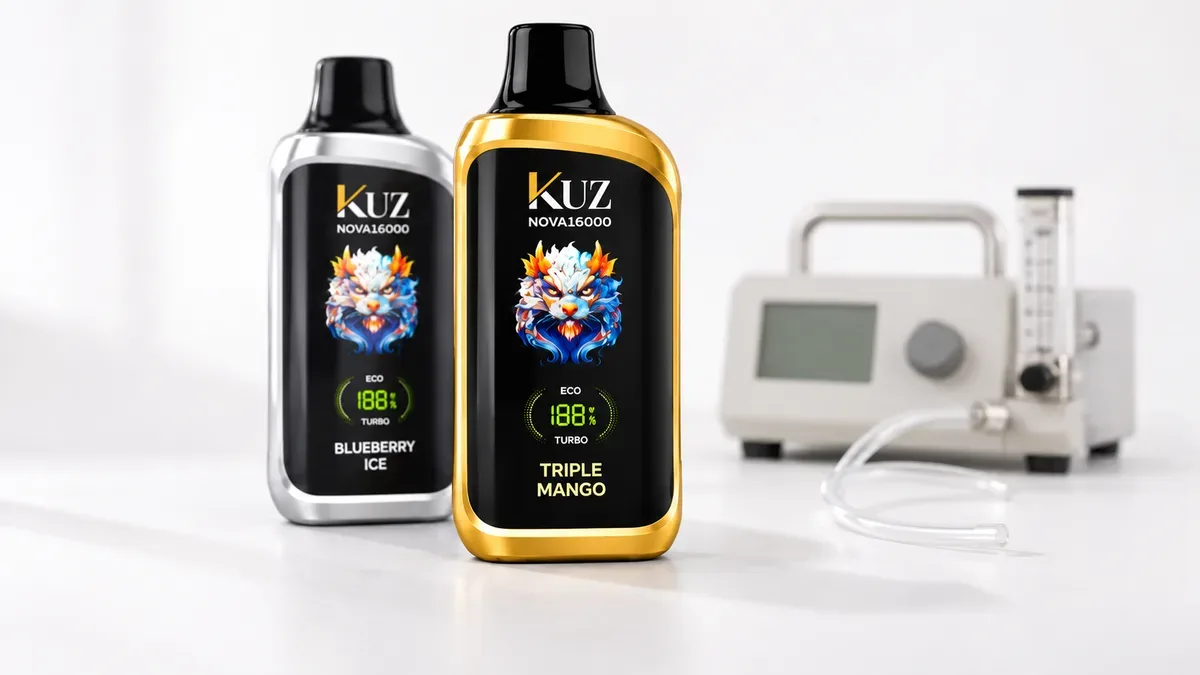
Does a device labelled for 16,000 puffs deliver exactly 16,000 draws to everyone who uses it? The phrase KUZ Nova 16000 Puffs: Understanding the Advertised 16,000 Puff Rating starts with one small qualifier. Specifically, the product listing says up to, and it ties that figure to ECO mode. That distinction matters when you turn a number on a package into an estimate of days.
For instance, two people might take 200 draws each day and still reach the end of their devices weeks apart. One might take short draws throughout the day, while the other takes longer draws in quick succession. Meanwhile, a machine test can control those differences by repeating the same draw until it reaches a defined stopping point.
1. What the KUZ Nova 16000 Puffs Rating Actually Means
The KUZ Nova 16000 Puffs rating describes the advertised maximum number of draws for the device in ECO mode. The Official KUZ Vape product listing gives TURBO mode a separate rating of up to 12,000 puffs. Therefore, the larger number applies to one operating mode, even though it appears in the model name.
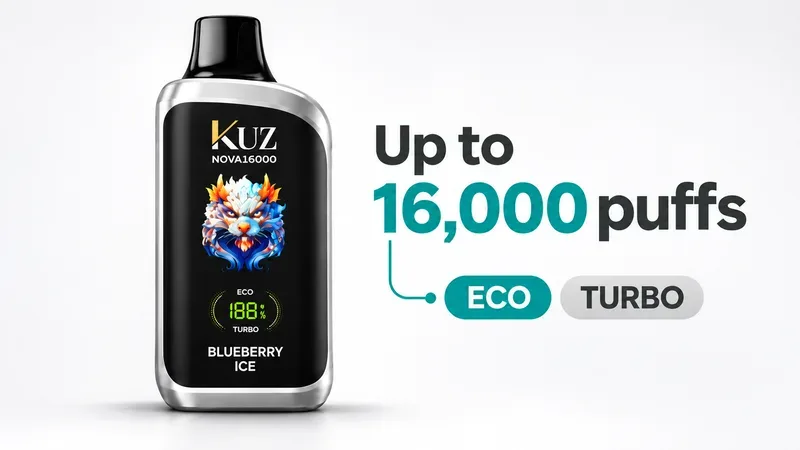
On the package, 16,000 looks as exact as a count you could verify with a tally. However, the words up to make it a capacity estimate under particular conditions. The listing gives you no personal minimum or typical result. In practice, two people can use the same model in ECO mode and finish with different totals.
What counts as one puff?
In everyday use, a puff is a single draw that activates the device. In a controlled test, the protocol can specify the airflow and duration that define each draw. For instance, a brief draw and a longer pull can each add one to the running total. The longer draw can still use more liquid and energy.
Therefore, a puff count alone tells you little about the amount of aerosol each draw produces. It also gives you no fixed measure of nicotine intake or total time spent using the device. For instance, 100 draws lasting two seconds add up to 200 seconds of draw time. The same number of four-second draws adds up to 400 seconds.
Why the mode matters
The advertised difference between ECO and TURBO is 4,000 draws, or 25 percent of the ECO figure. That calculation compares the two published ratings. However, it cannot tell you what happens when you switch modes throughout the day. The listing gives separate figures for each mode and offers no formula for mixed use.
A controlled result answers a narrow question about the number of draws recorded under a particular set of conditions. Meanwhile, a tally from your own device reflects the way you draw, pause, switch modes, and recharge. A personal count also depends on what you consider the last usable draw. Therefore, 16,000 works best as a reference point for ECO mode.
2. How Vape Puff Counts Are Typically Measured
A vaping machine can draw air repeatedly through a device while controlling the shape and timing of each puff. The operator connects the mouthpiece to the equipment and sets a draw sequence. Then, the machine repeats that sequence while the operator tracks activations, aerosol output, or both. Each run gives the operator a count for the conditions they selected.
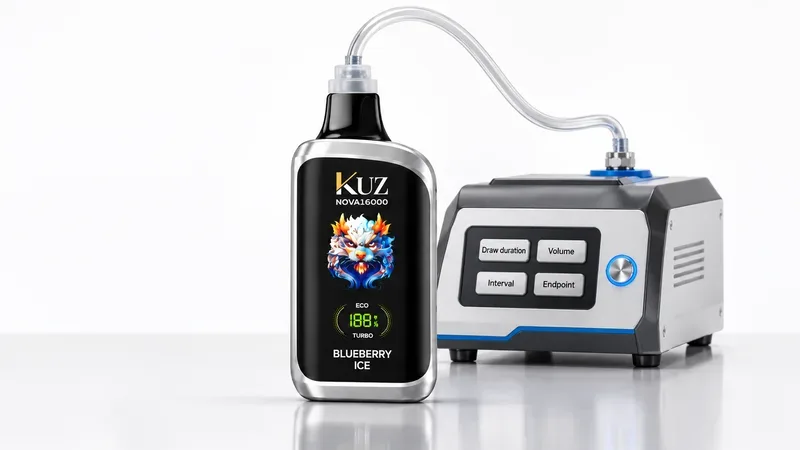
For instance, CORESTA Recommended Method No. 81 specifies a three-second draw of 55 millilitres every 30 seconds. It also specifies a rectangular airflow profile, which keeps the flow rate roughly steady during the draw. CORESTA designed the method for generating and collecting aerosol for analysis. Its settings illustrate what a controlled puff looks like, and the Nova listing does not identify them as its own.
What a test protocol can control
- Draw duration and volume. The protocol sets how long the machine draws and how much air it pulls through the mouthpiece.
- Airflow profile and pressure drop. It can define how airflow changes during the draw and how the setup measures resistance to airflow.
- Time between draws. Spacing affects how much time the coil has to cool and the wick has to absorb more liquid.
- Device position and mode. The procedure can specify whether the device sits upright, which mode it uses, and where any adjustable airflow sits.
- Ambient conditions. The tester can record room temperature and humidity so another lab can recreate the setup more closely.
When does the count stop?
Even with identical draws, the final number depends on when the tester decides to stop counting. For instance, one test might end when aerosol output drops below a set threshold. Another might continue until the device no longer activates. Meanwhile, a test that permits recharging can continue past the first low-battery cutoff if the device still has usable liquid.
Other endpoints include depleted usable liquid or a sustained decline in output over a defined series of draws. Consider a device that still activates at puff 10,000 but produces markedly less aerosol than it did earlier. A tester counting activations might keep going. However, a tester following an output threshold may already have recorded the final usable draw.
Therefore, a reproducible puff count needs both a defined puff and a defined endpoint. For instance, a test report could state which draws qualify and how many weak draws trigger the cutoff. Additionally, it could specify how to verify a low-battery event and resume testing after charging. Those details let another tester follow the same procedure and see whether similar devices produce similar totals.
3. Has KUZ Published the Nova 16000 Test Conditions?
The Official KUZ Vape product page reviewed for this article states up to 16,000 puffs in ECO mode. It also advertises up to 12,000 in TURBO mode. Additionally, the AUVAPER Nova listing presents the same two mode figures. These listings establish what the product advertising claims.
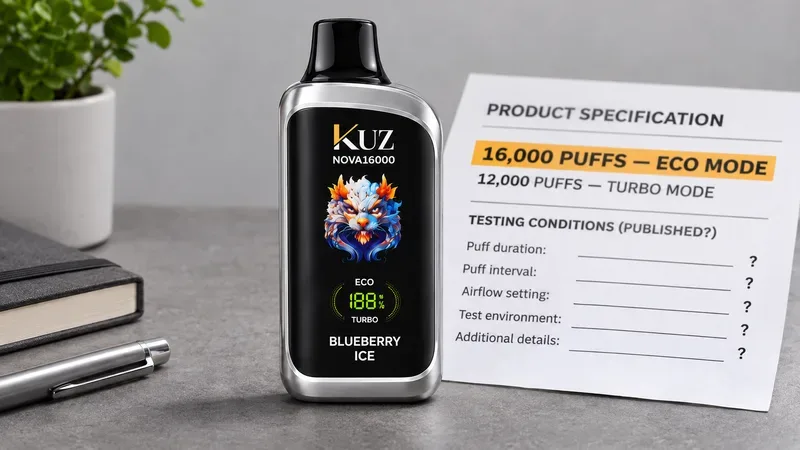
However, the reviewed material does not disclose a complete Nova-specific method for reaching either total. A reader cannot tell from those materials how long the test draws lasted or how much air each draw used. The materials also leave the interval between draws and the end-of-test threshold unspecified. Each detail could affect the recorded total.
What would a complete Nova test report show?
- Draw settings. The report would give the duration, volume, airflow profile, and interval the equipment used in ECO and TURBO.
- Charging procedure. It would say whether testers recharged the device, when they did so, and what charge level they restored.
- Test environment. It would record conditions such as room temperature and the device orientation during the run.
- Sample size and results. It would identify how many units the testers ran and show how much the counts varied.
- Failure threshold. It would explain how testers decided that liquid depletion, weak output, or loss of activation ended the count.
Sample size matters because a single unit tells you little about variation across a production batch. For instance, a report could show one unit reaching 16,000 while several others stopped earlier. A different report might show most units finishing near the headline figure. Without the results, readers cannot tell which pattern applies.
Likewise, a retailer review can describe the experience of one tester under that reviewer’s own conditions. A generic industry method can show how a laboratory controls its draws. Manufacturer validation would require evidence tying the Nova’s rating to a specified procedure and recorded results. Therefore, the reviewed material leaves readers without enough information to reproduce or fully evaluate the result independently.
Immediately before publication, recheck KUZ packaging, the product manual, official technical documents, and current manufacturer statements for any new disclosures. Look for a reference that identifies the Nova model and connects the method to both advertised figures. If KUZ publishes such a reference, check whether it includes the actual results and the full procedure.
4. Why Advertised and Actual Puff Counts Can Differ
Hold everything else steady and a longer draw generally keeps the coil powered for more time. That can use more liquid and energy each time the device activates. Likewise, a deeper draw can increase the amount of aerosol carried out of the device, depending on airflow and power. As a result, longer or more demanding draws can reduce the number of separate puffs available.
For instance, picture someone taking a quick draw during a break and someone taking four longer draws close together. By the fourth draw in that sequence, the second device may still retain heat from the earlier draws. Meanwhile, the wick has had less time to absorb liquid from the reservoir. A machine that spaces draws evenly may produce a different output pattern.
How power, liquid, and airflow interact
The Nova listing describes TURBO as the mode with stronger aerosol output and gives it a lower puff rating. Higher power can heat more liquid during a comparable draw and consume more battery energy. However, the advertised difference does not tell you how much extra liquid a specific TURBO puff uses. Draw length and airflow can change that relationship.
Airflow also affects how the draw feels and how air carries aerosol away from the coil. For instance, an airflow adjustment on a device that offers one can change the resistance you feel during a draw. You might respond by drawing harder or for longer. As a result, the setting and your draw pattern can both influence the count you observe.
Additionally, the usable liquid depends on how much of the fill can reach the wick. The coil can only turn liquid into aerosol when the wick supplies it. A device may still hold some liquid when the wick can no longer keep the coil supplied consistently. At that point, the electronics might still register a draw even as the output changes.
Why two units can finish at different times
Battery charge can affect how consistently a device delivers power or when it stops activating. For instance, recharging can restore power when low charge causes the cutoff and the device still holds usable liquid. However, a recharge cannot replenish the liquid or reverse wear on the coil and wick. Those limits can end useful operation independently of battery charge.
Meanwhile, storage conditions can affect how the battery and liquid behave before and during use. Devices from the same batch can also vary slightly in fill, coil resistance, or how the wick sits. Over thousands of activations, these differences can contribute to different finish times. Therefore, matching puff counts alone cannot establish that two devices delivered the same amount or quality of aerosol.
5. Converting the 16,000-Puff Claim Into Days of Use
Start with two numbers you can write down separately. One is an assumed total of usable puffs, and the other is your average daily count. Then divide the first number by the second to estimate the number of days. Estimated days of use = assumed usable puffs ÷ average daily puffs.
For instance, 16,000 divided by 200 equals 80 days. That result requires the device to deliver all 16,000 advertised ECO puffs and your daily average to stay near 200. If either input changes, the estimate changes with it. Therefore, 80 days represents the outcome of one specific scenario.
Example lifespan calculations
- 80 days. At 200 puffs per day, the full advertised ECO count of 16,000 would last 80 days.
- 60 days. At the same 200 puffs per day, an assumed total of 12,000 would last 60 days.
- 40 days. At 250 puffs per day, a lower assumed total of 10,000 would last 40 days.
- About 67 days. At 150 puffs per day, the same 10,000-puff assumption would last nearly 67 days.
The lower totals illustrate what happens when fewer usable draws are available. They do not come from measured Nova results or a published average for ECO mode. Likewise, the 12,000 figure in the calculation is an assumed usable total, even though it matches the advertised TURBO rating. To see the effect of capacity alone, keep your daily count fixed across scenarios.
How to estimate your daily average
Track your usual draws for several days, including a weekend day if your routine changes. For instance, daily counts of 180, 220, 160, and 240 add up to 800 over four days. Divide by four for a daily average of 200. Additionally, note your usual draw length, which mode you use, and whether you often take draws close together.
A phone tally or a note after each session can give you a starting point. However, it is easy to miss a draw or accidentally count one twice. Mark any day when you know the record is incomplete before relying on the average. A rounded daily count usually gives a more honest estimate than a figure with several decimal places.
Most importantly, use the tally to estimate duration. Puff count alone cannot quantify nicotine exposure. Liquid strength, the nicotine carried in the aerosol, and individual inhalation patterns all affect exposure. Consequently, two people with the same daily count can receive different amounts of nicotine.
6. Can Puff Ratings Be Compared Across Different Devices?
Two puff ratings are directly comparable only when testers use equivalent conditions. That means matching draw duration, volume, and spacing, plus selecting operating modes that deliver comparable output. Additionally, the tests need equivalent recharge policies and rules for deciding when each device stops producing usable draws. A difference in any of those conditions can shift the totals.
For instance, imagine two hypothetical devices advertised at 20,000 and 16,000 puffs. The first figure is 25 percent higher. However, the first test might use shorter draws or count very weak output after the second test would stop. Without equivalent methods, that 25 percent gap cannot tell you how much longer either device will last for you.
A checklist for comparing two puff claims
- Read the wording. Check whether each figure is an up to claim and identify the mode that produced it.
- Look for a test method. Compare draw duration, volume, spacing, and the point at which each test stops counting.
- Check usable-liquid information. Look for data on how much liquid the device can actually deliver through its wick.
- Compare battery and charging designs. Check whether each device can recharge and whether testers recharged it during the count.
- Check independent evidence. Look for model-specific testing that explains the method, identifies the mode, and reports how many devices the tester used.
A well-documented test can help you interpret a lower rating because it gives you conditions you can compare. Additionally, an independent test can show whether several units reach similar totals under the same procedure. Check whether the tester measured aerosol output or simply recorded activations. That distinction determines how much the result tells you about consistent output.
When neither brand publishes comparable methods, treat both numbers as rough indicators of the advertised capacity category. For instance, narrow differences between two high ratings reveal little about which device would last longer under your draw pattern. Look at how each figure changes across modes when the product materials provide that detail. Then use a range of plausible totals to compare estimated lifespan.
Conclusion
The KUZ Nova’s 16,000-puff figure is an advertised maximum for ECO mode, and the listing gives TURBO up to 12,000. Actual lifespan depends on draw behaviour, mode, usable liquid, and how the device delivers power. Additionally, where the test stops affects the advertised total. The reviewed material leaves enough of the Nova-specific procedure undisclosed that readers cannot independently reproduce the count.
Therefore, use the rating as one input when estimating lifespan or comparing it with another device. Track your daily puff count and typical draw pattern for several days. Then divide the advertised maximum and a lower usable-puff assumption by your daily average. At 200 daily puffs, for example, assumptions of 10,000 and 16,000 give a scenario range of 50 to 80 days.
