

You step outside a shop, reach for your vape, and notice a no-smoking sign. Does that sign cover vaping too? Can You Vape in Australian Shopping Centres? Generally, no, especially inside enclosed malls and shops. However, entrances, car parks, dining zones, and open-air precincts require a closer look.
Australian rules combine state or territory legislation with each centre’s conditions of entry. Therefore, a location may remain vape-free even when legislation does not expressly prohibit vaping there. Shoppers, tourists, employees, and managers should check both layers before deciding where someone may vape.
1. Can You Vape in Australian Shopping Centres?
Vaping is generally prohibited inside enclosed Australian shopping centres. These buildings operate as enclosed public places, workplaces, or both under local smoke-free laws. Moreover, the restrictions usually cover individual shops and shared areas throughout the centre.

Across Australia, vaping restrictions commonly follow existing smoking restrictions. Therefore, a “No Smoking” or “Smoke-Free” sign should normally be treated as covering vapes. A sign does not always need the word “vaping” or a picture of an e-cigarette.
Which products and spaces are covered?
These rules generally cover e-cigarettes, vape pens, personal vaporisers, and similar activated devices. Notably, many legal definitions also capture nicotine-free devices and liquids. The restriction concerns the act of producing and inhaling aerosol, not only the presence of nicotine.
For example, consider someone using a low-powered device inside a quiet service corridor. The aerosol may disappear quickly, and nobody may complain. However, discreet use does not create an exemption from smoke-free legislation or centre policy.
A product labelled “nicotine-free” does not automatically make indoor use lawful. In fact, location rules usually operate independently from rules governing a product’s ingredients. A prescription or lawful pharmacy purchase also does not permit vaping in a prohibited place.
Indoor restrictions normally cover much more than the central mall walkway. Specifically, shoppers should expect the following enclosed locations to remain vape-free:
- Individual shops, supermarkets, department stores, and kiosks
- Food courts, restaurants, cafés, and licensed premises
- Cinemas, entertainment venues, and indoor play facilities
- Toilets, parenting rooms, lifts, and enclosed stairwells
- Staff rooms, offices, stockrooms, and service corridors
- Loading areas or car parks that qualify as enclosed places
Moreover, opening a toilet window or standing beside an automatic door does not turn an enclosed space into an outdoor area. Legal definitions consider walls, roofs, airflow, and public access. Therefore, the safest response indoors is simple: keep the device switched off.
2. Australian Shopping Centre Vaping Laws by Jurisdiction
States and territories primarily control smoke-free public places in Australia. Consequently, definitions, outdoor boundaries, enforcement powers, and penalties are not completely uniform. Every jurisdiction nevertheless restricts vaping in relevant enclosed public places or applies smoking rules to e-cigarettes.

As a result, enclosed shopping malls are effectively vape-free nationwide. The table below provides a practical overview rather than individual legal advice. Furthermore, local regulations and property rules may create additional restrictions.
State and territory comparison
| Jurisdiction | Position inside shopping centres | Important outdoor considerations |
|---|---|---|
| New South Wales | Vaping is prohibited in enclosed public places, including shopping centres. NSW applies its smoke-free restrictions to e-cigarette use. | Restrictions include commercial outdoor dining areas and locations within four metres of pedestrian access points to public buildings. Public transport stops and playground buffers also apply. |
| Victoria | Vaping is prohibited in enclosed workplaces and specified public spaces. Shops, staff areas, and enclosed mall spaces normally fall within these protections. | Outdoor dining areas remain smoke-free and vape-free. Restrictions also cover certain transport areas, playgrounds, swimming pools, and protected entrances. |
| Queensland | Smoking-product laws cover vaping in enclosed places. Therefore, enclosed malls, stores, and food courts are generally vape-free. | Queensland prohibits vaping within five metres of many non-residential entrances. Outdoor pedestrian malls, eating areas, playground buffers, and public transport areas can also be restricted. |
| Western Australia | Vaping is banned wherever smoking is prohibited. This includes enclosed public places and enclosed workplaces, such as shopping centres. | Specified outdoor public places may also remain vape-free. Additionally, owners can prohibit vaping throughout outdoor centre property. |
| South Australia | Enclosed public areas and workplaces are smoke-free and vape-free. The rules apply to shopping-centre interiors and relevant employee areas. | Smoking and vaping are prohibited at and within ten metres of non-residential building entrances. Outdoor dining, playground, transport, and other protected areas may also be covered. |
| Tasmania | Tasmanian smoke-free rules cover e-cigarettes and personal vaporisers. Enclosed public places and workplaces, including shopping centres, are generally protected. | Restrictions can cover entrances, pedestrian malls, outdoor dining areas, playgrounds, and other declared places. Centre-wide policies may extend beyond those locations. |
| Australian Capital Territory | Smoking and vaping are banned in enclosed public places, with shopping centres specifically included. A lawful therapeutic vape does not create an exemption. | Outdoor eating and drinking areas, government-managed playground buffers, and public transport waiting areas have additional restrictions. |
| Northern Territory | The restrictions applying to tobacco consumption also extend to e-cigarettes. Enclosed public and workplace areas within shopping centres are therefore generally vape-free. | Outdoor eating and drinking rules, licence conditions, workplace duties, and private property policies may impose further limits. |
Why local details still matter
Differences become important once a person leaves the enclosed mall. For instance, one jurisdiction may protect a shopping-centre entrance with a four-metre buffer. Meanwhile, another may use five or ten metres, or regulate the area through a different legal definition.
A council can also declare certain streets, pedestrian malls, events, or public spaces smoke-free. Additionally, transport authorities may control nearby bus interchanges or railway platforms. These overlapping rules can make two visually similar shopping precincts legally different.
Penalty units present another source of variation. Their monetary value can change without the underlying offence being rewritten. Therefore, readers should confirm current figures through the relevant health department before relying on an older sign, article, or saved webpage.
Legislation can also change definitions, exemptions, and enforcement procedures. Most importantly, official guidance offers the best starting point for a location-specific decision. Centre management can then explain any stricter conditions applying to the property.
3. Entrances, Car Parks and Open-Air Shopping Centres
Walking outdoors does not automatically make vaping legal. Entrance buffers, dining restrictions, playground protections, pedestrian-mall rules, and transport laws may overlap. Moreover, the centre may prohibit vaping across its entire site.
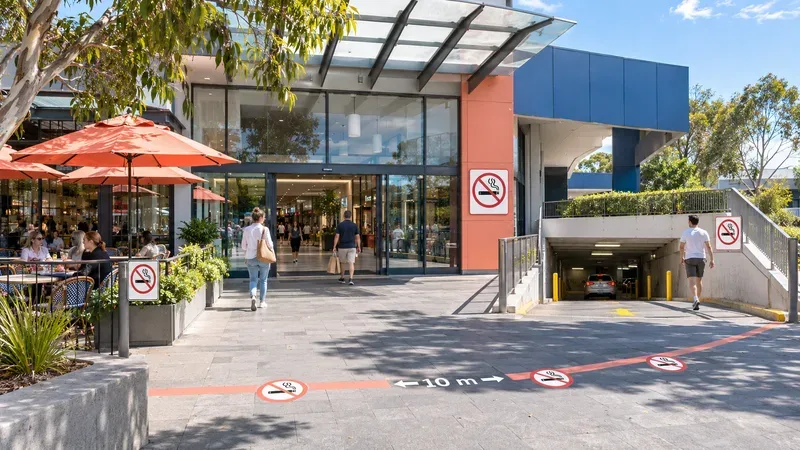
Entrances and nearby walkways
Entrance rules deserve particular attention because the required distance varies. New South Wales generally uses a four-metre pedestrian-access buffer for public buildings. Queensland commonly uses five metres for non-residential entrances, while South Australia uses ten metres for covered entrances.
However, measuring from the nearest door may not resolve every case. A centre can have several entrances, open doors, air intakes, or connecting transport facilities. Therefore, moving well away from the building and checking signs offers a safer approach.
Outdoor cafés near an entrance create another complication. Even beyond an entrance buffer, legislation may prohibit vaping throughout an outdoor dining area. Additionally, tables can extend farther than the shopfront or marked tenancy boundary.
Enclosed and open car parks
An underground car park should not be treated like an unrestricted outdoor space. It may qualify as an enclosed public place, an enclosed workplace, or both. Furthermore, staff, delivery drivers, cleaners, and security officers work there for long periods.
Multi-storey car parks require similar care. Open sides do not always prevent an area from meeting a legal definition of “enclosed.” Specifically, the amount of roofing, wall coverage, and airflow may affect its status.
An uncovered outdoor car park may fall outside a particular statutory ban. However, nearby entrances, footpaths, taxi ranks, bus stops, or dining areas can remain protected. The centre can also ban vaping across the whole car park through its property conditions.
Open-air centres and shopping strips
Open-air shopping centres often contain a patchwork of regulated and unregulated spaces. For example, an uncovered walkway may connect shops, a playground, café tables, and a bus stop. Each component can carry a different restriction.
Some genuinely open areas may not fall under a specific statewide prohibition. On the other hand, that does not create an automatic right to vape. A landlord, body corporate, council, or centre operator may impose stricter rules.
Weather protection can also change the practical assessment. A roof, awning, screens, and closely positioned walls may make an area substantially enclosed. Therefore, avoid guessing from appearance alone when signs or staff can provide a clear answer.
Most importantly, check conditions displayed at vehicle entrances, pedestrian gates, directories, and customer-service desks. A centre-wide rule can cover landscaped grounds and open courtyards. It can apply even where public health legislation sets no specific outdoor ban.
4. Centre Policies, Designated Areas and Security Powers
Shopping-centre owners and occupiers can adopt stricter conditions than the legal minimum. These conditions protect customers, workers, and contractors while simplifying enforcement across complex properties. Therefore, an otherwise lawful outdoor location may remain vape-free under centre policy.
A policy can cover shops, footpaths, car parks, loading docks, gardens, service yards, and staff areas. Moreover, the centre may communicate that rule through signs, lease conditions, employment policies, or published conditions of entry. Visitors should follow reasonable directions even when they missed the original notice.
Designated areas are not guaranteed
Australian shopping centres do not generally have to provide a smoking or vaping area. In fact, many centres operate entirely smoke-free and vape-free sites. Others place a designated area at a lawful outdoor location away from doors and crowded walkways.
Management may relocate or close that area because of renovations, safety concerns, complaints, or legislative changes. Additionally, staff may have separate workplace arrangements that do not apply to customers. An old ashtray or discarded cigarette butts do not prove that vaping is permitted.
A marked smoking area should not automatically be treated as a vaping area. Centre rules may distinguish between products, although legislation often regulates both similarly. Therefore, read every sign and ask management when the wording appears unclear.
What security can do
Security officers or managers can ask a person to stop vaping on centre property. They may also direct that person to move to an approved area or leave. These actions usually rely on property rules, conditions of entry, and applicable security procedures.
Refusing a lawful direction can escalate an avoidable situation. For instance, management may withdraw permission to remain on the property and arrange removal. Further action may follow if the person refuses to leave, becomes aggressive, or commits another offence.
However, private security does not automatically possess every power held by police or authorised health inspectors. Their actions must remain within applicable law and workplace procedures. Most incidents end when the person switches off the device or leaves the restricted area.
5. Penalties, Enforcement and Reporting Illegal Vaping
Consequences depend on the location, conduct, and enforcing authority. A person may receive a warning, a direction to stop, or removal from the centre. Additionally, an authorised officer may issue an infringement notice or begin prosecution.
There is no single national fine for vaping in a prohibited shopping-centre area. Each jurisdiction sets its own offences, maximum penalties, and penalty-unit values. Therefore, an amount quoted for one state may be inaccurate somewhere else.
How fines and compliance duties work
As a dated example, NSW Health guidance available in November 2026 states that inspectors can issue a $300 on-the-spot fine. That example should not be treated as a nationwide amount. Moreover, court proceedings can involve different maximum penalties and circumstances.
Owners and occupiers may also carry compliance responsibilities. Depending on local law, they may need to display signs or take reasonable steps against prohibited conduct. Furthermore, workplace safety duties may require controls that reduce employee exposure to aerosol.
A manager should document repeated incidents and confirm which authority handles them. However, staff should not place themselves at risk during a confrontation. Established security and incident-reporting procedures provide the safer route.
Where to report a concern
For immediate vaping inside a centre, notify customer service, security, or the store manager. Provide the time, precise location, and a factual description. Specifically, avoid confronting the person when doing so could create a safety risk.
Ongoing breaches in legislated smoke-free areas can usually be reported to the relevant state or territory regulator. Useful information may include repeated dates, the affected entrance, and whether staff received earlier reports. However, the regulator may not disclose details of its investigation.
Reporting unlawful vape sales is a separate process from reporting prohibited public use. Retail sales, commercial possession, importation, and advertising can involve health departments, the Therapeutic Goods Administration, or other enforcement bodies. Therefore, select the reporting category that matches the suspected conduct.
- Report vaping on centre property to management or security first.
- Report repeated smoke-free area breaches to the relevant local regulator.
- Report suspected unlawful retail supply through the designated government channel.
- Contact emergency services only when an incident creates an immediate safety threat.
6. Why Vaping Is Restricted and Where You Can Vape Legally
Vape aerosol is not simply harmless water vapour. It can contain nicotine, fine particles, solvents, flavouring chemicals, and other substances. Moreover, nearby people can inhale emissions released into shared air.
Enclosed shopping centres give visitors few practical ways to avoid that exposure. Workers may remain near the same kiosk, doorway, or corridor for an entire shift. Therefore, smoke-free rules protect people who cannot simply move elsewhere.
Children, families, older visitors, and people with health conditions also use these spaces. Additionally, visible vaping can make the behaviour appear routine or socially accepted. Smoke-free and vape-free environments support quitting and reduce that normalisation.
A practical lawful-location checklist
A lawful location must satisfy both legislation and property rules. In fact, private property is not automatically available for vaping. The owner or occupier may withhold permission even when no public-place prohibition applies.
Before using a vape, follow this checklist:
- Leave the shopping centre’s property when its conditions require it.
- Move beyond every applicable entrance or building-access buffer.
- Avoid outdoor dining and drinking areas.
- Stay away from playgrounds, schools, pools, and protected sporting areas.
- Do not vape at transport stops, platforms, ranks, or interchanges.
- Avoid crowds and places where aerosol may drift toward others.
- Check signs, council rules, and directions from centre management.
- Obtain the owner’s permission when using other private property.
For example, crossing from a mall entrance to an outdoor café does not necessarily solve the problem. The café tables may form a protected dining area. Meanwhile, the nearby footpath could fall within an entrance or transport buffer.
A better option may involve leaving the property and finding an unrestricted outdoor location. However, you must still respect adjoining businesses and local rules. Most importantly, do not assume an empty lane, loading area, or private car park permits vaping.
Location rules and product laws are different
Rules about where someone may vape differ from laws controlling the product itself. National and jurisdictional laws regulate importation, manufacture, sale, supply, commercial possession, and pharmacy access. A legal location cannot make an unlawfully supplied product lawful.
Conversely, lawful pharmacy access does not create permission to vape inside a mall. Australian Government guidance explains that vapes can only be sold through participating pharmacies under strict conditions. Readers can review the Australian Government’s current vaping laws before obtaining or using a product.
People aged 18 or older may access certain therapeutic vapes through participating pharmacies, subject to applicable conditions. Other requirements can apply to younger people and higher nicotine concentrations. Additionally, state or territory law may affect access and possession.
Therefore, verify both sets of requirements before relying on general advice. Check the Australian Government’s guidance for product controls and the relevant health department for location rules. For a specific centre, confirm the current property policy directly with management.
Conclusion
Vaping is generally prohibited inside enclosed Australian shopping centres. Many entrances, dining areas, car parks, and open-air precincts also face legislative or property-based restrictions. Therefore, treat “smoke-free” as “vape-free” unless reliable current guidance clearly says otherwise.
The safest approach is to follow every sign and ask centre management before using a vape. Check the centre’s conditions of entry and your health department’s current smoke-free guidance. Finally, report suspected breaches through centre management or the appropriate regulator.
