

A tenant vapes beside an open window, yet the landlord says the lease has been breached. Who is legally right? The answer to “Can Landlords Ban Vaping in Australian Rental Homes?” depends on the agreement, local tenancy law, and any strata rules. Therefore, neither party should rely on assumptions about smoking alone.
Australian rental law does not always treat smoking and vaping identically. Moreover, every state and territory applies its own legislation, notices, and dispute procedures. This guide explains lawful restrictions, tenant protections, evidence, bond claims, and practical enforcement steps.
1. Can Landlords Ban Vaping in Australian Rental Homes?
Yes, landlords can generally prohibit vaping through a clear and lawful tenancy term. However, the term must comply with residential tenancy legislation in the property’s state or territory. A landlord cannot enforce any condition simply because they own the home. Specifically, prohibited, unreasonable, or inconsistent additional terms may have no legal effect.

Australia has no single national law governing residential tenancies. Instead, eight separate legal systems regulate rental agreements, property access, breach notices, bonds, and termination. Therefore, a clause accepted in Queensland may face different requirements in Victoria or New South Wales. Local advice becomes especially important when eviction or substantial compensation is threatened.
The lease is only part of the picture
A contractual vaping ban creates an obligation concerning the act of vaping. Meanwhile, general tenancy duties can apply even without an express ban. Tenants usually must avoid property damage, serious nuisance, unsafe conduct, and unreasonable interference with neighbours. They may also need to return the property reasonably clean, allowing for fair wear and tear.
For example, a lease may say nothing about vaping in a private courtyard. However, repeated vapour entering a neighbour’s bedroom could still produce a nuisance complaint. Similarly, tampering with a smoke alarm may breach safety duties, regardless of why the tenant interfered with it.
A valid restriction does not remove the tenant’s right to privacy and quiet enjoyment. Landlords and agents must still follow lawful entry rules and provide required notice before inspections. Furthermore, they cannot continuously monitor tenants or arrive without permission, except where legislation permits urgent entry. A no-vaping term regulates conduct; it does not create unrestricted inspection powers.
2. Does a No-Smoking Clause Automatically Cover Vaping?
Not necessarily. Smoking usually involves burning tobacco or another substance, while vaping heats liquid or material to create an aerosol. Therefore, a conventional clause stating “no smoking” may not clearly include e-cigarettes or vape pens. The outcome may depend on the clause’s wording, context, and local interpretation.
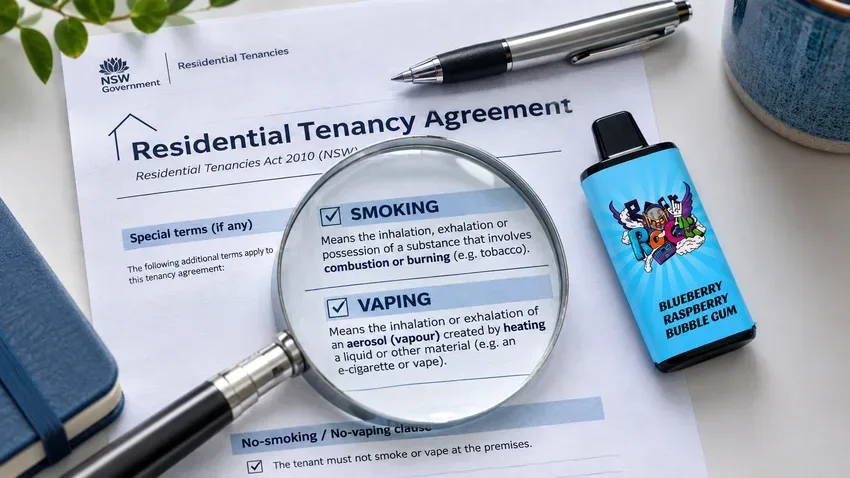
Landlords should not assume that ordinary references to smoke always include vapour. Likewise, tenants should not assume that different technology guarantees permission. A broader clause may define smoking to include vaping and electronic devices. However, an ambiguous clause can make enforcement slower, more expensive, and less predictable.
What a clear clause should address
Careful drafting separates the relevant activities and devices. Specifically, the agreement can name smoking, vaping, e-cigarettes, heated-tobacco products, vape pens, and electronic nicotine-delivery systems. It can also cover devices that use nicotine-free liquids. Moreover, the wording can address cannabis vaping without suggesting that the lease authorises conduct prohibited by other laws.
A practical clause should explain:
- Prohibited conduct: smoking, vaping, heating, or using specified products.
- Covered locations: rooms, garages, balconies, gardens, courtyards, or common areas.
- Covered devices: e-cigarettes, disposable vapes, refillable devices, and heated products.
- Visitor responsibility: whether tenants must ensure guests and occupants comply.
- Possible consequences: lawful notices, compensation claims, or other available remedies.
For instance, “no smoking inside” may leave a disposable nicotine-free vape outside the clause’s express wording. In contrast, “no smoking or vaping inside the dwelling or garage” provides greater certainty. However, even precise language remains subject to legislation governing additional tenancy terms. A lease cannot remove statutory rights merely by describing a restriction clearly.
Both parties should clarify uncertainty before signing. Additionally, any agreed explanation should appear in the written agreement, rather than relying on a casual conversation. Written definitions reduce later arguments about products, places, visitors, and expected conduct.
3. Can a Landlord Add a Vaping Ban During the Tenancy?
A restriction agreed before signing usually forms part of the original bargain. However, a policy introduced during an existing tenancy presents a different issue. A landlord generally cannot assume that an emailed rule automatically changes a signed lease. Posting a notice in the building may not amend the agreement either.

During a fixed term, a variation commonly requires mutual agreement and proper written documentation. Additionally, the change must remain consistent with applicable legislation and prescribed agreement terms. Periodic tenancies can involve different rules, but landlords still cannot invent immediate contractual obligations. Notice requirements and limits depend on the relevant jurisdiction.
Changes, renewals, and written consent
A renewal may provide an opportunity to propose a prospective no-vaping clause. Therefore, both parties can review its wording before accepting the next agreement. Local law may limit particular terms or the consequences of refusing them. Tenants should seek advice if a proposed condition appears unreasonable or conflicts with legislation.
A tenant should not ignore a proposed variation. Instead, the tenant should request the following details in writing:
- The complete wording of the proposed restriction.
- The legal or contractual basis for introducing it.
- The areas, devices, occupants, and visitors it covers.
- The proposed commencement date.
- The stated consequences of an alleged breach.
Most importantly, silence should not become a substitute for a documented agreement. The parties should record whether they accepted, rejected, or revised the proposal. Furthermore, each party should retain a signed copy of any valid variation.
A properly drafted clause may make tenants responsible for ensuring occupants and visitors comply. For example, a guest vaping in a prohibited bedroom could create an alleged breach. However, enforcement must still follow tenancy law and the agreement’s actual wording. A landlord cannot bypass required notices simply because a visitor caused the problem.
4. Indoor, Outdoor, Balcony, and Strata Vaping Rules
Location can change the analysis considerably. Vaping inside a bedroom differs from vaping in a private garden, garage, balcony, or shared hallway. Therefore, the agreement should identify every covered area. A broad reference to “the property” may require interpretation when outdoor spaces form part of the tenancy.
A lease can attempt to restrict vaping in specified outdoor areas. However, local tenancy law determines whether that additional term is valid and enforceable. A restriction covering an enclosed garage may appear more directly connected with residue or fire risks. On the other hand, a complete ban across a large private garden may attract closer scrutiny.
Drifting vapour and neighbouring homes
Outdoor vaping does not always remain a private matter. For instance, vapour from a balcony may enter the apartment above through an open window. Repeated exposure could produce complaints concerning nuisance, health, or interference with reasonable peace and comfort. Therefore, conduct may raise concerns even when the lease contains no express balcony ban.
One isolated complaint may not prove a breach. However, dated reports from several neighbours can carry more weight than a vague allegation. Building layout, frequency, weather, and the direction of drifting vapour may also matter. Both parties should separate genuine evidence from assumptions about a tenant’s habits.
Strata and common-property restrictions
Owners corporations, strata schemes, and bodies corporate may impose additional rules. These rules can regulate conduct on balconies, shared gardens, corridors, lifts, foyers, and other common property. Notably, the Queensland Residential Tenancies Authority confirms that body corporate bylaws may address smoking and vape devices. Such rules may cover common areas and balconies.
Common-area restrictions may also arise under other applicable laws. Therefore, a silent tenancy agreement does not necessarily grant permission to vape in a shared stairwell. Tenants may need to comply with both their lease and the scheme’s current bylaws. Landlords should provide applicable rules when local law requires them to do so.
Renters should obtain the complete tenancy agreement and current strata or community-title rules. Additionally, they should confirm whether a balcony forms part of the lot, common property, or an exclusive-use area. That distinction can affect which rules apply. A building manager’s informal statement should not replace the actual documents.
5. Evidence, Property Damage, Cleaning Costs, and the Bond
Vaping may create concerns about odour, residue, staining, or surface contamination. Curtains, carpets, painted walls, and ventilation systems may require attention in some cases. However, vaping does not inevitably damage every property. The landlord must distinguish a possible risk from proven loss during the particular tenancy.
Interference with smoke alarms creates a separate concern. For example, covering a detector to prevent activation may create safety risks and breach specific duties. Evidence should show what happened, who caused it, and whether repair became necessary. Assumptions about a disabled alarm should not replace an electrician’s findings.
What can support a claim?
A bond deduction should reflect demonstrable damage or cleaning beyond fair wear and tear. Therefore, suspicion that vaping occurred may not justify withholding money. The claimed amount should also reflect reasonable cleaning or repair costs. A landlord should not use the bond as an automatic penalty for breaking a rule.
Useful evidence may include:
- Entry and exit condition reports completed carefully by both parties.
- Dated photographs showing surfaces, curtains, carpets, or damaged fixtures.
- Routine inspection notes that identify specific observations.
- Cleaning or repair invoices describing completed work and actual costs.
- Independent assessments explaining unusual residue or contamination.
- Written admissions or messages concerning vaping inside the property.
- Dated neighbour complaints describing locations, times, and frequency.
- Before-and-after records from ventilation or smoke-alarm professionals.
By contrast, finding a vape device does not prove where it was used. An unverified smell may not establish frequency, duration, or the responsible person. Moreover, a photograph of a device on a table proves possession, not necessarily contractual breach. The evidence must address the wording of the relevant clause.
Causation and reasonable expenses
A financial claim needs a logical connection between the conduct and the expense. For instance, an invoice for whole-house cleaning may be excessive when evidence concerns one small room. Likewise, replacing old curtains may include ordinary ageing unrelated to vaping. Accurate entry records help separate pre-existing marks from new damage.
The tenant can request invoices, photographs, reports, and a calculation of the amount claimed. Meanwhile, the landlord can ask the tenant for an explanation and supporting records. Both parties should compare the property’s initial and final condition. They should also consider depreciation, existing wear, and whether targeted cleaning resolved the concern.
If no agreement emerges, the relevant bond authority or tribunal may determine the dispute. The decision-maker can consider the clause, evidence, causation, and reasonable loss. Therefore, both parties should preserve original records rather than relying on memory months later.
6. Breach Notices, Inspections, and Possible Eviction
Eviction is not normally immediate or automatic because someone alleges indoor vaping. Usually, the landlord must gather reliable evidence and communicate the concern. The landlord should identify the relevant agreement term or statutory duty. Where required, they must issue the correct breach notice and allow time to remedy.
The precise pathway varies between jurisdictions. Termination grounds, notice periods, remedy rights, and tribunal applications can all differ. Moreover, repeated conduct may receive different treatment from a single minor incident. Serious damage, safety interference, or substantial nuisance may also change the available response.
Three different evidentiary questions
The parties should separate three issues that often become confused:
- Evidence of vaping: proof that a person used a vaping device.
- Evidence of breach: proof that the conduct violated a valid term or legal duty.
- Evidence of loss: proof that the breach caused damage, cleaning costs, or nuisance.
For example, a written admission may establish indoor vaping. However, it may not prove permanent staining or justify replacing carpet. Conversely, a residue assessment may show contamination but not identify its source. A strong claim connects each step with reliable evidence.
Inspections and privacy
Landlords and property managers must comply with lawful entry requirements. Therefore, they cannot conduct surprise inspections merely to search for vaping evidence. They must give the required notice, use a permitted entry ground, and attend at lawful times. Emergency entry rules may differ, but ordinary suspicion rarely creates an emergency.
Intrusive surveillance can also raise privacy and surveillance-law concerns. A no-vaping clause does not authorise hidden cameras inside a tenant’s home. Furthermore, repeated unnecessary visits may interfere with quiet enjoyment. Landlords should use ordinary inspection procedures and document visible conditions objectively.
Both parties should keep factual, dated communications in writing. Tenants should respond to formal notices within applicable deadlines and obtain advice promptly. Meanwhile, landlords should avoid changing locks, shutting off services, or removing possessions without lawful authority. Retaliation and self-help measures can create separate legal problems.
7. State and Territory Rules and Practical Next Steps
Residential tenancy laws differ across every Australian jurisdiction. New South Wales, Victoria, Queensland, Western Australia, South Australia, Tasmania, the Australian Capital Territory, and the Northern Territory apply separate statutes. Consequently, one national answer cannot resolve every disputed clause. Each jurisdiction also uses different authorities and tribunal processes.
The following table identifies the principal official starting points. Agency names and responsibilities can change, so readers should confirm current details through the relevant government directory.
| Jurisdiction | Official tenancy or bond authority | Dispute forum |
|---|---|---|
| New South Wales | NSW Fair Trading and Rental Bonds Online | NSW Civil and Administrative Tribunal |
| Victoria | Consumer Affairs Victoria and the Residential Tenancies Bond Authority | Victorian Civil and Administrative Tribunal |
| Queensland | Residential Tenancies Authority | Queensland Civil and Administrative Tribunal |
| Western Australia | Consumer Protection and Bonds Administration | Magistrates Court or the applicable bond dispute service |
| South Australia | Consumer and Business Services | South Australian Civil and Administrative Tribunal |
| Tasmania | Consumer, Building and Occupational Services and the Rental Deposit Authority | Residential Tenancy Commissioner or Magistrates Court, depending on the issue |
| Australian Capital Territory | Access Canberra and ACT Rental Bonds | ACT Civil and Administrative Tribunal |
| Northern Territory | NT Consumer Affairs | Northern Territory Civil and Administrative Tribunal |
The relevant authority can explain forms and general procedures. Additionally, a local tenants’ advice service can assist with disputed clauses, bond claims, and breach notices. Tribunal staff may explain filing processes but generally cannot provide personalised legal advice. A property lawyer can help when significant compensation or termination is likely.
Checklist for tenants
- Read every smoking and vaping term in the signed agreement.
- Request current strata, body corporate, or community-title rules.
- Ask for unclear restrictions and proposed variations in writing.
- Negotiate a specific outdoor arrangement where appropriate.
- Complete detailed entry and exit condition reports.
- Photograph walls, curtains, carpets, vents, and smoke alarms.
- Retain correspondence, notices, invoices, and inspection records.
- Seek advice before ignoring a notice or accepting a bond deduction.
Checklist for landlords and agents
- Define smoking, vaping, devices, products, and covered conduct expressly.
- Identify whether rooms, garages, gardens, balconies, and common areas are covered.
- Explain tenant responsibility for occupants and visitors.
- Provide applicable strata or body corporate rules.
- Prepare detailed condition reports with dated photographs.
- Use evidence to connect conduct with actual loss or nuisance.
- Follow statutory entry, notice, remedy, and tribunal procedures.
- Avoid automatic penalties or unsupported bond deductions.
Seek specific assistance when a clause appears unclear, unreasonable, or inconsistent with legislation. Advice is also sensible when eviction or a substantial bond dispute seems possible. Suitable sources include a tenants’ union, consumer affairs authority, fair trading service, property lawyer, or tribunal information service.
This material provides general legal information, not advice about a specific tenancy. Laws, forms, and procedures differ by jurisdiction and can change. Therefore, obtain current guidance before acting on a clause, notice, bond claim, or termination proposal.
Conclusion
Landlords can generally establish smoke-free and vape-free rental homes through clear, lawful agreement terms. However, ambiguous smoking clauses, mid-tenancy changes, strata rules, and privacy protections can affect the outcome. Evidence and jurisdiction-specific procedures also matter. Therefore, neither an allegation nor a broken rule automatically proves financial loss or permits immediate eviction.
Check the exact tenancy agreement wording and all applicable strata rules first. Next, confirm current requirements with the tenancy authority or tenants’ advice service in the property’s jurisdiction. Take that step before issuing, accepting, or challenging any vaping restriction.
