
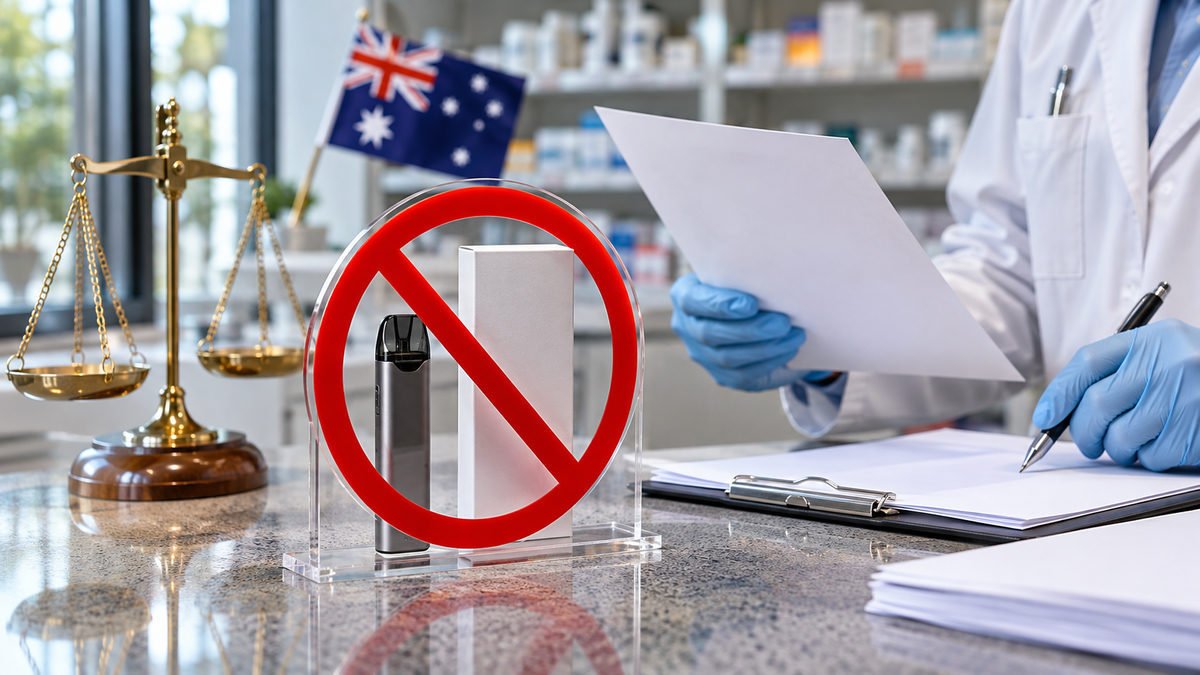
Could a pharmacy webpage, influencer post, product discount, or quitting campaign trigger penalties under Australian vaping laws? Vape Advertising Restrictions in Australia Explained begins with a simple warning: promotion extends far beyond traditional advertisements. Therefore, retailers, pharmacies, professionals, publishers, and creators must examine every public message carefully.
Australia regulates vape promotion through overlapping federal, state, and territory laws. Moreover, one communication may fall under several legal regimes at once. A lawful pharmacy supply pathway does not create a general right to market vaping products. Likewise, factual wording does not automatically make public content lawful.
The rules contain narrow permissions for packaging, professional communications, patient consultations, supply-chain material, and authorised health campaigns. However, each permission carries detailed conditions. This guide explains the main federal bans, practical risks, possible liability, enforcement methods, and essential compliance steps. It provides general information only, rather than legal advice.
1. Vape Advertising Restrictions in Australia Explained
The general position
Australia generally prohibits advertising or promoting vaping goods to the public. Specifically, the restriction covers therapeutic and non-therapeutic products, nicotine products, devices, components, and related accessories. It can apply even when a promotion does not produce an immediate sale. Therefore, free content may create the same legal concern as paid advertising.
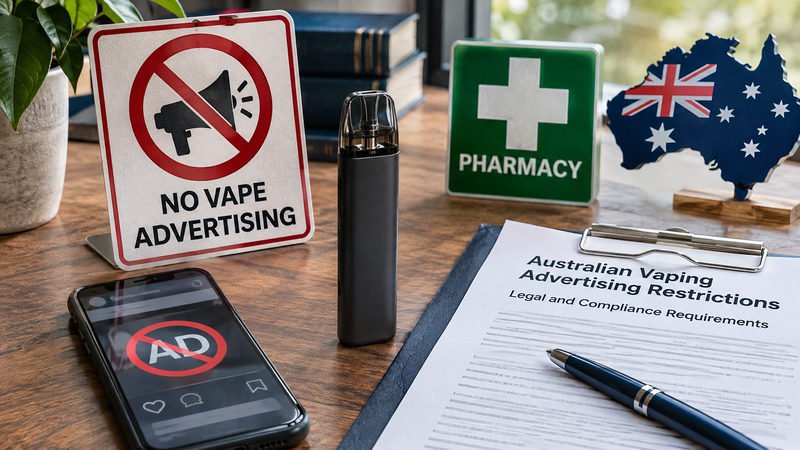
The prohibition reaches online and offline communications. For instance, it may cover websites, search advertisements, social posts, emails, videos, podcasts, signs, merchandise, and printed catalogues. Moreover, sponsorship arrangements can raise separate concerns when they promote vaping, a product, or a commercial brand. A small audience does not necessarily remove that risk.
Consider a pharmacy that publishes, “New nicotine vapes available now—ask our team today.” The pharmacy may legally supply certain therapeutic products under strict conditions. However, that supply authority does not automatically authorise this public promotion. The webpage could encourage product use and fall outside permitted patient counselling.
Why the rules feel complicated
Two major federal frameworks operate together. The Therapeutic Goods Act 1989 broadly prohibits vaping-goods advertising unless the Therapeutic Goods Administration authorises it. Meanwhile, the Public Health (Tobacco and Other Products) Act 2023 restricts e-cigarette advertising, promotion, and sponsorship. State and territory requirements may add further controls.
As a result, passing one legal test does not guarantee compliance. A business must check every applicable rule before publication. Additionally, pharmacy law, professional standards, consumer protection law, and medicines scheduling may affect the same material. The publisher should assess both the message and its surrounding context.
The safest starting point treats public-facing vape promotion as prohibited unless a clear permission applies. Moreover, the organisation should confirm every condition attached to that permission. It should never rely on assumptions such as “educational,” “for adults,” or “available through pharmacies.” Those labels do not decide the legal outcome.
- Public communication: Assume broad restrictions apply across every channel.
- Professional communication: Restrict access and confirm the recipient qualifies.
- Patient communication: Keep it direct, clinical, relevant, and consultation-based.
- Product information: Use only details that the applicable authorisation allows.
- Local rules: Check the relevant state or territory before publication.
2. The Federal Laws Governing Vape Advertising
The Therapeutic Goods Act
The Therapeutic Goods Act 1989 uses a broad concept of advertising. It includes statements, pictures, and designs intended to promote a vaping product’s use or supply. Notably, the definition also reaches labels, packages, and material packed with the goods. However, a specific authorisation permits limited content in those settings.
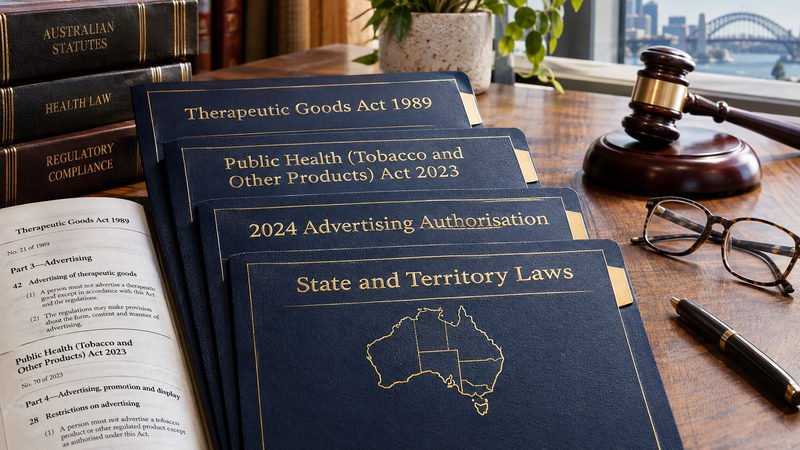
The law can apply when someone advertises directly or causes another person to advertise. Therefore, brands cannot avoid responsibility simply by using agencies, affiliates, publishers, or creators. Payment is not always necessary either. Control, instructions, approvals, or requested publication may connect several parties to the same promotion.
The Therapeutic Goods Administration, known as the TGA, administers this framework. In practice, it evaluates content, context, presentation, audience, and surrounding commercial activity. Moreover, it can consider whether material appears designed to encourage use or supply. A publisher’s claim of neutral intent will not necessarily settle the issue.
The public health framework
The Public Health (Tobacco and Other Products) Act 2023 also restricts e-cigarette advertising and sponsorship. Its coverage includes communications and activities that directly or indirectly promote vaping or relevant products. Specifically, written words, images, audio, video, trademarks, signs, and symbols can all matter. Public internet publication clearly falls within the regulated landscape.
Sponsorship deserves separate attention. For example, a vape business might fund a concert, gaming competition, sports team, creator, or community event. If that contribution promotes vaping or an e-cigarette product, the arrangement may breach federal restrictions. Moreover, indirect promotion can matter even when no product appears on stage.
Some public health exceptions concern news, political communication, government purposes, or anti-smoking material. However, businesses should not transfer those exceptions automatically to vaping-goods advertising under therapeutic goods law. Every e-cigarette communication must satisfy all applicable federal requirements. Therefore, an exception under one statute may not solve exposure under another.
How the regimes work together
The federal laws operate cumulatively, not as alternatives. In fact, official guidance states that e-cigarette advertising must comply with both federal frameworks. Other Commonwealth rules may also apply, including the Australian Consumer Law. Misleading health claims could therefore create additional problems beyond the vaping prohibition.
Professional obligations add another layer. Medical practitioners, nurse practitioners, and pharmacists must follow their registration standards and applicable medicines rules. Furthermore, therapeutic vaping goods follow controlled supply pathways. A health professional cannot convert clinical authority into a general marketing opportunity.
Organisations should review current official instruments, not just summaries copied from older policies. Laws, product standards, permissions, and regulator guidance can change. Therefore, every compliance file should record the source, publication date, reviewer, decision, and approved version. That record can later show how the organisation approached its duties.
- The content must satisfy the Therapeutic Goods Act 1989.
- The activity must satisfy the federal public health advertising and sponsorship rules.
- The product and supply pathway must meet therapeutic vaping requirements.
- The message must comply with consumer protection and professional obligations.
- The publication must meet any additional state or territory restrictions.
3. What Counts as Advertising or Promotion?
Substance matters more than labels
Calling content “education” does not prevent it from becoming advertising. Instead, regulators examine whether the material promotes use or supply, directly or indirectly. For instance, balanced clinical information may remain informational in a suitable professional setting. However, persuasive claims beside product availability could create a promotional impression.

Context often changes the result. A scientific discussion might appear neutral in a peer-reviewed journal. Meanwhile, the same sentences may become promotional on a retailer’s product page. Price buttons, stock notices, brand imagery, testimonials, discount codes, and purchase directions can strengthen that conclusion.
Consider an article titled “Five reasons vaping makes quitting easier.” It praises benefits, displays branded devices, and finishes with “ask your pharmacy today.” Even without a purchase link, the combined message encourages product use and supply. Therefore, removing the price or checkout button may not remove the advertising risk.
Common digital risk areas
Social media creates particular exposure because posts can spread beyond their intended audience. Specifically, captions, hashtags, stories, livestreams, comments, pinned posts, and profile links can contribute to one promotion. A creator may also republish old material automatically. Therefore, organisations should review archives, scheduled posts, and third-party content.
Influencer arrangements require careful scrutiny. Free products, affiliate codes, commissions, invitations, or informal brand relationships may support a promotional finding. Moreover, a testimonial can remain problematic even when the speaker gives an honest personal opinion. Permitted vaping communications generally cannot contain testimonials or endorsements.
Publishers and platforms should not assume only the product owner faces liability. A person may attract responsibility by publishing an advertisement or causing its publication. Additionally, agencies and contractors may control drafting, targeting, approval, or distribution. Contracts can allocate tasks, but they cannot cancel statutory obligations.
- Product photographs paired with favourable claims or availability notices
- “New stock” announcements, price promotions, bundles, or discount codes
- Creator reviews, unboxing content, testimonials, or endorsements
- Email campaigns encouraging customers to request a particular vape
- Search advertisements using vaping terms or branded product names
- Social competitions, giveaways, samples, referral rewards, or commissions
- Sponsored events, branded merchandise, and paid entertainment placements
Indirect promotion and brand cues
Indirect promotion can use colour schemes, slogans, logos, or lifestyle imagery without naming a product. For example, a campaign might show an identifiable device beside nightlife imagery. The caption may only say, “Make the switch.” However, the overall presentation could still encourage vaping or product use.
Substitute language may also cause problems. A pharmacy cannot safely promote “modern nicotine alternatives” if readers understand that phrase as therapeutic vapes. Similarly, age gates and “adults only” notices do not create an authorisation. They may restrict access, but the underlying communication can remain promotional.
Price information requires especially careful handling. Direct patient advice may include availability and price under strict conditions. Conversely, a public price list can encourage supply and reach people outside a clinical consultation. Therefore, pharmacies should not copy consultation permissions onto public webpages, social profiles, or window signs.
Information that may remain non-promotional
Some factual content may fall outside advertising when it genuinely lacks promotional purpose and characteristics. For instance, balanced reporting might discuss benefits, risks, limitations, and regulatory developments without directing readers toward products. Nevertheless, the assessment remains contextual. Commercial connections, selective claims, brand emphasis, and calls to action can change the outcome.
Smoking-cessation services can advertise their professional support. However, the material should focus on the service, not vaping goods or their supply. A safer message might promote a pharmacist consultation covering evidence-based quitting options. It should avoid suggesting that vapes represent the preferred or featured solution.
Organisations should test the complete consumer journey. Specifically, reviewers should examine the headline, image, caption, landing page, buttons, links, and follow-up messages together. A neutral first page does not cure promotional content two clicks later. Likewise, deleting a product name may not remove recognisable brand cues.
4. Authorised Advertising and Pharmacy Communications
Limited authorised settings
The TGA authorisation permits specified communications that support the legitimate therapeutic supply chain. It does not create a broad public marketing permission. Instead, it covers defined settings, audiences, information, and conditions. Therefore, anyone relying on it should document the exact provision supporting each communication.
Permitted categories can include labels, packaging, and material supplied inside the package. Additionally, qualifying communications may target specified health practitioners exclusively. Certain material may also pass exclusively between people involved in wholesale or retail supply. Public access can destroy the controlled nature of these communications.
For example, a supplier portal may contain authorised product material for verified pharmacy buyers. However, search engines should not index that material for general viewing. The operator should use authentication, recipient checks, access controls, and appropriate records. A footer saying “professionals only” may provide insufficient protection when anyone can enter.
- Authorised information on compliant labels, packages, and package inserts
- Material directed exclusively to specified health practitioners
- Material directed exclusively within qualifying wholesale and retail channels
- Direct clinical communication with a patient during relevant treatment
- Qualifying Commonwealth or state public health campaigns
Direct discussions with patients
A medical practitioner, nurse practitioner, or pharmacist may give certain information directly to a patient. The communication must occur during treatment for smoking cessation or nicotine dependence management. Moreover, it should remain clinically appropriate for that individual. It is not permission for mass emails, public seminars, posters, or social campaigns.
Allowed information may cover availability, price, and details necessary for safe and effective use. It may also address intended purpose, ingredients, formulation, composition, design specifications, or presentation. However, the practitioner should limit discussion to authorised subjects. Persuasive lifestyle claims and exaggerated comparisons remain dangerous.
The authorisation excludes several promotional methods in the patient setting. Specifically, practitioners should not use audiovisual displays, stalls, banners, promotional pamphlets, electronic advertisements, or samples. Testimonials and endorsements are also prohibited. Therefore, a tablet slideshow promoting several vape brands would not become lawful merely because it appears inside a consultation room.
Rules for pharmacy communications
Pharmacies may supply qualifying therapeutic vapes through lawful pathways. However, public advertising or promotion remains prohibited unless specifically authorised. A pharmacy should separate supply information from public service promotion. It can promote quitting support without presenting vapes as products for customers to request.
For instance, “Book a private consultation about quitting smoking” focuses on a professional service. Conversely, “Book today to access our nicotine vape range” highlights product availability. The second message may encourage supply before any patient assessment. As a result, it carries substantially greater risk.
Pharmacy teams should also review automated systems. Online booking descriptions, chatbot scripts, search listings, reminder emails, digital screens, and customer relationship software may contain promotional language. Moreover, a national pharmacy group may control content used by individual stores. Both central and local approvals should address vaping restrictions.
Conditions apply even within an authorisation
Authorised advertising must comply with its detailed conditions and relevant advertising rules. Generally, permitted material must avoid patient samples, testimonials, endorsements, and prohibited representations. It must not offer personal payments, gifts, discounts, incentives, or commissions for recommending or supplying vaping goods. Event promotion also faces strict limits.
Therefore, access control alone does not guarantee compliance. A verified professional email could still contain an unlawful incentive or unsupported claim. Similarly, correct product facts may become non-compliant through a testimonial. Reviewers must examine the audience, content, delivery method, and commercial arrangement together.
5. Packaging, Point-of-Sale Rules, and State Laws
Packaging and physical presentation
Labels, packaging, and enclosed materials can contain advertising only within the federal authorisation. Moreover, the product must meet applicable therapeutic vaping standards and other legal requirements. Businesses should not add promotional stickers, colourful sleeves, bonus cards, or persuasive inserts without careful review. Ordinary branding choices may carry regulatory significance.
Point-of-sale assumptions also create risk. Tobacco rules may allow narrowly defined information in certain circumstances. However, businesses should not assume those tobacco permissions extend to e-cigarettes or vaping goods. The therapeutic goods prohibition still applies, alongside the separate public health framework.
A pharmacy counter should not resemble a conventional vape retail display. For example, visible product arrays, promotional price boards, comparison charts, and “best seller” signs may encourage public demand. Therefore, pharmacies should store and present products consistently with applicable medicines, supply, and advertising obligations.
State and territory requirements
Every state and territory can impose additional restrictions on advertising, display, sale, possession, or use. These rules may cover retail premises, signs, vending arrangements, sponsorship, online activity, and enforcement powers. Furthermore, pharmacy supply conditions can differ between jurisdictions. A nationally approved campaign may therefore require local variations.
Businesses should identify where each communication appears and where its audience resides. Online content can cross borders instantly. As a result, organisations may need to satisfy the strictest relevant settings or limit access geographically. They should also review local health department and pharmacy regulator guidance.
- Check product standards and permitted package information.
- Remove unauthorised promotional stickers, inserts, and display materials.
- Separate tobacco permissions from vaping-goods requirements.
- Review each jurisdiction where the communication reaches consumers.
- Confirm local pharmacy, medicines, retail, and public health rules.
6. Penalties, Reporting, and Vape Marketing Compliance
Enforcement consequences
Unlawful advertising can lead to serious criminal and civil consequences. Under the therapeutic goods framework, offences and civil penalty provisions can apply to advertising or causing advertising without authorisation. They can also apply when someone breaches an authorisation’s conditions. Continuing conduct may produce further exposure for each day it remains unresolved.
Regulators can use education, warning letters, infringement notices, investigations, and court proceedings. Additionally, enforcement activity may accompany action against unlawful importation, possession, manufacture, or supply. Product seizure may also occur in relevant cases. Businesses should not treat advertising compliance as a minor website issue.
Current monetary values depend on applicable penalty units, statutory provisions, and case circumstances. Therefore, organisations should verify amounts before giving financial or legal advice. Serious vaping contraventions elsewhere in the federal scheme can also involve imprisonment. Qualified legal advice remains essential when enforcement risk exists.
Reports and internal responses
Members of the public can report suspected non-compliant therapeutic goods advertising to the TGA. Reports may include webpages, screenshots, account details, dates, and explanations of concern. Other agencies may handle public health, consumer law, or state offences. Therefore, organisations need a clear process for receiving and escalating complaints.
When a concern arises, the business should preserve evidence before changing content. Specifically, it should capture the complete page, publication history, audience settings, approvals, contracts, and distribution data. Then it should assess whether immediate removal or restriction is necessary. Legal advisers can guide privilege, regulator engagement, and corrective action.
A practical compliance system
Effective control starts before content reaches the public. Every vape-related communication should receive specialist review, including apparently educational material. Moreover, the reviewer should examine images, metadata, tags, buttons, comments, and linked pages. Approval should cover the final version, not an early draft.
- Keep a register of all vape-related content and publication channels.
- Identify the legal basis for every claimed permission.
- Verify audiences before sending professional or supply-chain materials.
- Block public indexing where communications require exclusive access.
- Prohibit testimonials, samples, inducements, and unauthorised discounts.
- Train staff, agencies, creators, franchisees, and pharmacy teams.
- Monitor websites, social accounts, archives, and third-party reposts.
- Record approvals, source guidance, review dates, and removal decisions.
Contracts should require compliance, approval rights, prompt removal, and cooperation with investigations. However, contractual clauses cannot transfer all regulatory responsibility away from the organisation. Regular monitoring remains necessary after publication. Staff should also know who can suspend questionable content immediately.
Finally, organisations should schedule periodic reviews. Product rules, authorisations, guidance, and state requirements can evolve. Additionally, older webpages may remain searchable long after a campaign ends. A controlled archive and documented removal process can reduce continuing exposure.
Conclusion
Australia generally prohibits public advertising, promotion, and sponsorship of vaping goods across online and offline channels. Moreover, the restrictions can reach pharmacies, brands, publishers, agencies, influencers, professionals, and event organisers. Lawful therapeutic supply does not create a general marketing right. Indirect promotion can attract scrutiny alongside obvious product advertisements.
Only tightly controlled communications may qualify for permission. These include specified packaging information, exclusive professional or supply-chain material, direct clinical patient discussions, and authorised government health campaigns. However, every category carries conditions concerning content, audience, and delivery. Federal permission also does not displace additional state or territory requirements.
Before publishing or retaining vape-related content, compare it with current TGA and Department of Health guidance. Additionally, complete a documented compliance review covering every relevant federal, state, and territory rule. Seek qualified Australian legal advice whenever an authorisation or exception remains uncertain. This article provides general information only and is not legal advice.
